Flipper photographed by Kevin Warnock

Rachel Thoele, Ted Falconi, Steve DePace and Bruce Loose of Flipper, March 2, 2012, Oakland, California. Photo by Kevin Warnock.
I have photographed bands since I was in college. Usually the bands were small punk rock bands few had heard of.
Sometimes the bands had a recording or two out.
I even did a shoot for an album jacket for Sluglords, for my friend Willy Lipat, the bass guitar player for Sluglords.

Rachel Thoele, Ted Falconi, Steve DePace and Bruce Loose of Flipper, March 2, 2012, Oakland, California. Photo by Kevin Warnock.
I have never conducted a formal photo session with a famous band until earlier this month, when I photographed the groundbreaking punk band known as Flipper.
I was fortunate to have the opportunity to photograph Flipper because I am friends with the drummer, Steve DePace.
DePace handles publicity and booking for Flipper, and he asked me in February if I could come to their concert at The New Parish on March 2, 2012 and photograph the band before their show. I agreed, and I am really glad I agreed.
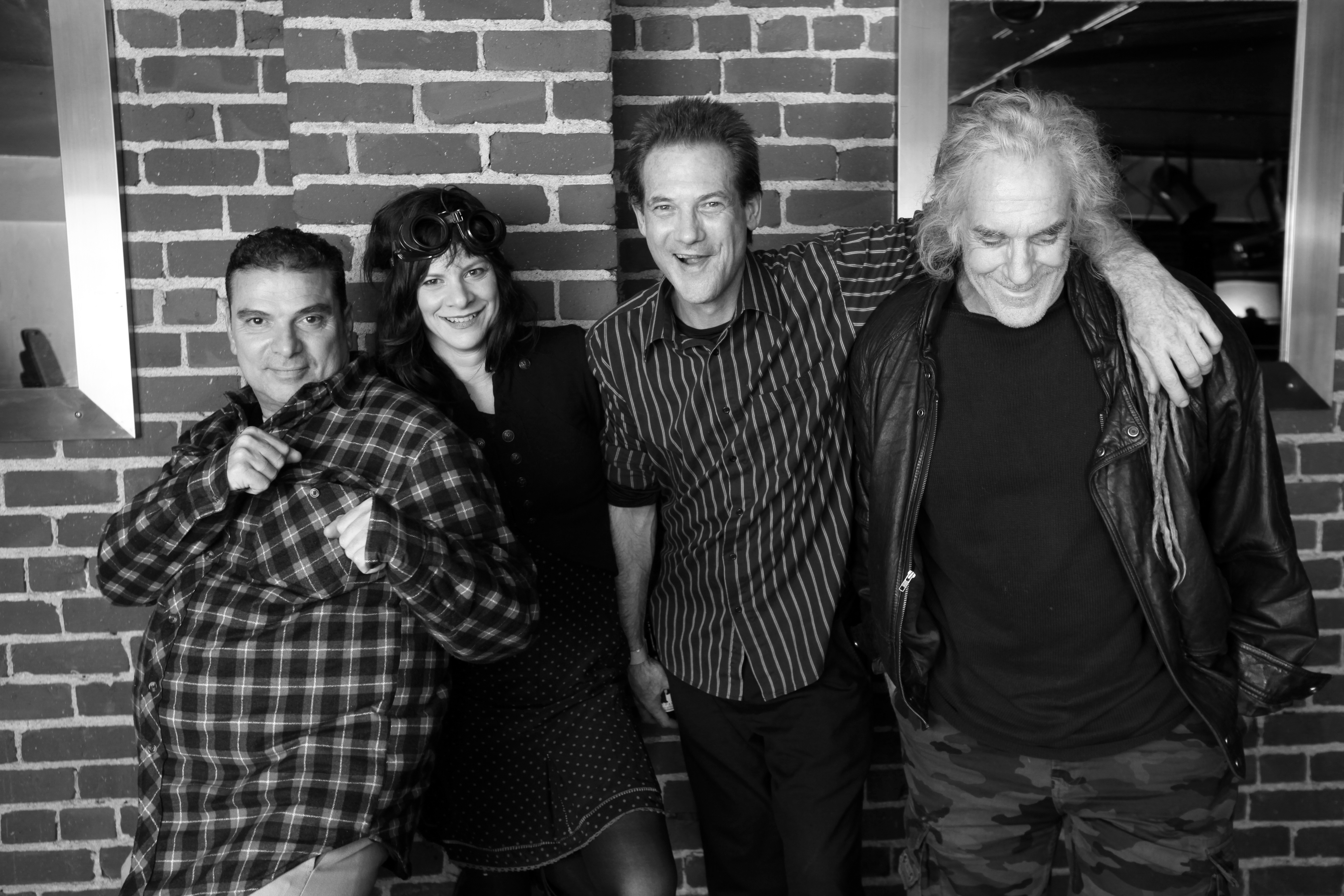
Steve DePace, Rachel Thoele, Bruce Loose and Ted Falconi of Flipper, March 2, 2012, Oakland, California. Photo by Kevin Warnock.
I wrote about Flipper on February 25, 2012 to help promote this concert. The show itself was outstanding, and I hope to write a review later. I shot high definition video at the show which turned out well. I brought a tripod and set up in the balcony with a clear shot of the stage. I got some great stills of the band performing, including an exceptional shot of guitarist Falconi in action.
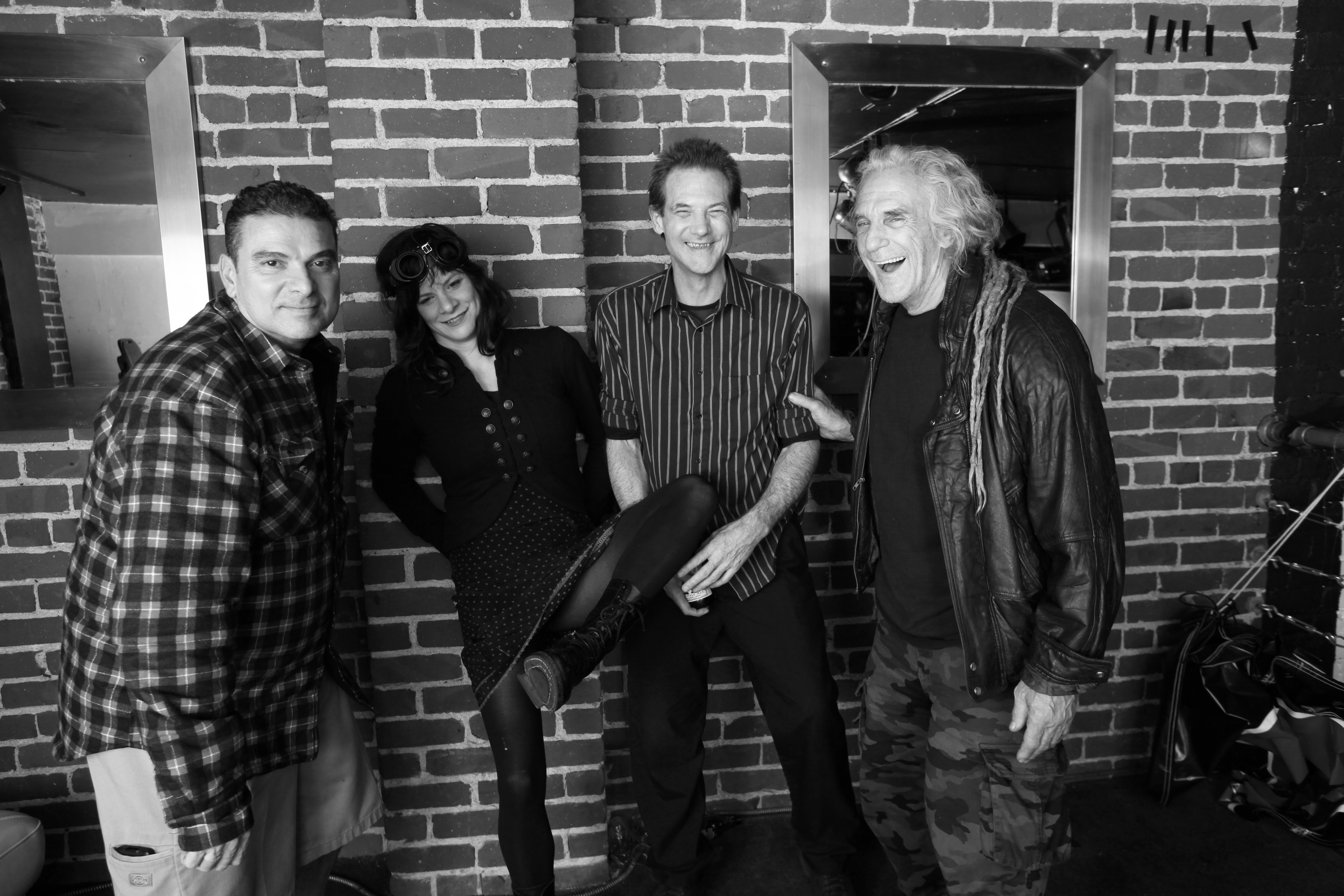
Steve DePace, Rachel Thoele, Bruce Loose and Ted Falconi of Flipper, March 2, 2012, Oakland, California. Photo by Kevin Warnock.
Here are my favorite eight shots from my nine minute photoshoot March 2, 2012 with Flipper. The band was also formally interviewed before their show. I didn’t want to take too much time, and I felt that after nine minutes that I had some good results. I could have gone on much longer, but I wanted to make a good impression by being decisive and quick. I hope that Flipper will recommend me to other bands they know, as I really enjoy photographing groups of people. I gave a lot of directions on this shoot — including telling people where to sit, stand and where to look. I didn’t tell Rachel Thoele, the bassist, to kick singer Bruce Loose in the head. They were joking around which was great. You would think I knew all these members in advance from how relaxed everyone looks, but I just met Thoele, Loose and guitar player Ted Falconi a few minutes prior to the shoot.
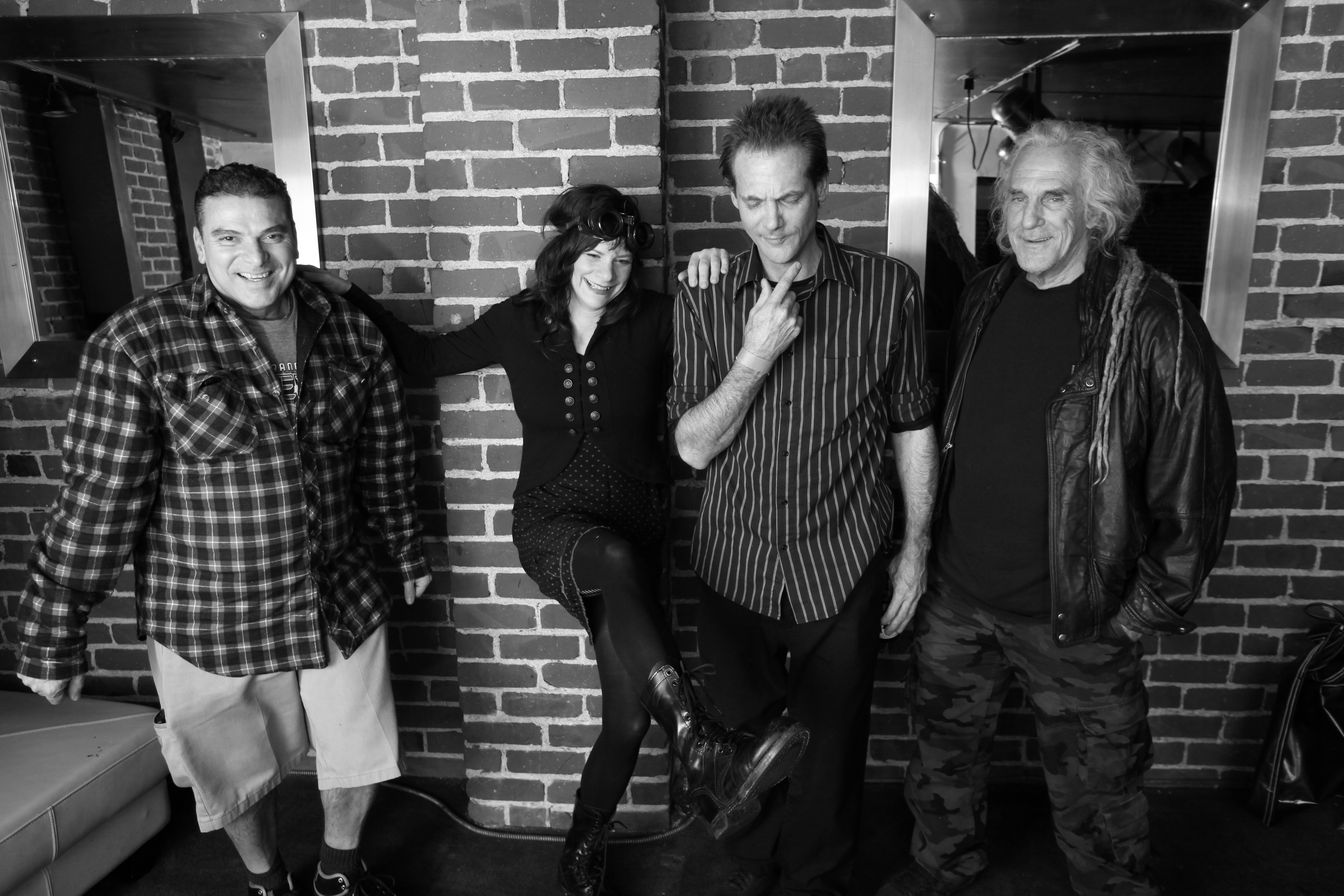
Steve DePace, Rachel Thoele, Bruce Loose and Ted Falconi of Flipper, March 2, 2012, Oakland, California. Photo by Kevin Warnock.
Loose only pretends to be hurt from his kick in the head. He grimaced for a solid ten seconds like he was really injured — then he broke into laughter and stood up straight and was fine, as you can see in the final shot. He had me fooled.
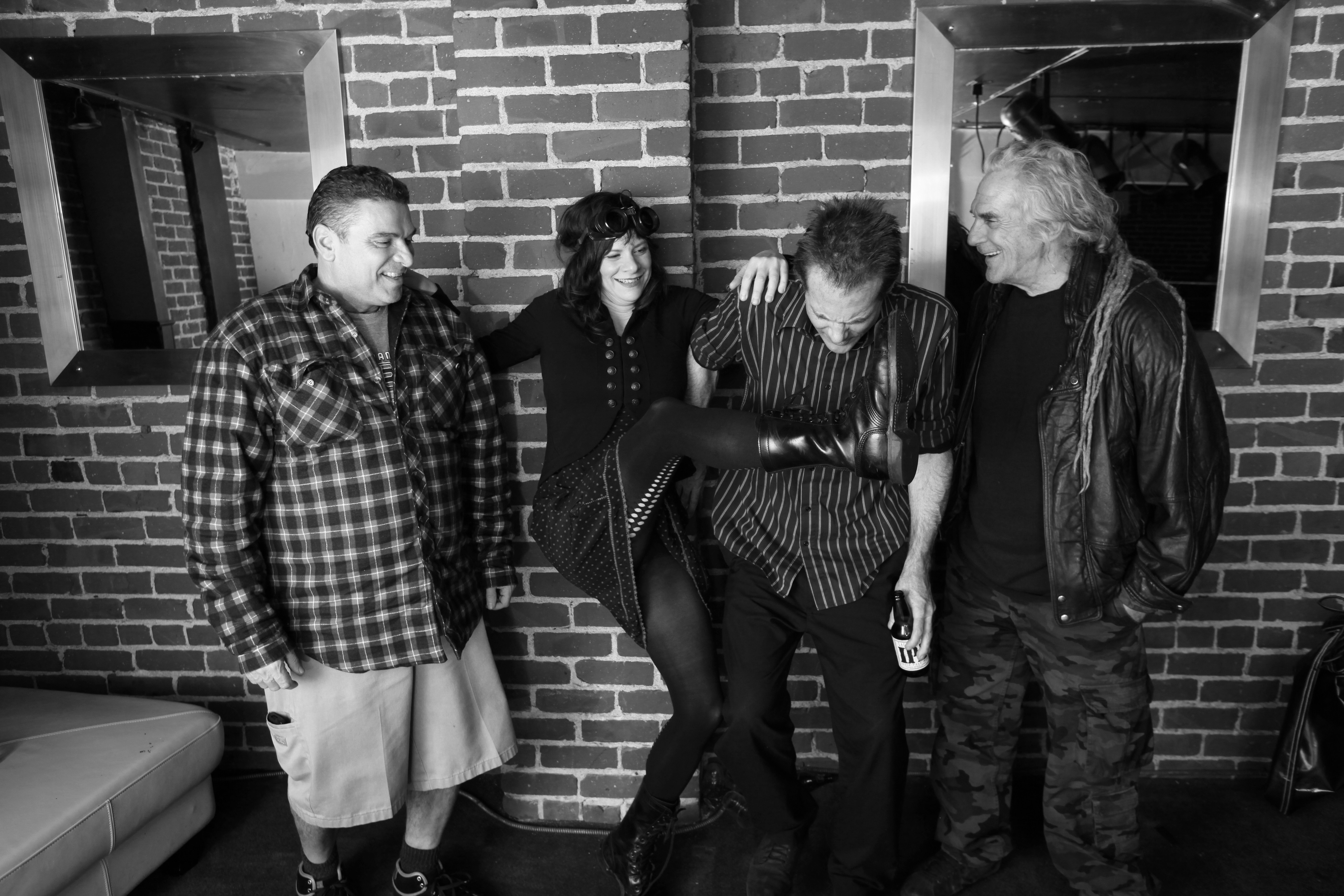
Steve DePace, Rachel Thoele, Bruce Loose and Ted Falconi of Flipper, March 2, 2012, Oakland, California. Photo by Kevin Warnock.
All the members of Flipper were exceptionally nice to me. Ted Falcone even talked with me as I was putting away my lighting equipment. He asked me about LED photography lights and what I thought of them. I was impressed by his knowledge of the subject.

Steve DePace, Rachel Thoele, Bruce Loose and Ted Falconi of Flipper, March 2, 2012, Oakland, California. Photo by Kevin Warnock.
I shot these pictures with a Canon 5D Mark II camera. These pictures may be seen at full size if you click on them twice. Full size is 21 megapixels — huge — bigger than your screen.
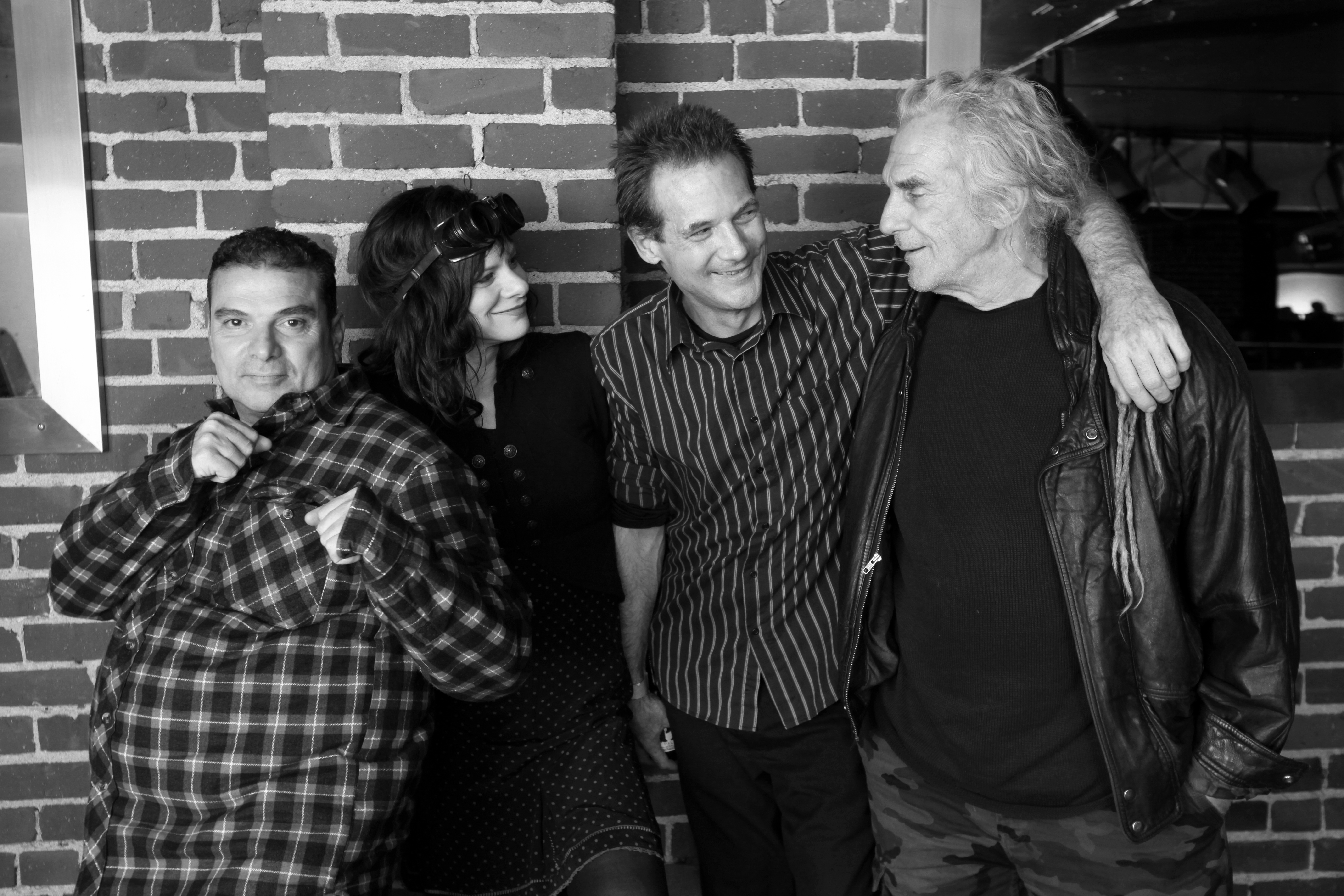
Steve DePace, Rachel Thoele, Bruce Loose and Ted Falconi of Flipper, March 2, 2012, Oakland, California. Photo by Kevin Warnock.
Flipper leaves soon for a European tour. They will be flying, not swimming.
Here are the tour dates:
- April 5, 2012 The Croft — Bristol, UK
- April 6, 2012 Rescue Rooms — Nottingham, UK
- April 7, 2012 The Duchess — York, UK
- April 8, 2012 Stereo — Glasgow, UK
- April 10, 2012 XOYO — London, UK
- April 12, 2012 De Klinker Club — Aarschot, Belgium
- April 13, 2012 Sonic Protest Festival — Paris, France
- April 14, 2012 L’Epicerie Moderne — Lyon, France
- April 16, 2012 Nachtleben — Frankfurt, Germany
- April 17, 2012 Knust — Hamburg, Germany
- April 18, 2012 Stengade
- April 20, 2012 Arena — Vienna, Austria
- April 21, 2012 Latte piu’ Live — Brescia, Italy
- April 22, 2012 Rössli — Bern, Switzerland
- April 24, 2012 Wild At Heart — Berlin, Germany
- April 25, 2012 Club Vaudeville — Lindau, Germany
- April 26, 2012 LVC — Leiden, The Netherlands
I got this list from the Flipper official website. I added the hyperlinks by performing Google searches for the names of the venues.
Before you book a trip to that venue, please check to be sure I got the link right by making sure you can find Flipper listed on that site for that day. The sites all looked like music venues, but I didn’t take the time to try to buy tickets to make sure I found the correct venue.
Have an MBA and an idea? Looking for a technical co-founder to build it and join your unfunded startup for equity alone?
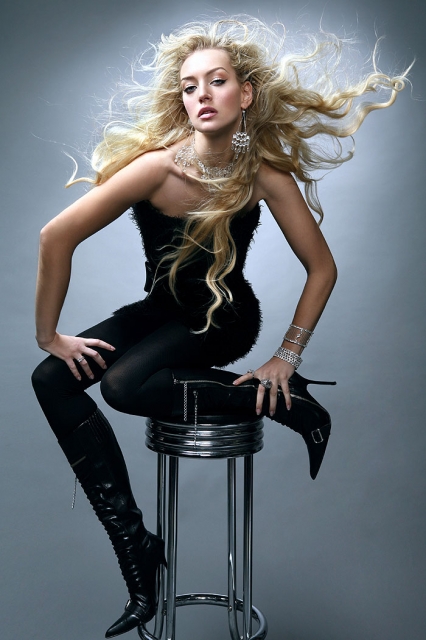
Model Karelea Mazzola from Supermodels.com
One of my highlights each month is serving as a mentor for the Haas Founders group.
Haas Founders is a group for Haas School of Business graduates from the University of California at Berkeley. It’s an invitation only group, but if you graduated from Haas you are quite likely to receive an invitation if you are a founder or co-founder of a startup company.
Another way in is to have a meaningful connection to the Haas School. That’s how I became a member. I have been a judge for the Berkeley Startup Competition from about 2004 through 2011.
Finally, all Haas graduates can buy their way in by agreeing to pay for the food and drinks. This allows service providers like bankers, investors and accountants to attend. Such service providers can meet ambitious startup founders that sometimes turn into clients.
I write the above to introduce you to the Haas Founders meeting. There is a Facebook page and a Twitter account for Haas Founders. Michael Berolzheimer moderates and organizes the Haas Founders meetings. Berolzheimer runs the genesis-stage venture firm Bee Partners which, according to his firm’s web site, pollinates visionary entrepreneurs with financial, human and social capital. Kishore Lakshminarayanan helps Berolzheimer set up the meetings, which take place at different venues each month, in the East Bay, South Bay and San Francisco, California USA. I met Berolzheimer in 2007, before he took on the responsibility for Haas Founders from the previous organizer, Mat Fogarty, CEO of Crowdcast.
Haas Founders has established a group on the professional social networking site Linked In. As of this morning there are 86 members. I believe the group is seeking new members, so if you fit the requirements, please introduce yourself to Michael Berolzheimer.
Haas Founders can be thought of as a board of directors like support group for startup founders, where no issues are off limits for discussion. That makes Haas Founders one of the most compelling meetings I’ve had the good fortune to attend.
I have attended the Haas Founders meetings since about 2005. Individual meetings are limited to 20 attendees.
This open forum for frank talk is made possible because attendees are asked to keep the the conversations confidential. To my knowledge, there has never been a meaningful breach of this rule. I think that’s a reflection of the trustworthiness and integrity of Haas students and graduates.
Given this secrecy, how can I write a blog post about Haas Founders?
Well, I am not going to discuss confidential information. The advice I am going to give is my own. I gave this advice to a participant at the most recent meeting March 6, 2012 in San Francisco.
I am not breaking confidentiality by repeating what I said that day because I have given this same advice many times without any restriction of confidentiality. It’s already public information. Problem averted. I ran this post by Berolzheimer before publishing it, as I want to be extra careful so as to not be uninvited to future meetings.
I decided to write this post because the issue I am going to talk about comes up so frequently that I have spent hours and hours answering this question over the years.
The question and answer are as follows:
Q: I am a non-technical founder and I have thought of a business idea that requires something technical be built. How do I find a talented technical co-founder to join my company for equity only to build my vision for me?
A: Forget it!
You can’t find a talented technical co-founder to join your unfunded idea stage company for equity only.
There are rare exceptions, but you can not count on them and should not consider counting on them.
One solution is to think of and pursue a business idea that you can implement with only the skills you have already. Here are three companies that I suspect began with little computer programming, for example:
- Become a mushroom farmer.
- Start a fair trade import company.
- Start a men’s fashion manufacturing company.
The smart people I suggest this answer to don’t quickly embrace my advice. That’s understandable. They are in love with their vision and they want to pursue that vision right now. They don’t want to hunt for a technically simpler business idea. They don’t want to learn the technical skills necessary to develop their original idea. They want a savior, a Steve Wozniak, to fall from the sky to do the real work of making a viable product. Usually such non-technical founders also want to reserve more of the company equity for themselves than for this savior, because they thought of the idea. If there is to be an equity disparity, I suggest it be weighted toward the technical contributors who make the product happen, not the non-technical people who think up the idea.
What non technical founders fail to appreciate is that talented technical individuals with the grit to want to start a company are in high demand. They are like supermodels in their desireability. A lot of people are asking them for dates. A lot of these suitors have lots of money to woo them with.
Why would a supermodel date a founder with no money when there is a line of suitors with six, seven or eight figure stacks of money at their side ready to spend?
The answer is supermodels don’t date broke founders.
Supermodels don’t hook up with unfunded MBAs that have a cool idea.
The perhaps sad truth is that MBAs are not held in high regard by many technical experts. This is not a comment on Berkeley MBAs, but on all MBAs. Of course, technical experts desperately need business experts at some point, as exits are rare for companies filled with only technical experts. I am not taking a stand on which type of person is more valuable because they are both vital. What I am saying is the technical people generally perceive that MBAs are not that important. If that’s the perception, then how can an MBA recruit a technical person without money?
There are millions of cool ideas to pursue at any moment. That’s always been the case and that will always be the case.
Talented technical people know they are in demand. They have recruiters calling them telling them so all the time. They read TechCrunch, VentureBeat and GigaOm. They know the technology world is in the middle of a full fledged boom right now. So only 2nd, 3rd, 4th and 5th rate technical people will agree to an equity only founder position with a non-technical sole co-founder.
The only practical exception is if you’ve already been friends with the person for years and they know your work and respect it. So classmates graduating together can get together and start a company, with some founders being non technical and some being technical.
But if you’re looking for a stranger to drop out of the sky to build your vision, you should forget it and focus on finding a simpler idea or on learning the technical skills yourself so you can build the first version of the product by yourself.
Yes, the product won’t likely have to polish of one created by a more seasoned expert, but it can be good enough. You only need it to be good enough to raise money that you can then use to pay a more skilled technical person to make an improved version.
I am not spouting off advice I read somewhere or heard somewhere — I know what I am talking about. Pardon me while I now go into extreme detail to convince you that I do know what I am talking about. What follows may seem like too much, but I have spent dozens and dozens of hours trying to beat this lesson into the heads of very smart non-technical company founders. I feel I need to pull out all the stops here to convince the skeptical that I am right.
I know it’s smart to learn to program because this is what I did to take my startup Hotpaper.com, Inc. from a USD $10,000 investment when I had almost no applicable skills through to a USD $10,000,000+ sale to a public company just six years later.
This is news I’ve written about more than once. But I haven’t described the grueling early work I put in that made this ‘quick success’ possible.
When I started Hotpaper, I was a minicomputer programmer. A Digital Equipment Coporation VAX minicomputer running Open VMS. There was nothing miniature about this computer. It filled an entire raised-floor water-cooled computer room and served 1,000 users in five offices in two US states. I believe it cost more than USD $12,000,000. Back then a 9 gigabyte disk drive cost USD $250,000. I saw the invoices and recall calculating the price per gigabyte.
When I started Hotpaper my only experience programming a PC was writing rudimentary DOS batch files. One can still write these for Windows, to run at a command window prompt. You can do amazing things with batch files, but you can’t write serious client-server or web applications with them. I had to learn to program graphical Microsoft Windows applications, and I had only used DOS on a PC up until that point. I had played for a few hours with a copy of Windows 3.1, but that was the extent of my experience with Windows. The one machine my employer had that ran Windows was so slow (Intel 386 with perhaps 1 megabyte of memory) that when you pressed a letter in a word processor (Ami Pro), there was a lag of about 1 full second before the character would show up on screen. It was pathetic.
I immediately bought a Hewlett Packard Pentium 60 Mhz computer with 4 megabytes of RAM and Windows 3.1 for Workgroups. I added Microsoft Office, which came on 30+ 3 1/2″ floppy disks, not a CD-ROM. This was a Pentium, not a Pentium II, III or IV. In fact, it was the slowest Pentium chip ever sold. But this was the fastest computer I had ever used. I still have it, in storage.
I all but shut myself off from the world for two years with hundreds of dollars of technical books, a 28.8K modem and a telephone. I taught myself to be an event driven computer programmer. Event driven programming is much different from the procedural programming I had done to program the huge VAX system run by my employer at the time, Cooley LLP. Yes, I knew how to program a little bit on a VAX, but Windows is so different that it’s almost as if I was learning to program from scratch.
Thankfully, Microsoft was not yet the market leader in word processing in 1994 since WordPerfect for DOS still dominated, so Microsoft tried very hard to persuade developers to embrace their Word word processing software. They offered free telephone technical support for programming problems, provided you paid for the phone call. There were no unlimited business phone lines back then, so my office phone bill was perhaps USD $100 a month due to all my calls to Microsoft — hours and hours of calls per month. I owe Microsoft so much for those calls, as they helped me to solve every problem I ever encountered. Thank you Microsoft.
Eventually Microsoft overnight switched from free technical support calls to USD $55.00 per incident technical support calls, and I had to stop calling them. But that was a couple of years later, and I had already gotten to be proficient by then, and I could get my questions answered for free on their well run newsgroups. By that point, Word and Office were the market leaders, and they didn’t need to try so hard to make developers embrace their tools.
I worked hard — really, really hard. I worked from about 10am to 10pm Monday through Saturday. On Sunday I wouldn’t come into the office until the mid afternoon, but I would still stay until 10pm or so. I did this from January 1995 through the end of 1996 or so, I believe. It took me that long to learn Windows programming reasonably well.
I didn’t know other software developers. There were no popular coworking spaces. Meetup didn’t exist. I was shy. But I was driven… really, powerfully and passionately driven. I had so little money I was living in a tiny studio apartment on Mason Street near Bush Street in San Francisco, California USA. My rent was USD $625 a month including utilities. I only owned one computer, so I could not work at home. I was at the office a lot, and it was just a seven minute walk to get there. I became really good friends with my office mates the late Stan Pasternak and patent attorney Robert Hill. I have such fond memories of that time.
Was the code I produced great? No. Was it awful? No. Was it reliable? Yes. Was it understandable to others? Yes. Did it get used by others for meaningful projects? Yes. Did I raise money with it? Yes. Did I sell the company successfully by following this model? Yes. Can you do the same? I think so.
At Hotpaper, I had a customer from the day I bought a computer. I told them I could build what they asked for. I actually had never done so on Windows. I had to figure out how to program Windows because I had a paying customer that demanded a Windows client-server based solution. They were paying me thousands so I had to deliver. I didn’t study for two years and then start to look for a client. I got the client based on my past reputation as a VAX programmer and then faked it until I made it.
It turns out that first project failed and the client never used my work or the work of any custom software developer.
They just bought an off the shelf application and conformed to its way of doing things.
But that’s irrelevant in the end. I got paid USD $30,000. I worked hard. The client made the best decision, for they should never have hired me or any developer when an off the shelf package was available for much less than having custom software written. I learned a lot, kept the rights to what I had built but did not get used, and I used that for the basis for what I then turned around and sold to Coca-Cola and the United States Department of Commerce, where it did get used on an enterprise scale.
Today it’s easier than ever to become a programmer. There are so many online tutorials like those from Codecademy. There are so many hacker co-working spaces like Hacker Dojo where you can base your new venture. You can work there as many hours as you can keep your eyes open, and there are smart people around much of the time to get help from.
Today all the software you need to do almost any project is free. That wasn’t the case in 1995, when now standard building blocks like MySQL hadn’t been popularized yet.
I have seen smart graduates spin their wheels for months or years trying to recruit a magical co-founder to build their product. How much better it would be for these people to sit down at Hacker Dojo and focus their considerable brain power on learning to program software directly. Even if the entire result is eventually rewritten later by someone more skilled, they would be better off than if they somehow found the mythical co-founder.
For once you know how to program in any language, you will be able to talk about and think about technical problems far more effectively than you can as a non programmer. It will be far more difficult for people to confuse, mislead or bamboozle you. You will be able to hire better programmers who will respect you more. You will be able to tell programmers what to attempt with more clarity and conviction because you know at least something about their world.
You will have insight into a world that’s richly diverse and totally fascinating. Your life will improve even if you never make a penny from your venture.
Programming is not easy. It can be absurdly complicated and exasperating at times. That’s why new college graduates who know little about the real world of programming can still command pay approaching USD $100,000 to start.
I am just one modestly successful entrepreneur.
Before you become a programmer, ask some technical startup founders you trust and see if they agree with what I’ve written here. Remember, Steve Jobs got lucky with Steve Wozniak. Silicon Valley was a sleepy place back then compared to today. Go make your own luck by developing your technical skills. If you have an MBA, you presumably spent four years to get an undergraduate degree and two years to get a business degree. Spend two more years to become a programmer. Doctors spend more time studying before they complete their education, so view eight years of study as normal, not crazy or silly.
I love programming, and I am extremely grateful I spent those grueling early years just powering through the books and road blocks to learn to program.
I feel I can do nearly anything I can dream up.
That’s a powerful feeling I wouldn’t give up for anything.
Please subscribe to this blog by leaving your email address in the upper right corner. Please friend or subscribe to me on Facebook. Please follow me on Twitter.
It pays to challenge the assessed value of your home
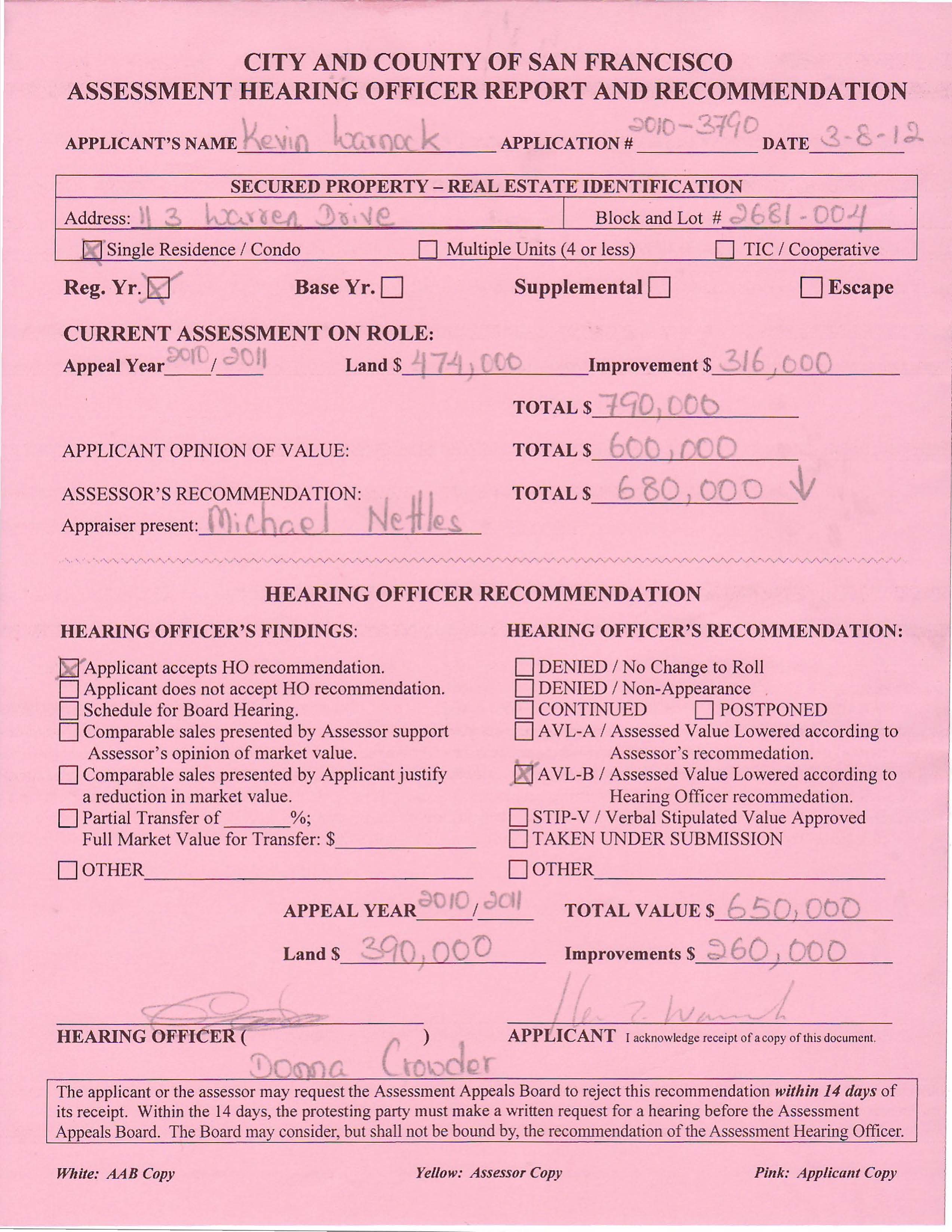
City and County of San Francisco Assessment Hearing Officer Report and Recommendation for Kevin Warnock, March 8 2012
On Thursday, March 8, 2012, despite my having a bad cold and feeling awful, I had a financially remunerative day.
I attended my assessment appeals hearing for my house. I had applied for a reduction in the assessed value in 2010, but because so many San Francisco property owners are also appealing their assessments, it took until 2012 to get a meeting with a hearing officer.
My property tax in 2010 was just over USD $10,000 if I recall correctly. The current assessment on role above shows a value of just before the hearing of USD $790,000. That value itself is reduced from the original 2010 assessment value. It was reduced at my request via an informal yet written request I made in 2010.
Thanks to declining home prices due to the Great Recession, my 2010 taxes declined to $7,616.70!
My new assessed value as a result of my formal hearing on Thursday is USD $650,000. So I got two meaningful reductions — once in response to an informal request where I didn’t have to appear in person, and the other where I did have to appear in person and present evidence. I presented a full appraisal I paid Christian Koenig of Koenig Appraisal USD $350 for. That was money well spent. Donna Crowder was the hearing officer and Garry Michael Nettles, Jr. was on hand representing the San Francisco Assessor’s office.
I was impressed with how well Nettles had researched the comparable sales my appraiser relied on. In one case the appraisal cited a fixer upper that sold for USD $595,000 but was professionally flipped for $935,000 soon after. I am friendly with the developer that did the flipping, and I saw the result, which was astonishing. My house is not in ready to be flipped condition, so the original comp was more fair than the flipped sales price. I had asked for my appraised value to be reduced to USD $600,000, but got only USD $650,000. Frankly, I think the higher number is right on target, as the comps were for houses not as nice as my house is.
Crowder and Nettles discussed their views in front of me, and they ran calculations on their large plug-in calculators. The hearing took about 15 minutes. I was impressed with how thoughtful and smart both Crowder and Nettles are, and I think they arrived at a number that is neither too high or too low.
I am pleased and relieved.
This happy result is something of a surprise, given how critical I was of the Assessor-Recorder’s office the last time I wrote about it on this blog. In brief, the office is so overwhelmed that they routinely hold customer checks for services for months before cashing them. When I was there paying in 2011 I used cash since the office had held my 2010 check for months before they cashed it. I complained and was told they routinely hold checks. I believed them because I saw checks sitting in the open around their office, including on the counter where I was standing. I could have copied the check numbers and drained the accounts if I were a bad guy. I was appalled and I wrote a critical piece about my findings. I don’t think my piece hurt me at the hearing, which is a relief. I looked in the Assessor-Recorder’s office on Thursday, and I didn’t see any personal checks laying around for the public to view, so maybe my earlier blog post was discovered by those in authority and changes were made. I relayed this story of holding checks to a teller at San Francisco Fire Credit Union, where I hold my checking accounts, and learned that they were familiar with San Francisco holding checks so long that they become impossible to cash due to how old they are. If a random teller knows about this issue, it must be pervasive. I hope my blog post about this was headed. This is an issue of real importance because holding checks causes people to overdraw their accounts, which results in big overdraft fees, which is a drain on society.
My tax rate is 1.1718%.
The Zillow home value website shows my house value as of March 8, 2012 to be USD $756,000. When I got married in 2008, the Zillow value was about USD $1,050,000. When I got divorced in December 2011, the Zillow value was far lower. Even the far lower Zillow value today is far higher than my new assessed value.
Since I plan to stay in this house indefinitely, I am thrilled the value is so low.
I paid USD $740,500 in 2001 or 2002 when I bought the house, which was far higher than the asking price of USD $619,000.
I had to outbid 19 other buyers to win this house, but it’s a great house with a spectacular view and copious free street parking for guests and housemates.
I was told to expect my refund check from San Francisco within six to eight months, but I won’t hold my breath, since one of the homeowners in front of me at Thursday’s public hearing said he had won an assessment reduction for 2009 but still hasn’t received his check, roughly a year after his hearing for that year.
Ellen Campesinos! says that female rock musicians rarely get laid on tour

LOS-CAMPESINOS! the band. Photograph from WikiPediA.
I have been thinking about the life of musicians. I just finished writing a post about the band Peligro.
Peligro is D.H. Peligro’s current band. I’ve known D.H. for over twenty years, having met him through my good friend from high school Willy Lipat that was in a band with him.
Peligro always had gorgeous models or model types around. I was a painfully shy photography student that hoped to become a fashion photographer so I could hang out with beautiful women. I was envious.
I imagined that rock stars got a lot of sex while on tour. I still imagine that.
Thus, it was with surprise that I learned touring is not a sex fest — at least not for female rock musicians.
Ellen Campesinos! of the indie-pop collection Los Campesinos! (sic) wrote a powerful piece for Nerve magazine that shattered my illusion about the sex life of traveling musicians. Before I get into what Ellen wrote about road sex, have a look at what WikiPediA has to say about her band, for context:
“Los Campesinos! are a seven piece indie pop band from Cardiff, Wales, formed in early 2006 at Cardiff University. Although the band formed in Wales, none of its members are Welsh. They released their debut album, Hold on Now, Youngster…, in February 2008 and followed this up by releasing a record titled We Are Beautiful, We Are Doomed, in October that year. Whilst many consider it to be an album due to its length, the band have always referred to it as a ‘record’ or EEP (Extended EP)[1] due to contractual and artistic reasons. Their second official album, entitled Romance Is Boring, was released on 1 February 2010. Their fourth full-length release, Hello Sadness was released on 14 November 2011. The band has announced US & UK tour dates for 2012.[2]“
All of the members use the word ‘Campesinos!’ as their surname, even though the members are not related. The exclamation mark is part of the last name. The real name of Ellen Campesinos! is Ellen Waddell, and I will refer to her as Ellen in this blog post, even though I usually refer to people by their last names once I first identify them by first and last name. It’s too confusing to use Ellen’s last name when all her band mates use the same last name.
Ellen quickly catches the reader’s attention in her Nerve article with this eye opening paragraph:
“Neko Case recently claimed via Twitter that “Ladies in bands don’t get ANY action,” and as a female musician with a frustrated libido, I can sympathize. I’ve been playing bass in a touring band for five years, and I’ve had intimate relations on the road four times. (I class intimate relations as third-base-plus, but even if I counted kissing and over-the-clothes fumbling, it would still be a pretty low number.) I’m lucky enough to be in a job where I get to tour the world and meet interesting people, but in my experience, musicians — especially females — get a lot less then you’d imagine.”
Ellen colorfully boils sex on the road down to these four points:
- Time and space are limited on tour since tour vans and buses are cramped and really are there for the band mates to work in, not play in.
- It is awkward and unsatisfying to seduce a fan from the audience because fans put musicians on uncomfortable pedestals.
- It creates workplace stress to seduce the musicians from bands touring with your band.
- Friends of fans that are attending the show out of their support for their friend rather than their knowledge of the band make the best targets for lustful connections.
Why am I writing about Ellen’s provocative story?
Ellen is an actual rock star. Ellen is beautiful. Ellen is young. Ellen writes well (she studied journalism). Ellen is a founding member of a well regarded band that tours the world. I would not expect that she would have any trouble in the sex on tour department. I would expect that she could point out to a roadie a guy that she is interested in, and that roadie could do the tough work of approaching the guy and explaining a deal of quick sex with Ellen in exchange for not stalking her or trying to attach long strings to her. I would estimate the success rate of such an approach would be around 90% or greater.
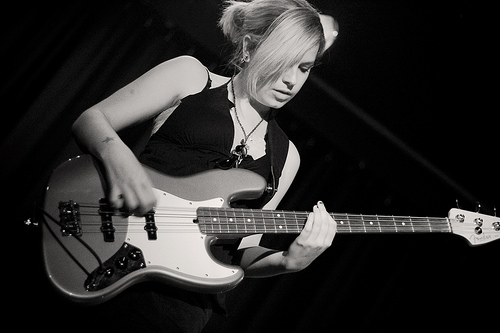
Ellen Campesinos! playing bass guitar. Photo from http://blogs.dallasobserver.com/dc9/2009/01/the_indie-verse_is_streaming_o.php
But Ellen is shy, like I am. And shyness just sucks. It has messed up a good part of my life. I am absolutely determined to not let it mess up the rest of my life, and by writing about sex and Ellen, I am drawing your specific attention to a subject dear to my heart these days.
When you really get down to it, I left UCLA for Brooks Institute because I was shy. UCLA is a big school, and the second year, when I did not get a slot to live in the dormatories, I had to live about a mile off campus in a soulless apartment building without any other students. Most of my classes had 500 people in them. There were no cell phones or texting. It was difficult to ever see the same students even twice.
Friendships were difficult to form.
Brooks at the time seemed so much better. Classes were small, at around 20 students, and I made and kept a lot of friends.
Trading the opportunity at UCLA for friendship at Brooks is not a trade I should have made.
I deeply regret leaving UCLA.
I regret it so much that I am seriously considering returning, especially since I recently learned I do not have to go through the admissions process of a new student, because I properly withdrew and I have the original stamped paperwork in my fire proof safe. I have learned that all I need to do is fill out a one page form, send in my Brooks transcripts and I am in.
I have lost most of my shyness, but not all of it.
I still am hesitant approaching women for dates. I can approach them painlessly for anything else, including to model for me. I can handle a roomful of women. I can direct one or more women in front of the camera with confidence and authority.
But when I ask a woman on a date, I feel vulnerable because I am signaling to her that I find her sexually desirable. I am in effect telling her that I want to have sex with her, even if I am a perfect gentleman asking her for coffee with her grandmother. I should not feel awkward. I feel less awkward about asking women for dates now than at any point in my life, so I am making progress. But for me to be most effective, I should dispatch all fear and nervousness, for I fear that women pick up on that and are less likely to accept an invitation.
I thank my lucky stars that I have taken care of myself and am only 10 pounds heavier than I was at age 16 when I got my driver license (155 then and 165 this morning, in pounds). I feel attractive and sexy which I think women are also good at decoding.
I will conclude with a crazy story from my youth.
I used to love DNA Lounge. It’s still there, and it’s still cool, from what I can tell from afar. It’s open late. When I was a regular, it closed at 4am.
I had been there dancing by myself at about 3am, and found myself dancing with a solo woman, as often happened. We danced together until closing, but didn’t exchange numbers or keep in touch. It was fun but she was one of many women that I had ‘met’ and danced with late at night. She did tell me a bit about herself, including that she worked at Levi Strauss.
About two months later I was at DNA for a concert. The bar was in the center of the main room, about 15 feet from the stage. I was standing facing the stage and leaning against the bar. It was extremely loud because the band was playing.
A woman slid in next to me at the packed bar, to my left. I glanced briefly at her and it was the woman from the 3am dancing the other month. We hadn’t kissed or anything when we met, but I thought she was very attractive. At the bar at the concert, I wrapped my arm around her shoulder and she immediately, within five seconds, leaned in towards me as if we were a couple. We watched the show like this for at least ten minutes, not speaking, as that was essentially impossible since the huge speaker columns were just 15 feet away.
Live music at DNA is much louder than the recorded music the DJ plays.
At this point, it was around midnight. Without worrying about anything, I leaned to the left and kissed this woman. She kissed back. Soon, we were upstairs on one of the couches making out. This is before the days of bottle service where the nightclubs charge big dollars to sit down.
After about an hour of making out, still comparatively early, I asked her if she still worked at Levi Strauss. She replied that she didn’t and had never worked there! This woman was a complete stranger, and I had not danced with her for an hour some two months earlier!
She was a student at UC Berkeley.
I still wonder what she thought of me being so bold with her that I put my arm around her and start kissing her without even saying hello or asking her name.
I have never done that again, but I sometimes wish I could. No, I don’t want to kiss women I don’t know, but I would like to be able to be so confident that I can attract a woman so powerfully that she would agree to kiss me, even if we never did so in such haste.
Ellen of Los Campesinos!, talk to strangers after your rock shows. Don’t wait for them to get up the courage to say something. You’ll be waiting a long time most of the time, as a guy alone at the bar upon seeing a hot band member is extremely unlikely to approach you because he’ll assume your boyfriend is going to be by your side any moment. You don’t look like the type to want to have casual flings either, which particularly works against you.
I am not interested in picking up women in nightclubs or bars, and I haven’t been out dancing by myself since 2005. The woman I am looking for is not likely in a nightclub or bar in any event, so I don’t feel that I am missing anything. But I did want to share this outlandish story from my past as I think there is much to be learned from it.
You might be wondering why I write this blog. I don’t make money from it. It costs me a lot of time and a little bit of money.
What I am doing here is making my own luck.
The women I want to meet are much more likely to be reading this blog than to be looking for me in some dark nightclub at 3am.
By sharing my life, dreams, secrets, ambitions and ideas, I am also setting the stage for my next marriage and starting a family with children, since I am single now.
Stay posted to learn how my life progresses.
You may subscribe by leaving your email address in the upper right corner. I also encourage you to friend me on Facebook, where I post status updates for each blog post.
And if you’re a woman you think I might like after you’ve read a dozen or more of my blog posts, please introduce yourself to me, OK? Remember, I’m still a little shy.
Peligro plays The New Parish in Oakland, California, March 2, 2012
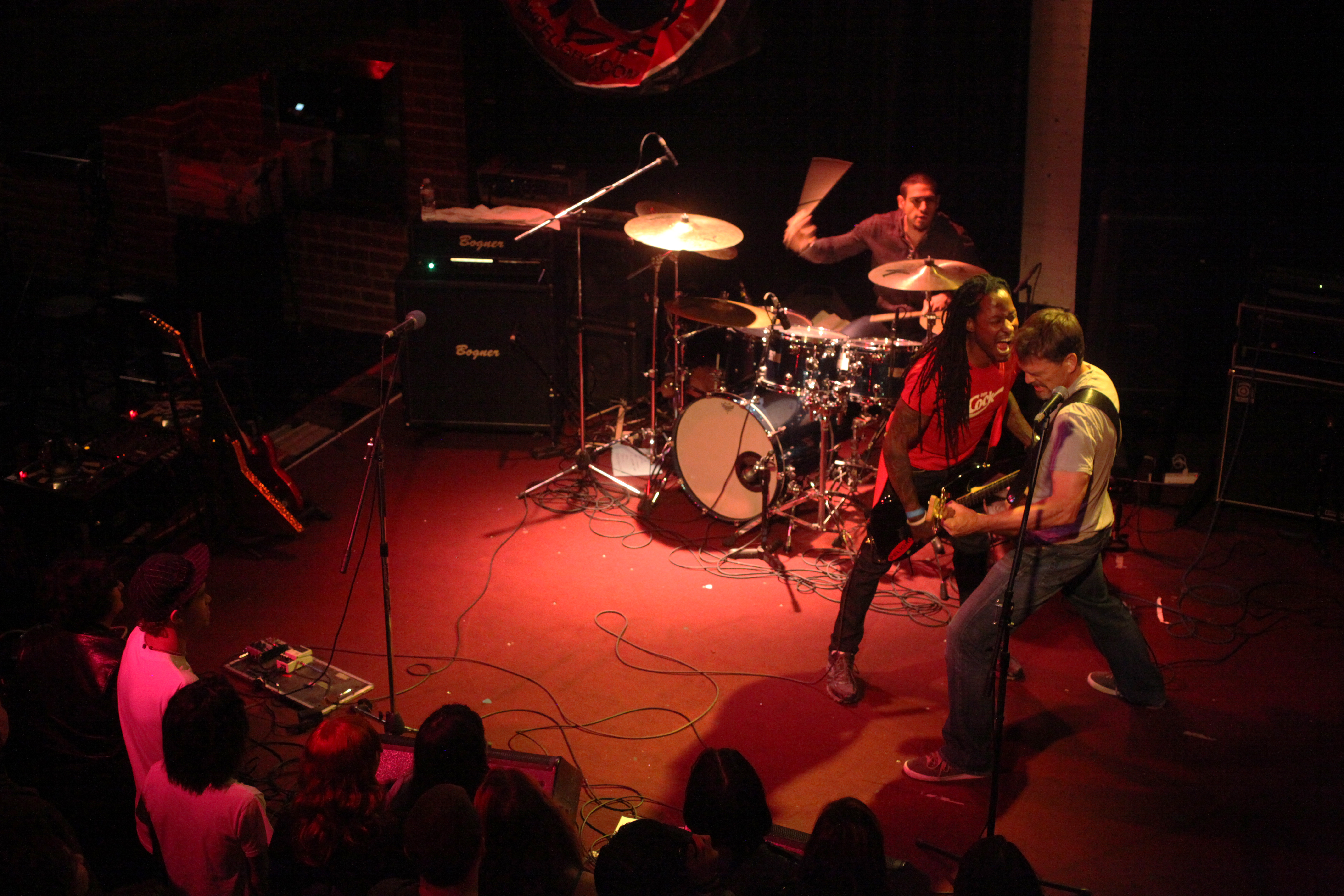
Peligro playing at music venue The New Parish in Oakland, California USA, March 2, 2012. Photo by Kevin Warnock.
My good friend Willy Lipat used to play in Jungle Studs and in Sluglords, two interesting punk bands from San Francisco, California USA.
Lipat got to know many musicians in the punk scene.
Steve DePace and D.H. Peligro were two of the other four members in Jungle Studs, along with Tony Chatham and Freddy.
Unfortunately, I have been told that Chatham got too deep into drugs and alcohol and ruined his mind so severely that the last time I heard he is living at Laguna Honda Hospital, which I can see at night only when its lights are on through the trees outside my living room window, about a mile away. I’ve been told Chatham doesn’t remember even his own wife and two children, so I have not been to see him. I would like to visit Tony Chatham, so if his family finds this, please let me know if a visit would be appropriate.
I got to know DePace and Peligro in their Jungle Studs days because I was studying (aka wasting vast amounts of my family’s money) at Brooks Institute at the time, and photographed Jungle Studs for a class assignment. One of these days I will drag out my old 4 x 5″ Kodak Vericolor negatives and have them scanned so I can illustrate a post about Jungle Studs.
Chatham was fond of telling me that he had framed the photograph I took of Jungle Studs and displayed it over his bed.
Lipat is still friends with DePace and Peligro, and DePace even came to my house for my birthday in 2007, with Lipat.
I just learned last week that Steve DePace went to high school at St. Ignacious, an elite and costly private school in San Francisco. This makes perfect sense to me because DePace is a sharp guy who writes well. DePace seems to have taken on a leadership role in the vintage hard core punk rock scene. He organized a great concert March 2, 2012 at the Oakland, California music venue The New Parish. The other musicians thanked him over the public address system several times throughout the four band event. DePace was the only organizer thanked, so clearly DePace is the guy.
Steve DePace is the drummer for the influential punk band Flipper, founded in 1979. I wrote a blog post in February, 2012 about Flipper.
D.H. Peligro was the drummer for Dead Kennedys, my favorite punk band, during its heyday in the 1980s. Peligro briefly was a member of The Red Hot Chili Peppers, according to Peligro’s WikiPediA entry.
D.H. Peligro has his own band now, appropriately named Peligro. Peligro means ‘danger’ in Spanish. One word cool band names are rare these days, so I suspect Peligro is glad to have Peligro.
Peligro played March 2, 2012 at the DePace organized show at The New Parish. I was there with my good camera, at the invitation of Steve DePace.
Peligro has produced three recordings. Sadly, I am not familiar with any of them, so I can’t comment on them.
What I can comment on is that on March 2nd, Peligro looked healthy, strong, lean and powerful, both on stage and off. He appears to have the same physique he had when he posed in a loin cloth at Powell and Market Streets (the tourist center of the City) in San Francisco for the cover of their Jungle Studs debut record over 20 years ago.
By my calculations, D.H. Peligro is 51 years old. He’s just as bold with women as I remember him being years ago. For his Friday night performance, Peligro wore a Coca-Cola red t-shirt emblazoned in the Coca-Cola font in white that read ‘Enjoy Cock.’ What I wouldn’t give for Peligro’s supreme confidence. Peligro used to date gorgeous and frequently published models, and I would not be surprised if he still does.
Playing in a punk rock band looks tiring. Whatever position one has in a punk band, the intensity is generally at the top end of the spectrum. Frankly, I am in awe that Peligro still has the physical energy for this. At the Friday show, he was on fire, as you can see in these pictures, which I took with my Canon 5D Mark II with a Canon 80-200mm L zoom lens on a tripod from the balcony.
Peligro has two other strong musicians that were also on fire on Friday.
I’m including video I shot of one song, to show you their musical energy. I spoke with D.H. after the show, and he remembered me which was flattering since I haven’t seen him in perhaps two decades, but I forgot to ask permission to post this video. I had permission from Steve DePace to capture video of Flipper. I had permission from the concert venue to be there capturing video. I simply don’t know if I had permission to capture video of the opening bands. D.H., if you’re reading this and would like me to remove the video clip, send me a message on Facebook. If you want me to photograph your band or just you, I would be honored to help out. Have a look at my work photographing people, here.
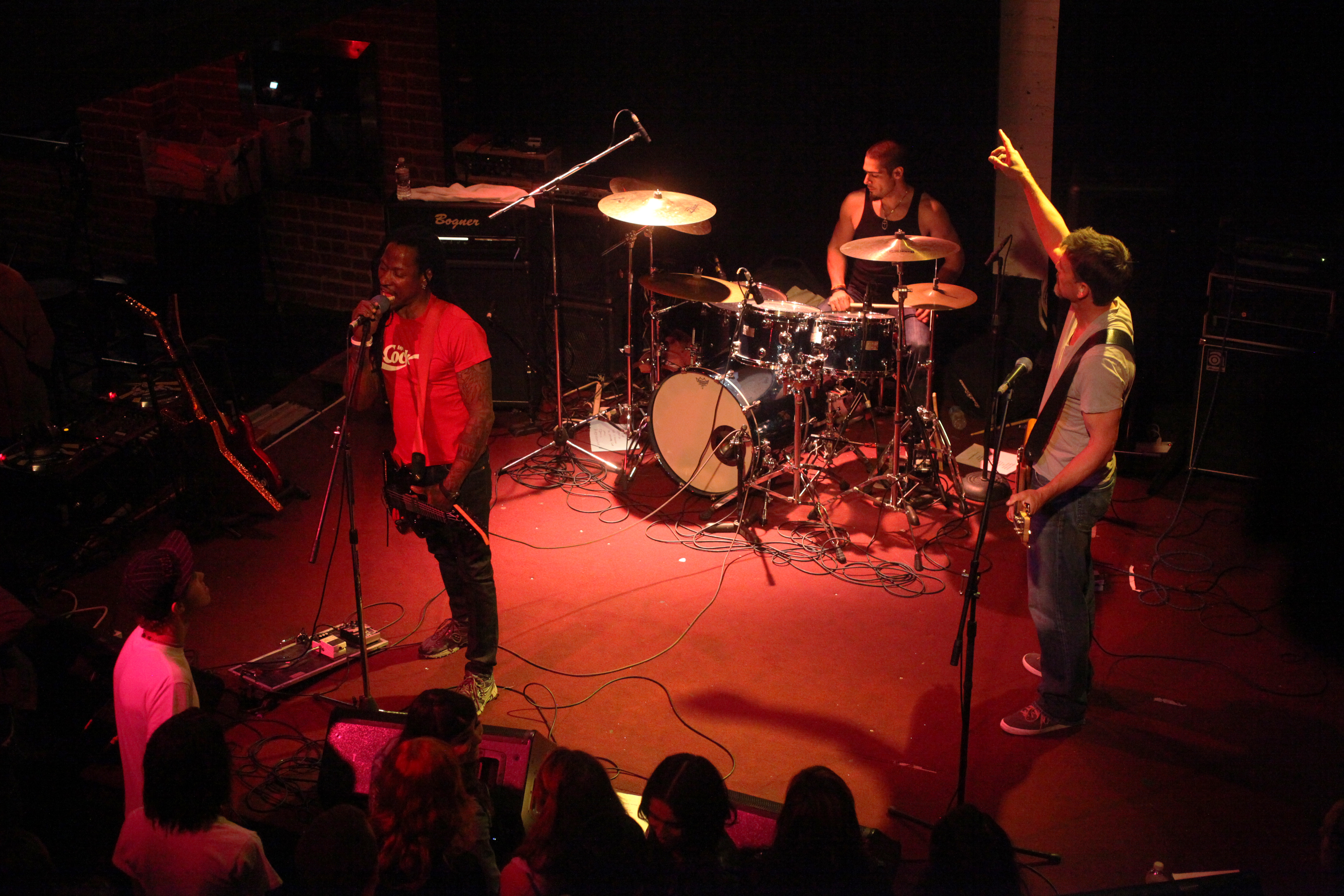
Peligro playing at music venue The New Parish in Oakland, California USA, March 2, 2012. Photo by Kevin Warnock.
As is usual, I posted these pictures at full camera resolution of 21 megapixels. Click on them to see them at full size.
Here are two Peligro music videos I discovered while researching this post. Powerful stuff.
Peligro was nominated for a Grammy Award for his rendition of Purple Haze by Jimi Hendrix, which you can see D.H. Peligro singing in the second video below.
9th anniversary for gOffice.com, my startup
My startup Silveroffice, Inc. (gOffice) is 9 years old today. I am so thankful I didn’t sell it to Google when they came calling in 2006.
Zero Net Energy Working Group roundtable coming up March 19, 2012

Jeremy Levine Design house. Photo via Flickr.com. Licensed for commercial use under a Creative Commons license.
I have joined the Zero Net Energy Working Group. This group was formed to advance zero net energy building construction in California, USA.
From WikiPediA:
“A zero-energy building, also known as a zero net energy (ZNE) building, Net-Zero Energy Building (NZEB), or Net Zero Building, is a popular term to describe a building with zero net energy consumption and zero carbon emissions annually.[1] Zero energy buildings can be independent from the energy grid supply. Energy can be harvested on-site—usually through a combination of energy producing technologies like Solar and Wind—while reducing the overall use of energy with extremely efficient HVAC and Lighting technologies. The zero-energy design principle is becoming more practical to adopt due to the increasing costs of traditional fossil fuels and their negative impact on the planet’s climate and ecological balance.”
Of course, such buildings consume prodigious amounts of energy each year, but that energy comes from solar and geothermal sources, which are as close to infinite as is possible in a universe where stars burn out over time.
The Zero Net Energy Working Group organizes roundtables to educate builders and other interested parties about zero net energy technology.
The next roundtable is free and open to the public, and with the group’s permission and enthusiasm, I am writing this blog post to invite you to attend.
The event will be held Monday, March 19, 2012 from 6pm to 9pm at The Energy Center, 370 Lang Road, Burlingame, California 94010 USA. There is ample parking on site.
Since this is a brief meeting, only one topic will be covered — spray foam insulation. This type of insulation is generally derived from soy beans or petroleum. Spray foam insulation seals air leaks and water leaks, and is generally considered a premium and highly desirable product. It’s what I plan to use to insulate my bus conversion, which I am designing to be exceptionally energy efficient, with triple pane windows, for example.
Brian C. Harris of Paradigm Promotions will introduce the panel.
William Malpas, a General Contractor with Malpas & Birmingham will moderate the discussion.
The panel will include:
- Mac Sheldon, representative from the spray foam manufacturer Demilec
- James Morshead, spray foam application expert from SDI Insulation
- Gary Kaufman, spray foam application expert from SDI Insulation
- David Edwards, Founder of Earthbound Homes
This panel discuss is expected to be most useful to architects, builders, developers and regulators, but all are welcome to attend. I appreciate their inclusive admission policy, since I am not part of the building industry.
Sign up via the MeetUp page for this rountable once the event is listed there. To RSVP before the MeetUp page is ready, send email to letmehelp at znewg dot org.
Novella Carpenter and Willow Rosenthal discuss their new book entitled The Essential Urban Farmer
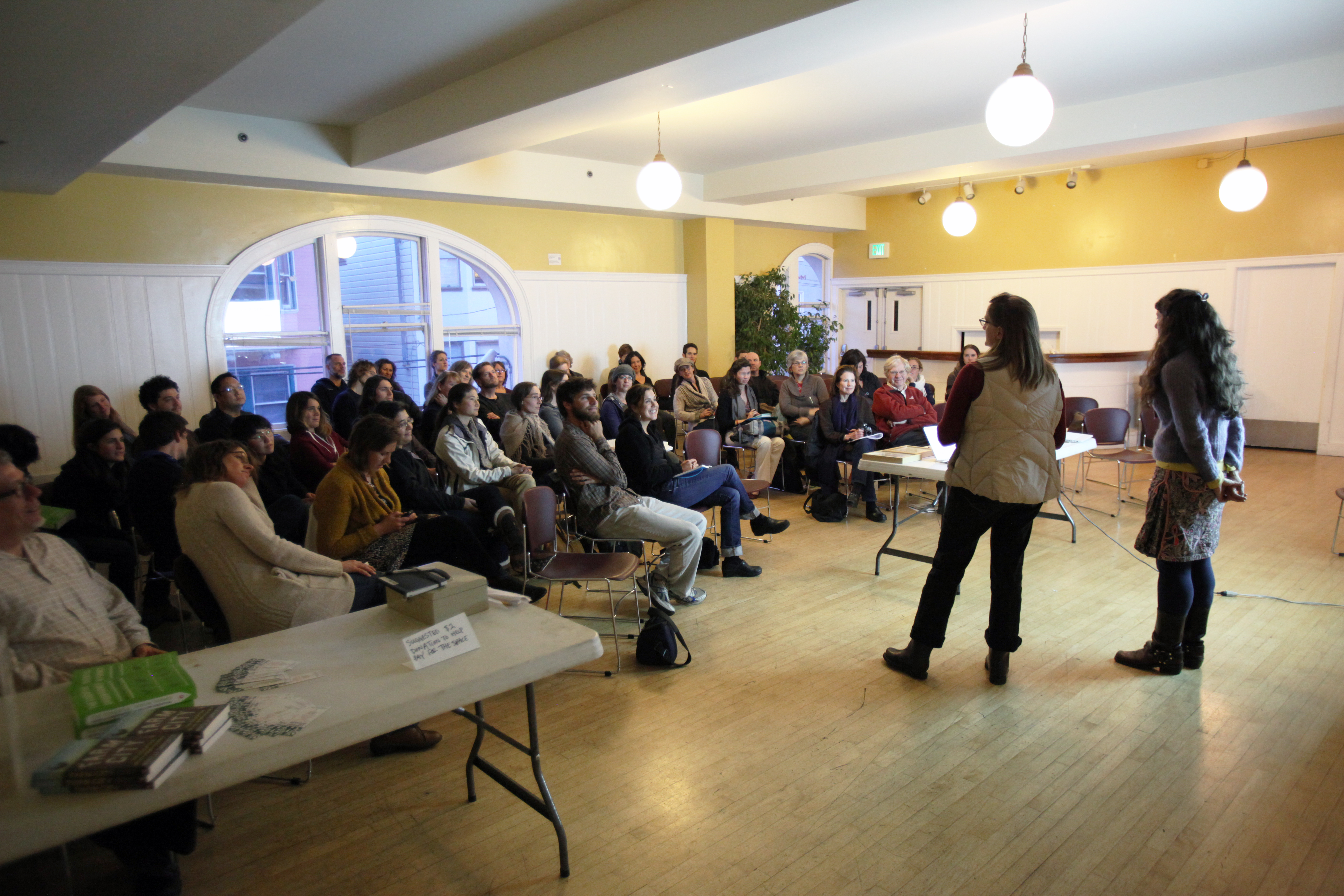
The Essential Urban Farmer book introduction 'Meetup' event February 29 2012, San Francisco, California
One of my favorite authors, Novella Carpenter, has a new book out. It was released December 27, 2011 by The Penguin Press.
Novella Carpenter and her friend Willow Rosenthal wrote The Essential Urban Farmer. This detailed how-to guide for individuals with or without farming experience looks destined to become a classic on the subject of urban farming.
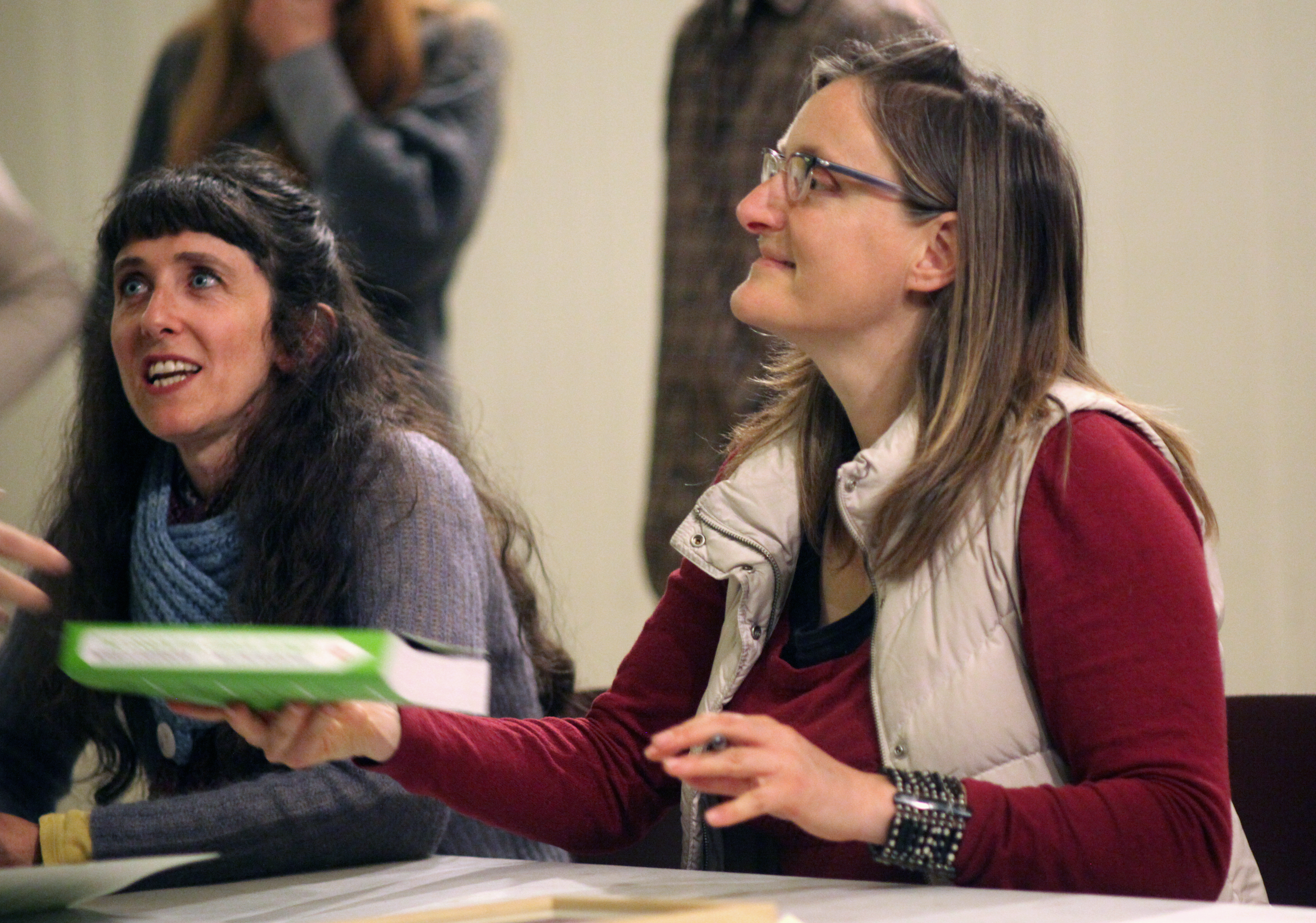
Willow Rosentha and Novella Carpenter February 29 2012 signing their book The Essential Urban Farmer
At 592 pages, Carpenter joked that the book is so heavy you can use it as a doorstop if needed.
Rosenthal and Carpenter gave a one hour talk this evening, February 29, 2012, at The Women’s Building at 3543 18th Street, No. 8, San Francisco, California 94110 USA. I was familiar with most of what Rosenthal and Carpenter spoke about. Nonetheless, it was fantastic to see them speak and answer audience questions.
Willow Rosenthal founded City Slicker Farms in Oakland, California USA, near San Francisco.
Novella Carpenter began her part of the talk with her infant baby girl nursing from a sling around her shoulder. I had been planning to capture video of her remarks, but I decided that was inappropriate with her baby feeding. After several minutes of talking, she asked a friend to take care of her baby, as I suspect it was just too distracting trying to address a room full of people and feed her baby simultaneously. Carpenter joked that at The Women’s Building the women all sit around breast feeding babies all day.
By that point, I recognized the light was too dim and the conditions too contrasty for a video to be any good. Carpenter was standing in front of a brightly lit video screen, so her face was dark. I decided to skip the video, except for a short clip I shot from the doorway to the room, showing Carpenter, Rosenthal and the audience together, with Carpenter answering a question about bee keeping.
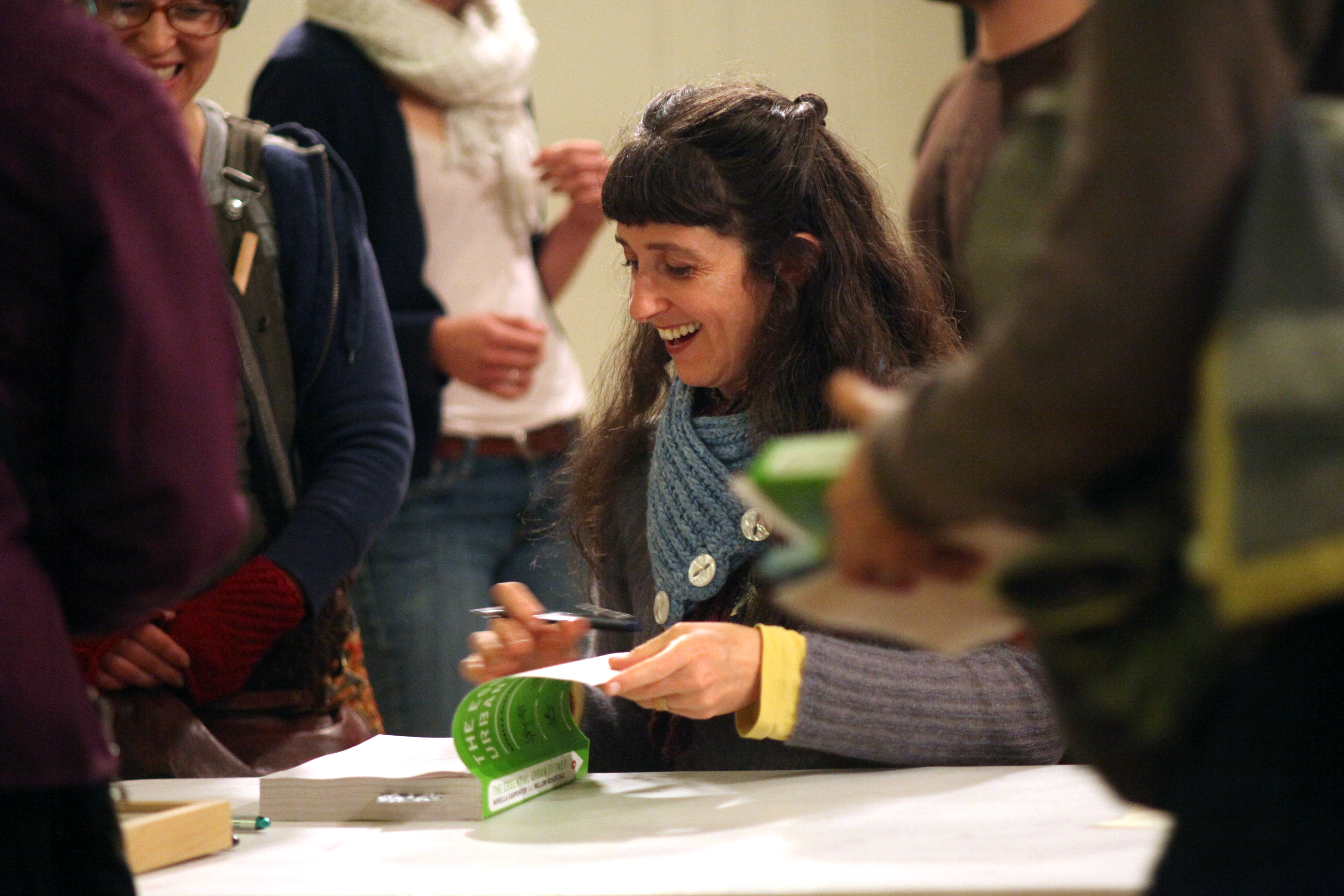
Willow Rosenthal signing The Essential Urban Farmer February 29 2012
Rosenthal and Carpenter spent three years writing this book so they could each reduce the perpetual effort they were exerting answering the same questions from their fans. Presumably they now can respond to emails seeking urban farming how-to information by saying “read the manual.” It’s a neat trick they’ll make some money along the way. I very much admire that Willow Rosenthal and Novella Carpenter have created. Learning to become self sustaining is valuable, and I predict this book will do well commercially and will expand the networks of Carpenter and Rosenthal dramatically. The audience for this book strikes me as different from the audience for Carpenter’s first book, Farm City, which was her delightful and captivating story, not a how-to guide.
As far as I can tell, The Essential Urban Farmer is Rosenthal’s first published book.
The Essential Urban Farmer covers growing vegetables, fruit trees, rabbits, ducks, chickens and goats. It also covers bee keeping.

The Essential Urban Farmer book cover, designed by Janet Hansen. Photograph from janet-hansen.com.
The guide has lists of vendors for supplies and information. It turns out there are sellers of bee keeping supplies right in San Francisco. I learned that San Francisco is a great place to keep bees because there are so many types of vegetation here, more so than on a farm in the country, where large expanses of single crops are more common. I learned that bees can and are willing to fly five miles each way to put in their days’ work.
They don’t call them ‘worker bees’ for nothing.
I would be exhausted if I had to walk five miles each way to work each day.
Something tells me bees work 365 days a year. Maybe that’s why colonies are collapsing. I sure would if I tried to work that much. I’m making a joke here, of course. Colony Collapse Disorder looks to be a dramatically serious problem.
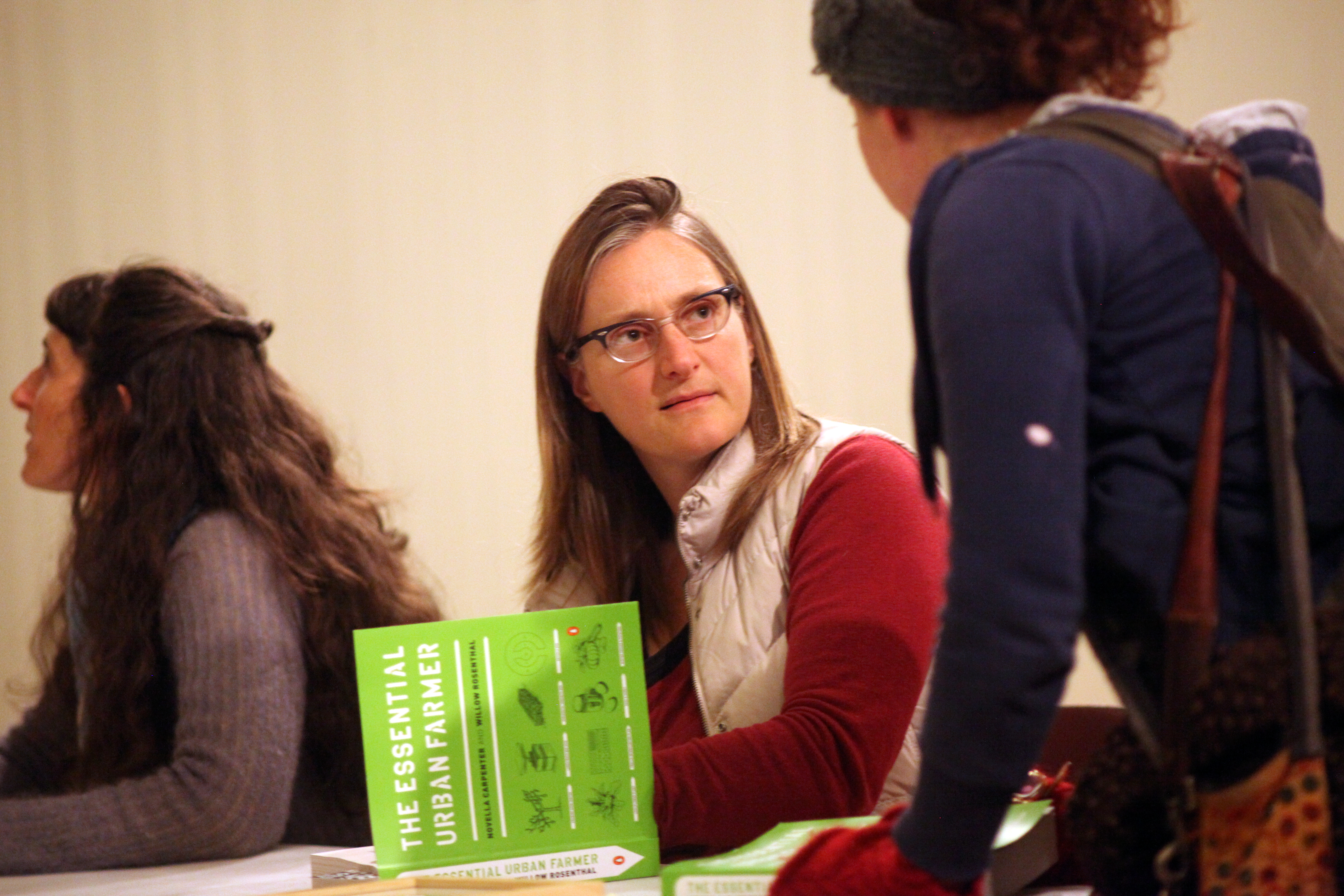
Novella Carpenter signing The Essential Urban Farmer Feb 29 2012, San Francisco, California USA
I came away with an idea for my super green eco bus conversion project. Fruit trees can be trained to be mostly two dimensional. This is done so trees can hug the sides of houses and fences, to save space. But it means I might be able to grow a dwarf apple tree behind my sofa on my coach with the flat side of the tree parallel to the window over the sofa. It would be crazy to be able to reach overhead and pluck an organic apple while reading The Essential Urban Farmer parked by the waterfront and warmed or cooled by the solar panels on the roof.
I told Rosenthal and Carpenter the short version of my plans for my eco vehicle, and they thought it was cool or they were great actors. I first met Novella Carpenter when she spoke at The Commonwealth Club of California January 25, 2011. Carpenter remembered meeting me back then, which was flattering.
Perhaps through the authors of The Essential Urban Farmer I will meet the adventurous souls I am seeking to take my eco bus on the road to spread the word about urban farming and homesteading.
The Essential Urban Farmer has three reviews on Amazon, and they are all five star ratings. Here is what reviewer Reckless Reader had to say:
“This book is the REAL DEAL — Novella and Willow are REAL urban farmers. You can read about it all in Novella’s Farm City, her memoir of taking a rasty vacant lot in funky ghetto West Oakland, California, and turning into a real urban farm — with vegetables, chickens, killer eggs, rabbits, and even, eventually a pig. That book made me wonder if I could really do this kind of thing out in my sprawling backyard. Even though I dont know jack-diddly, really, about how to farm. And you know what — this new book really tells how to do it, from how to pick land (near water, for instance, at least near a hose…), get the right to use the land, and then how to get the soil ready, how to get the right seeds, right through how to kill simple farm animals for food every now and then. It’s fun to read even if you dont want to go the length, but it seems like I am going to be able to do everything I want to do in my backyard, using just this one total REAL DEAL ‘how to’ guide to it all. Wow!”
I took the photographs above at the book signing Rosenthal and Carpenter conducted after their remarks.
I shot these pictures with my Canon 5D Mark II camera set at ISO 5,000. The lighting conditions were poor, and I needed all the light sensitivity I could get. I am pleased with the quality of the images considering how dark it was in that hall. I uploaded the pictures at full resolution. Click on them to see them at their full 21 megapixel resolution.
Janet Hansen designed the cover for The Essential Urban Farmer. I got the photograph of the book from Hansen’s website, which is worth visiting, as she’s a very talented designer.
My phone number is (415) 335-9116
I cancelled my home phone number a while back. It occurred to me that I am now slightly more difficult to call since my cell number is not in directory assistance like my old home phone number was.
I have two numbers that both terminate at my cell phone. One I keep somewhat private, but the other one is fully public and listed on my other website and on this blog on the About page.
The number is (415) 335-9116. Since this number makes my cell phone ring, please only call it when you think I will not be sleeping. Thanks.
Dan Rather’s big break
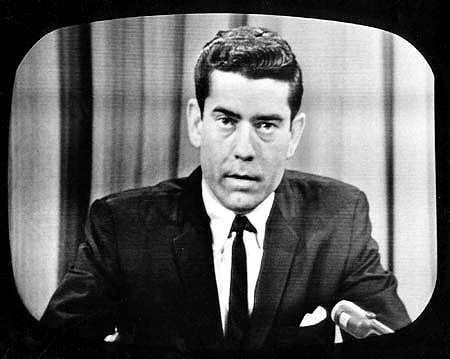
Dan Rather in 1963
I’ve been a fan of Dan Rather for years. Today I came across a great video interview of Rather where he tells how he got his break into television news in New York working for CBS News.
It’s a great story.
Dan Rather in 1960 was working as the News Director at KHOU television, a station Rather says in the video below was at the time the fifth or sixth station in a three station [television] market in Houston, Texas.
Dan Rather grew up in Texas in hurricane country and had had a life long fascination with hurricanes, perhaps from being born in Wharton, Texas on the Texas coast.
When he saw in September 1961 reports of what appeared to be an extremely large hurricane heading towards the Gulf of Mexico, he convinced his skeptical Program Manager Cal Jones that he should go to Galveston, Texas to cover the pending disaster, named hurricane Carla. Although Rather was not a meteorologist, he predicted accurately that the hurricane, which reached a level 5, would hit Galveston. Rather argued that Galveston would be flooded and inaccessible once the hurricane hit, so he had to go there immediately. His boss reluctantly gave Rather and a television cameraman the permission to go there.
This was the first time that a hurricane had been covered live on television.
Rather was correct — the huge hurricane hit and no other television news crew was in Galveston. Rather’s live coverage, including live radar screen video with a clear plastic map of the Texas coastline on top of the radar screen, was so compelling that the National CBS News producers picked up the feed from KHOU TV. The National CBS signal was fed throughout the United States, putting Dan Rather on a big stage at the center of a big news story, as the hurricane was monstrous in size and sadly killed 43 people despite 500,000 people being evacuated.
When Rather returned to his little television news department where he was the only full time employee, the bosses at CBS News headquarters called and offered Rather a job in New York. Dan Rather accepted a job as a television news correspondent, and his path toward anchoring the CBS nightly news became more probable.
This story should provide insight for everyone with big aspirations in life.
For the most part, people make their own luck.
I think Dan Rather made his own luck in this case. He turned his personal interest in hurricanes into his big break. He recognized the advantage to being the only reporter at the scene of a very big story. He persuaded his skeptical boss at the time, who knew nothing about hurricanes, to send him into the danger zone. He performed well under pressure, and when approached by the bosses at CBS News headquarters, he apparently had the political skill to turn their interest into a job. Finally, he had the good sense to leave his job as News Director to become Correspondent, even though Correspondent was a huge reduction in title.
Sitting around waiting for your lucky break is unproductive.
Go make your own luck like Dan Rather did.
Although my success pales in comparison, I followed much the same formula when I turned getting fired from Cooley LLP into selling my response to that firing for an extremely low eight figures just six years later. I could have fallen into a depression and plodded through life upset that Cooley didn’t want my expertise despite the positive press coverage my work had been receiving. Instead, I worked hard to expand and perfect my expertise. I packaged up my expertise into an attractive package called a corporation, and sold it when a buyer was buying, despite that being uncool at the time. I did all this with determination and purpose, and predicted accurately that I would sell as soon as soon as it became practical. I became an angel investor and advisor to startups, while also starting a third company, which I continue to work on.
I am remaking myself in similar fashion right now after an even more debilitating setback than being fired, and I predict that I will show even more success this time around. Why? Because I am more confident, wise, connected and savvy than I was when I started my first company at age 23 and my second company at age 30.
I used to be so shy, a huge impediment to entrepreneurial success. Now I can strike up a conversation with anyone, anywhere — even on the bus, at a club or in line at the bank. I sure wish I could have done this when I was 18, for my life would have been much better. But I am thankful that I can do it now. If you can’t do this now, make it your mission to figure it out as soon as possible, even if you have to hire a coach and practice at great pain to yourself. It’s simply not that hard once you practice a little bit and leave your fear at the door. I haven’t had one bad experience starting a conversation. There are few skills more important than being able to confidently approach and strike up an enjoyable conversation with anyone, no matter what you want to do in life.
