Here’s an unusual way to find a wife

Chas
My post yesterday announcing I am divorcing my wife was emotional.
Now my friends know I’m divorcing my wife.
The vast majority of my friends didn’t know that before yesterday.
I need to find a replacement wife, and pronto — hopefully in the next two years, as I want to start a family as soon as possible.
I’m not ready to date yet, and I haven’t been on any dates, but when I’m ready, I’ll let you know.
In today’s online edition of the San Francisco Chronicle newspaper, there’s a link to a story on a different website about Chas McFeely, who also wants to get married and start a family soon.
McFeely had tried online dating sites, with no success. So he decided to make a dating site where he’s the only member — Ten Thousand Dollars for Love?
To encourage people to visit, he’s offering a $10,000 reward to the person who introduces him to the woman he marries. According to the story, he’s received hundreds of sincere emails from all over the world.
His dating site, HookChasUp, is pretty well done. It’s very light on text, and there is no blog, so it’s tough to get to know him. But the photos and captions are well done, to my untrained male eyes.
Do you think this experiment Chas is trying will work? I’m worried it will attract unsuitable replies, but still, I wish Chas all the best in his search.
I wonder if most viewers notice what record album he’s holding in the picture above, and what percentage of them understand he’s communicating a lot about himself by that record selection.
Time to move Berkeley’s Pacific Steel to suitable industrial space
Pacific Steel of Berkeley, California is apparently the 3rd largest steel foundry in the United States. Pacific Steel’s unionized employees are currently on strike and the company must be losing a fortune each day.
I have mixed feelings about this company. My company Silveroffice, Inc., the makers of gOffice, in 2005 used to be housed on 10th Street in Berkeley, about 8 blocks from Pacific Steel. Our tenancy at that location lasted just a couple of weeks because one of our employees got sick and started to miss work due, he claimed, to the noxious and poisonous fumes emitted daily by Pacific Steel.
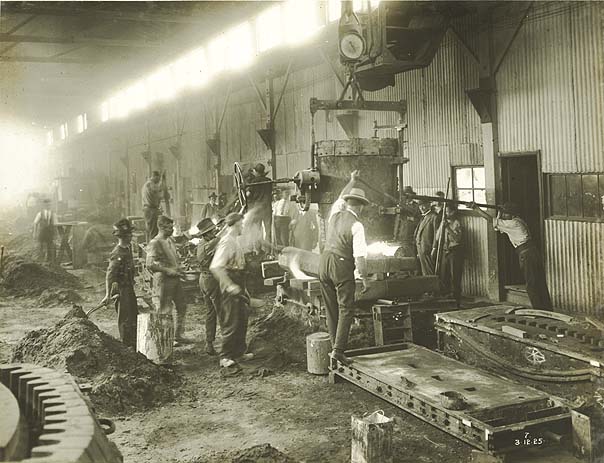
Hadfields Works steel casting, 1925
The smell resembled a pot with a plastic handle left empty on a burning stove.
I smelled this smell as we were moving in, but didn’t think it was an ongoing condition. But after a few days, a neighbor dropped in to introduce herself and left us with a flyer advising the cause of the odor was Pacific Steel. I attended public meetings organized by the neighbors, and learned the plant emitted all sorts of carcinogens.
The plant moved into Berkeley in 1934. Apparently, back then, there were no homes, schools or offices anywhere near the plant. That was smart thinking, as I don’t see how a foundry can be odor free, given what they do inside, which is pour molten steel into molds to make truck and other parts. Even soldering an electrical connection on my desk makes a nasty smell, and I’m only melting a tiny amount of metal.
I think that Berkeley itself may be the party to blame here. They should have never allowed houses and nursery schools to be built walking distance to this huge factory, which fills more than a city block of land. Berkeley should have paid Pacific Steel to relocate if needed before they let a nursery school be opened across the street.
I suspect that Berkeley collects a LOT of tax revenue from Pacific Steel and ‘needs’ them to pay the bills. But I bet it can be shown people die earlier if they live for a long time near this plant. The current leadership of Berkeley didn’t cause the current mess, I’m sure, and from what I know, the leaders of Berkeley are kind and conscientious leaders. I’ve met Tom Bates, Berkeley’s mayor, and I’ve heard him speak. I was impressed with what I heard, but of course, he was not speaking about Pacific Steel.
Within days of discovering the health threat, I moved my company out of the vicinity of Pacific Steel. We moved back to our Berkeley Entrepreneurship Laboratory space for a few weeks to give me time to find new office space, which I did. We moved to downtown San Francisco into the Mills Building at 220 Montgomery Street in early 2006.
According to the article I link to here, Pacific Steel is losing money and thus it has asked its employees to pay for their health care insurance coverage. My guess is this coverage costs a fortune, because the air must really stink inside these ancient factory walls. The article says some of these employees have been working there for 30 years! The health consequences must be horrific, though I am just guessing, and perhaps there are air scrubbers inside that make the air as fresh as crisp ocean air. Has anyone reading this been on the factory floor while the plant is in operation? If so, please leave a comment telling us what the air smells like.
I think the solution is to simply shut the factory, take the modern equipment to a truly industrially zoned city area, perhaps far from Berkeley, and set up business operations there. Scrap the ancient equipment, perhaps by melting it down into truck parts as a final tribute to the company’s long and no doubt colorful history. Offer jobs to the best employees and don’t fight unemployment compensation for the rest of them. Yes, it’s sad some longtime employees will lose their jobs. But they are nearly certainly being slowly killed by working there, and given time, they will realize I predict that this wrenching change is in their best interests.
Remember, my office was about 8 blocks from the factory, and I found the smell unbearable once I learned it was carcinogenic. It was quite unpleasant before I found out the smell was carcinogenic.
In 2005, there was reportedly a nursery school right across the street from this old factory! Those poor children! Those poor teachers!
I have read Pacific Steel has spent millions on new equipment in recent years. They can take these goodies with them to the new factory. There probably is a closed factory out there that they can just buy for pennies on the dollar, like Tesla Motors just did with the Toyota/General Motors plant in Fremont, California. It must be so stressful for the Pacific Steel owners to be doing constant battle with its neighbors, so I would think they would welcome a chance to start over in an area that would welcome them, not shun them.
I’ve never written such a harsh post before, and I hope I don’t upset the workers or the executives too much by what I write here. I think Pacific Steel was harmed by Berkeley decades ago, and it’s probably too late to seek redress. So what needs to happen now is to make the best of a bad situation. Even if Pacific Steel has to reduce its size so it’s the 10th or 20th largest foundry in the US, it still makes sense to adopt my plan. Once they stop bleeding money on fines, lawyers and public relations, they can grow a number 10 or number 20 firm back to the number 3 firm, probably in only 10 years. Clearly the family has exceptional drive and tenacity to survive this long under such trying circumstances. When they can stop fighting and really work on their business, I predict great things will happen, and the health benefits to the whole community will allow that section of Berkeley to thrive.
I invite comments, even harsh and critical comments. I don’t know all the details, and I am open to writing follow up posts to correct or amplify points I make above. I’ll even meet with representatives of either side if they like to make certain I ultimately write a fair and balanced analysis. I’m a new journalist with no training, so please be patient with me as I tackle controversial, even explosive subjects.
PS – Moving away from Pacific Steel hurt my relationship with Priya Haji, who founded World of Good, Inc. gOffice was renting space from World Of Good on 10th Street, which is how gOffice came to locate near Pacific Steel. I had been quite close with Priya up until that point, and we would talk everyday, each advising the other on our repsective ventures. Once I left in a rush, we never talked like we used to, which makes me sad, as Priya is one of the most fascinating people I know. You could say our relationship was a casualty of Pacific Steel’s presence in the neighborhood, which should give you some background on why I felt compelled to sound off on my blog about such a controversial story.
The Secret History of Silicon Valley, by Steve Blank
I consider attending the Berkeley Entrepreneurs Forum to be one of the high points of each month during the academic year. The Forum is the premier event developed and hosted by the Lester Center for Entrepreneurship and Innovation at the University of California, Berkeley. I’m a member of the Advisory Council for the Entrepreneurs Forum, and I’ve enjoyed participating very much.
The draw for the evening is the speaker or panel on a subtopic of entrepreneurship. The action though is in the networking during the cocktail hour prior to the formal program and immediately after the program when there’s an opportunity to meet the speakers. I’ve shaken hands with more billionaires at the Entrepreneurs Forum than at any other single place.
The most recent program was by an individual speaker, my favorite format. The speaker was Steve Blank, the same Steve Blank I saw at the Commonwealth Club of California last month.
Blank delivered his talk entitled ‘The secret history of Silicon Valley’, which I had already watched on YouTube from an earlier presentation elsewhere. This talk is rich with colorful information about how Silicon Valley was formed. It’s a fascinating story tightly intertwined with Stanford University and World War II, of all things. I didn’t know this, I’m embarrassed to admit. But I would guess 99% of people don’t know this history.
I shot high definition video of Blank’s talk, but I have decided to link instead to the official version, which is edited with clear views of his slides. I’m not a fan of speaker slides generally, but these slides really do help tell the remarkable story more effectively.
I’ve heard Blank is an exceptionally engaging and likeable teacher, which probably explains why he won the Earl F. Cheit Award for Excellence in Teaching for the Berkeley-Columbia MBA Program last year 2010. Jerry Engel, the Faculty Director of the Lester Center, said in his opening remarks to Blank’s talk that he’s envious of Blank, since Engel hasn’t received this award.
Here’s the YouTube video of Blank’s talk, which happened February 24, 2011 in the Anderson Auditorium at the Haas School of Business on the UC Berkeley campus in Berkeley, California, USA.
Engel was a member of the board of advisors for my first company, Hotpaper.com, Inc. and is a member of the board of advisors for my current company, Silveroffice, Inc., the makers of gOffice, the first true online office suite, launched in 2004.
Steve Blank wrote what I consider to be the best book I’ve read on how to start a successful technology company — The Four Steps to the Epiphany, Successful Strategies for Products that Win.

The four steps to the Epiphany book cover
If you consider yourself an entrepreneur, even if you’ve been successful for years, you need to own this book and read it multiple times, because you’ve probably just been lucky. Seriously.
A heartwarming story about buses and their role in Civil Rights history
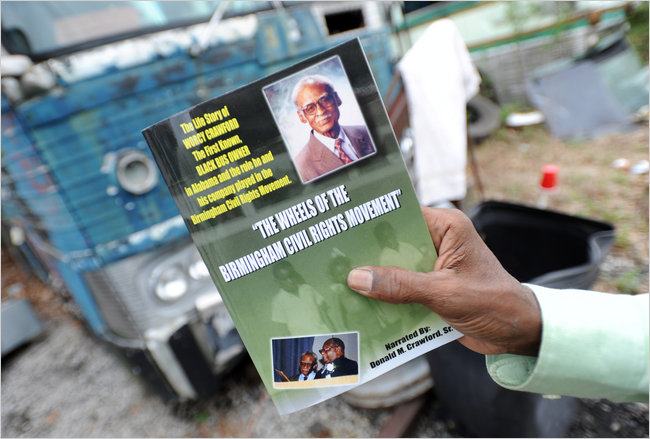
The Wheels of the Birmingham Civil Rights Movement
Here’s a heartwarming story about buses, which, as you know, I love:
The story of the Microsoft IPO, as told by Fortune
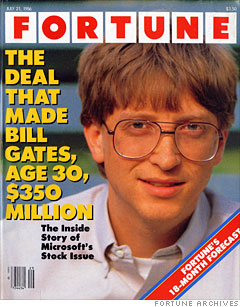
Fortune Magazine cover from 1986 featuring Microsoft IPO
Inside the Deal That Made Bill Gates $350,000,000 is the title of a story by Fortune that covers what happened behind the scenes with the initial public offering of stock in Microsoft. Yes, that was in 1986, but these kinds of stories are not commonly ever made public, to my knowledge, so I thought I would make note of it here. I certainly learned something. For example, Microsoft, Oracle and Sun all went public within days of each other. Wow.
I remain a big believer in Microsoft, and I use Visual Studio, Windows Server, SQL Server and their Office software to run my company’s website, gOffice. Microsoft’s products are unfairly derided, in my view. Sure, I have my unhappy moments with their products a few times a year. But no other company makes an office suite as rich and genuinely powerful as Office. There is no way to substitute any other programs for Word and Excel for really serious work, because the macro language in Word and Excel lets you do almost anything. Online office products are terrible by comparison, including my company’s own gOffice product. Microsoft has thousands of smart people working on this stuff constantly, and it shows. Sure, the products could be better, but they’re already quite good today.
I think Microsoft will be around longer than Google.
Google doesn’t hold the monopoly power afforded Microsoft by its ownership of Office and to a lesser extent, Windows. People other than advertisers and website owners can stop using all of Google’s products without too much pain. But who can not use Excel for serious corporate work with others?
I recognize these are remarkably unpopular positions to take, but my job here is to tells things as I see them, not recite the popular viewpoint.
By the way, Microsoft considers gOffice a ‘competitor.’ I find this humorous given our tiny market position relative to theirs, but it is nice to see your company name in Microsoft’s 10K annual report for the most recent 5 years in a row. Don’t believe me? Look it up on the Microsoft website here.
gOffice has been depressingly and uncharacteristically quiet for years now, but all that will change this year, and I have modest but wildly realistic plans to revive the brand and product. Stay tuned.
One final crazy point: I think the market value of Facebook will eclipse that of Google and Microsoft, but probably only temporarily. Facebook has a tremendous network effect advantage that will be tough to break, and people really can’t substitute any other site for Facebook, since that’s the only site where all your friends are nearly certain to be.
Friend me on Facebook at Facebook.com/kevinlwarnock to help prove the market power Facebook holds.
We have four baby chicks nesting in an incubator in my bay window

Mill Valley Chickens, Mill Valley, California, USA, March 19, 2011
I have four housemates — Gina, Marie, Megan and Jesse. They all responded to my Craigslist ad where I proposed starting an urban homestead at my San Francisco house. One of the plans I outlined was to raise chickens for eggs. Today I went with Gina, Marie and Jesse to Mill Valley, California to Mill Valley Chickens where we selected four adorable tiny chicks to come live with us.
Marie provided a portable dog cage to make into an incubator. I supplied the light fixture and the hardware cloth to narrow the gaps in the dog cage to make them too small for the chicks to be able to escape through.
In just a few hours the chicks were eating voraciously in my dining room. We’ve decided to keep them in the dining room for now so we can enjoy their cuteness as much as possible since they grow so fast. Three of our chicks were born March 16, 2011, just 3 days ago. The other was born about 3 weeks ago and is about 3 times the size of the newborns.
I took some pictures of our new babies and have posted the best ones below. Enjoy!

Kevin's Americana chick, center, which produces green and blue eggs, 1.15oz, 3 days old, March 19, 2011

Kuma, the Great Dane, with 3 week old chick. March 19, 2011.

3 week old chick, making noise, March 19, 2011

3 week old chick looking serious, March 19, 2011
I hope Harbor Freight never gets acquired

Harbor Freight Tools logo
I love the tool store Harbor Freight. To my knowledge, there’s no store like it in the San Francisco Bay Area, and perhaps in the entire United States.
What’s to love?
The prices are just so far below those at Home Depot and Lowes and the neighborhood hardware store that you can afford to by twice or three times as many tools. I can’t think of any other example of a large sector where just one business dominates the bargain priced end of the business as does Harbor Freight.
Some will say Harbor Freight tools are junk, but I disagree. They are quite good enough for home hobbyist use. I’ve only had one power tool break, but I was really overdoing it – getting it too hot by continuous use for over an hour. It was an electric planer. I replaced it for a new one for just $39.95. Not a big deal, and I learned my lesson to give the tools more of a break to cool down.
I fear that if Home Depot or Lowes were to acquire Harbor Freight they would either raise the prices or shut it down, to avoid the competition.
What’s my latest super bargain purchase from Harbor Freight? An 11 horsepower gas engine with an iron clad two year extended warranty where they give you a new engine if the original one breaks. All you have to do is bring in in any condition what’s left of the engine and they immediately hand you a new unopened new engine in the box. All of this for under $300! I am going to make a super quiet battery charger from this engine by having it run at idle, not full speed. Idle is about 1,800 RPM, like a high end diesel generator that costs $5,000 and up. I don’t need or want the 5,000 – 10,000 watts that are produced by a high end diesel generator. I would be thrilled with a quiet 1,500 watt generator, which is what I hope to get from this Harbor Freight engine run through my Trace SW4024 inverter via a Delco 105 amp 24 volt alternator, I picked one up last week on EBay today for less than $100 including shipping. I will put this engine in a sound box and cool it with a pair of Honda Civic car engine radiators I got new from Amazon for $160 including a dedicated 12 volt radiator fan matched to the radiator that will be outside the sound deadening enclosure. Once I convert the engine to run on propane, I’ll have an electric start quiet, environmentally friendly and very quiet generator for a very low price. Should the engine blow up for any reason, I get a brand new one with no questions asked. I could even carry a spare since they weigh just 74 pounds.
Harbor Freight makes inventing, building and experimenting easier to afford, and I’m glad they appear to be thriving.
Even so, there is probably a dark side to Harbor Freight such as cruel working conditions that I don’t know about. If you have any information about such things, please post a thoughtful comment. I could be persuaded to not shop there if warranted, but to my knowledge their products are made in China, just like I suspect most of the tools for sale at the big box super centers.
In Japan, parents train their children to return lost property, even coins found on the pavement
Slate, the online newsmagazine originally funded in part by Microsoft, March 16, 2011 published an article about why there is so little looting now in Japan, following the March 11, 2011 9.0 earthquake and resulting devastating Tsunami.
I don’t know if the articles claims are true, and I won’t sumarize the article here, as I would prefer you give Slate the traffic and read the full article at their site, here: Stop, Thief! Thank You.

Aerial view of damage to Wakuya, Japan following earthquake
However, I do want to call your attention to the part of the article that says that in Japan parents train their children to return property that’s been lost by its owner. How? It takes a bit of effort, but I know it can work, and I recommend you do this with your children.
If a child finds a coin on the street, the parents will take the child and the coin to a police station and have the child turn in the coin to the police. If the owner doesn’t claim the coin within six months, the coin is returned to the child to keep. According to the article, parents and police take this training exercise very seriously.
How do I know it can work? Because my own parents did this with me when I was 9 years old. We were living in London, England at the time. One day I found a 5 pound banknote in the gutter. I think the pound was worth about USD $2.50 then, so this bill was worth about $12.50. But I was 9 years old, and my allowance at the time was probably 25 cents week, so this bill represented a fortune. I was elated to have found it!
My parents cooled my spirits when they told me I would have to turn it in the the police! I recall that we went to the police station and turned it over. Like in Japan, I was told I would get the money returned to me in six months if nobody claimed it. Of course, nobody claimed it, and half a year later my parents somehow got the money from the police and gave it to me.
This was a lesson I never forgot, and I love my parents for teaching me so well.
I know plenty of people who should know better that never learned this lesson, and will pocket anything of value they find. I know people who accepted overpayments from their employer without a word. This was not a few dollars, but thousands of dollars! I know people who would not send a bill back at a restaurant for revision upwards if an item was left off. I know people who will keep any change a cashier returns to them in excess of the proper amount due. I’m certain that everyone reading this knows people like this as well.
I remember when I was about 12 years old and was a student at University of Chicago Laboratory School. I’m told that this is one of the finest schools in the United States, and many of the students come from privileged backgrounds. The father of one of my classmates is a justice of the Supreme Court of the United States, for example. The mother of another classmate will probably win a Nobel Prize, my mother tells me. This student’s mother was featured in a long article about her life in The New Yorker magazine last year, to make the point she really has a shot at such an important prize.
In gym class, our lockers were arranged in alphabetical order, so my locker was near that of my friend Vincent Webster. One day he forgot to put his wallet in his locker and I found it. I returned it to Vincent or to the school authorities. Vincent got his wallet back and the whole class somehow learned I had done this. Believe it or not, I got teased and several of my classmates criticized me for not keeping it! I don’t think there were any poor students in my class. Many of my classmates have gone on to do important work in life. Nobody at this school ‘needed’ whatever could have been in Vincent’s wallet.
Never once did I consider keeping Vincent’s wallet. Vincent was my friend, but even if he were my enemy, I still would have returned his wallet.
My parents raised me well, and I am sure my honesty has been noticed and appreciated by the good people I’ve encountered in life. This is not to suggest I’ve never done anything I’m not pleased with in life, or have never made a decision that looks bad in retrospect. But I have really gone through life guided by an exceptionally strong moral compass.
If you cheat, stop, apologize and go back and make it up.
Slide out solar panels for my bus conversion
For a while now I’ve been thinking about putting solar hot water and solar photovoltaic panels on slide out mechanisms on the roof of my RTS bus conversion.
Today I found a supplier that would make this plan easy to implement.
I imagine that when camped I could push a button and solar panels could extend from the street and curb side of the conversion.
There would be the primary panels about a foot over the top of the roof, flush with the top of the roof deck shroud I’m planning. The extra panels would be under the primary set, and these are the panels that would slide out.
At first I thought I would use stainless steel heavy duty drawer slides for this project, but they are very costly and would require that I build a frame to use them with. Then, on YouTube, I found the solution: Glide N Grab
This company makes slide out platforms for pickup trucks, work vehicles and RVs. The platforms are available made from aluminum, which I like for weight savings and corrosion resistance. The aluminum slides are available in capacities up to 1,000 pounds. Photovoltaic panels weigh about 50 pounds, and I probably could fit two at once on one of these slide out platforms. That would leave unused capacity of 900 pounds to battle the forces of the wind, which could be ferocious. The Glide and Grab company even sells a motorized extend and retract option, so I wouldn’t have to build something special.
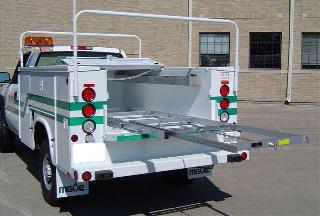
Glide N Grab brand aluminum cargo slide installed on work truck
These slides are quite affordable compared to drawer slides, and I think they’re much more suited to the task. I probably won’t implement this plan for years, as I still have so much work to do, and I’m busy with work and my urban homestead. But I wanted to write about this today as I am really excited about this idea. For bus converters where money is of little object, these slides are cheap, and if you covered the roof of a $2,000,000 Prevost with panels and slide out panels on the street and curb side, that’s probably enough power to run an air conditioner to keep 1/4 or a 1/3rd of the vehicle cool without running a generator. This would be a green selling point, and it would certainly be a conversation starter in the high end resorts where the owners of these vehicles vacation. These 45 foot monsters could be segmented with doors or curtains so the entire vehicle doesn’t need to be cooled at once.
If I build shipping container houses, these slides make sense, since a key goal is to not need grid electricity. For extreme climates, the area on the roof of a container may not be large enough to generate all the energy needed. With these Glide N Grab slides, one can at least triple the solar capture area. I suspect that the slide area does not count as ‘projected roof area’ when building codes are applied, since the panels can be retracted each day when the sun goes down or during severe winds. Using slides on the roof of a shipping container house would also allow more of the roof of the container itself to be used for food production, increasing the potential for self sufficiency.
This idea is certainly less adventuresome than the idea of making entire rooms slide out of an RV or bus conversion, which must have seemed crazy when first proposed. Room slides caught on, and even inexpensive RVs and travel trailers now offer them.
I see no reason why solar hot water heating panels can’t be placed on these Glide N Grab slides, though perhaps the heavier duty steel slides would have to be used, and special water tubing would have to be used that is both flexible and resistant to ultraviolet radiation.
If you implement this sliding solar panel plan before I do, please send me some pictures.
I suspect someone has already thought of this idea and has implemented it. I couldn’t find any references after a brief search online. If you know of a writeup that predates this one, please add a comment to this post. Thank you!
I’m an angel, apparently…
I do Google my name on occasion, like most people. Today I was shocked to find myself listed as an angel investor on the blog Mark Alen, a PhD student in the field of Operations Research at University of California at Berkeley.
I have made 3 angel investments, but I knew the founders as legitimate close friends before I invested. I’ve never held myself out to the public as an angel investor, but somehow Mark has decided I’m an angel investor.
This is flattering, so Thank You Mark.

Mark Alen blog, September 5, 2009, http://openresearch.wordpress.com
