Social Capital: The Intersection of Money and Meaning – at Commonwealth Club of California

Penelope Douglas, April 4, 2011 speaking at The Commonwealth Club of California
Last evening I attended a talk entitled Social Capital: The Intersection of Money and Meaning at The Commonwealth Club of California.
The speakers were:
Patrick Donohue — co-founder and CEO of The Hoop Fund
David Hodgson — Co-founder of Connective
Kate Sofis — Executive Director of SF Made
Penelope Douglas — President of the Board of SOCAP
I got to meet Kate Sofis, the Executive Director of SF Made. You may recall that I wrote about SF Made in February, 2011 and in that post wrote that I hoped to meet Sofis. I didn’t at the time know that I would meet her just over a month later.

Patrick Donohue and David Hodgson, April 4, 2011 at The Commonwealth Club of California
Sofis reminded me about Modern Cabana, a company I originally learned about from my friend Kevin Casey of New Avenue, Inc. Sofis told the audience that Modern Cabana consists of just 2 people, the co-founders. This was one of the most inspiring facts I’ve learned since joining the Commonwealth Club less than 6 months ago.
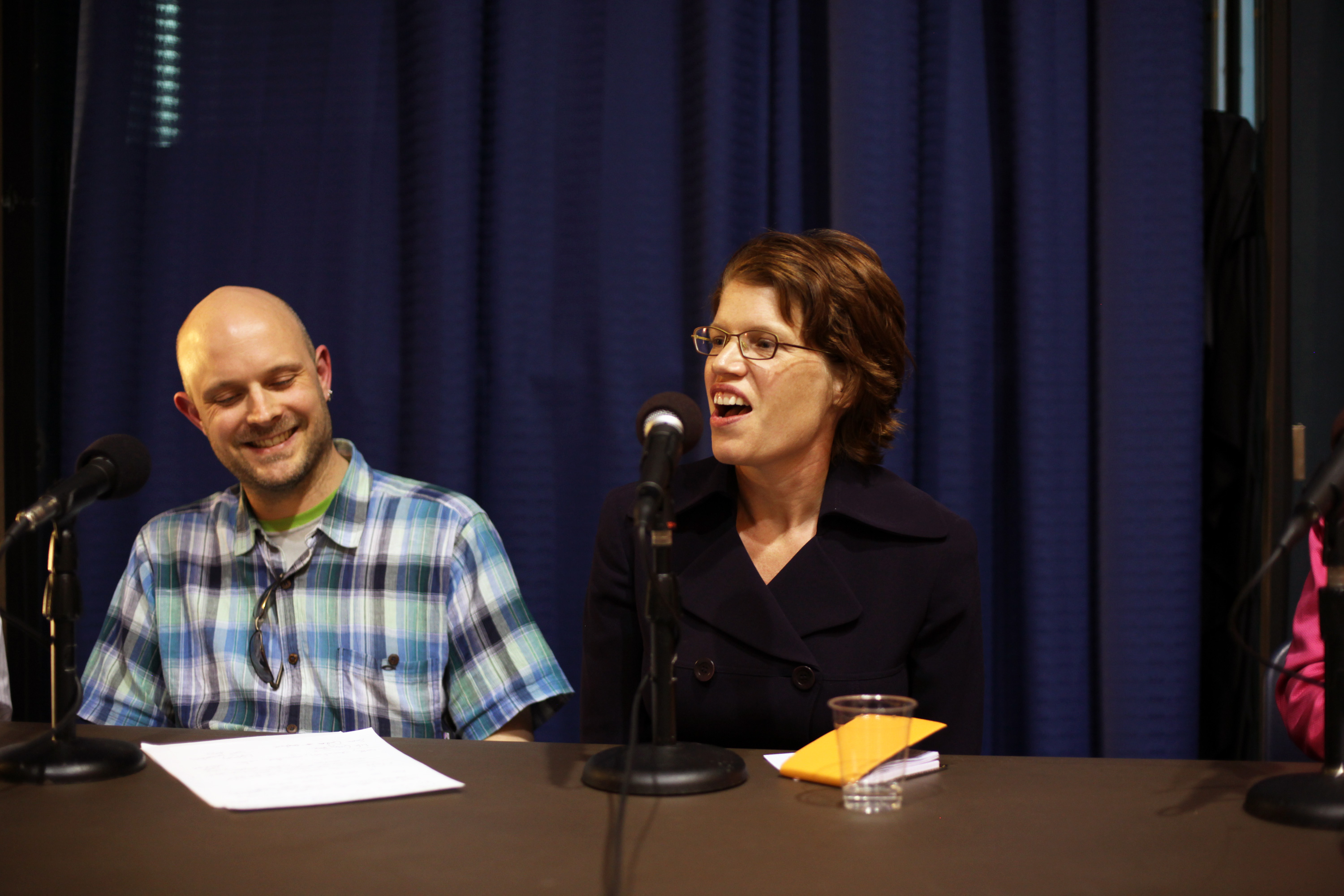
David Hodgson and Kate Sofis, April 4, 2011 at The Commonwealth Club of California
Modern Cabana offers an appealing product from an attractive website. The company appears to be much bigger than it is. They are based in San Francisco, and make their products in San Francisco, according to Sofis. This is just outstanding news for me, since I am thinking about making a business of selling off-grid capable green homes, and I would like to do this in San Francisco, since I don’t plan to move and I don’t want to commute to a different city to work, as I think commuting long distances to work is itself unhealthy, unwise and not green.
Here’s a clip from the talk. The first speaker shown is Penelope Douglas. The second speaker is Kate Sofis of SF Made. I had nice conversations with all of the panelists after the formal program concluded.
Of course, the panel talked about much more than Modern Cabanas. The primary point I believe the speakers were making is that good can be done by investing in and creating double bottom line businesses. This subject is close to my heart, thanks to the education provided to me by my friends Priya Haji and Siddharth Sanghvi.
I want to drive my bus conversion around the world to promote green living
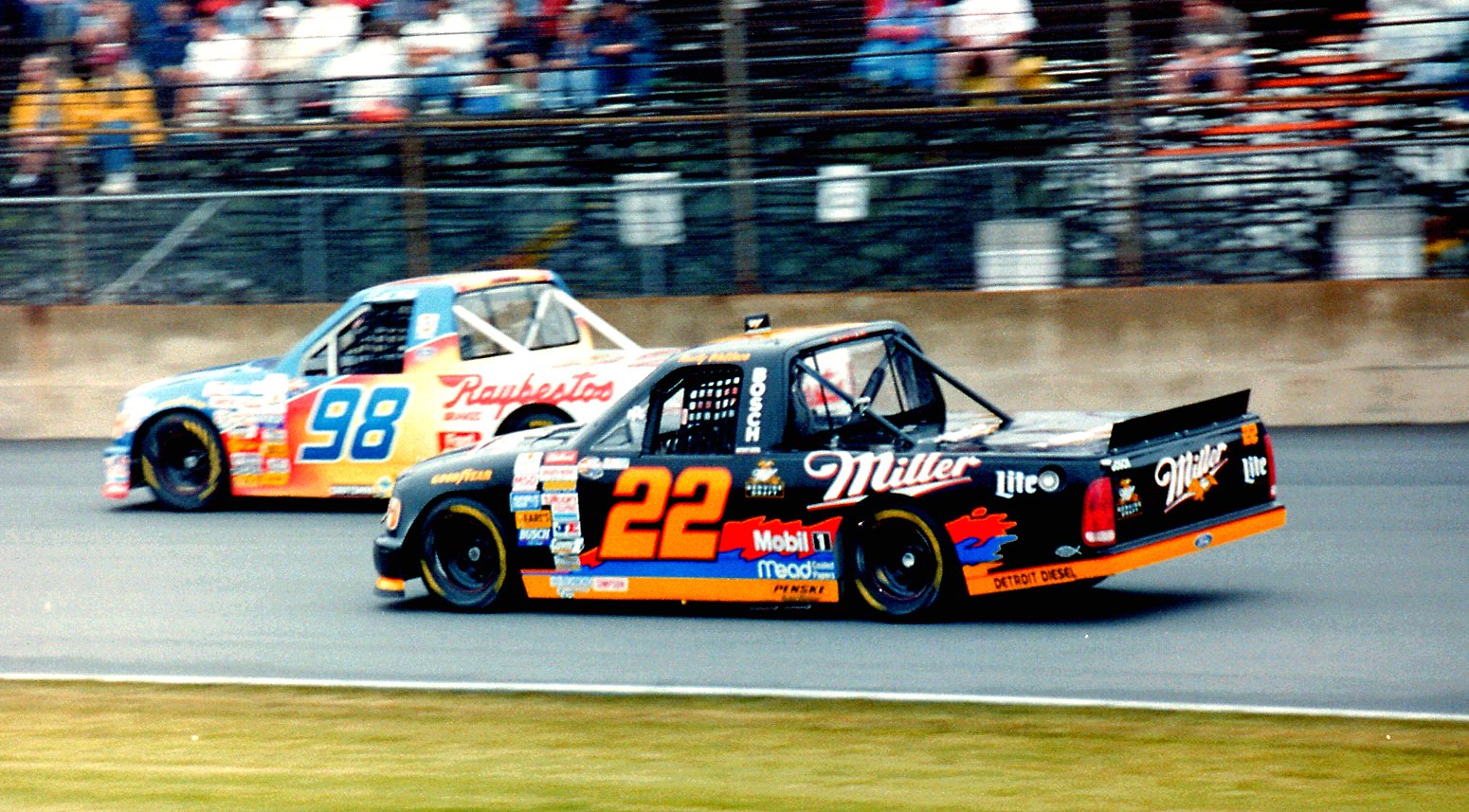
Nascar pickup trucks covered in sponsorship ads
Last year I read the book Take your RV to Europe by Adelle and Ron Milavsky. This book was inspiring, for it made me want to take my RTS bus conversion to Europe, and I have been planning this trip now for about a year. Last year I told my entire family about my plans.
The authors of Take your RV to Europe took their Toyota based class C RV to Europe, and now leave it parked there full time so they can fly over and go on extended multi-month voyages as they please without the hassle of shipping the vehicle over for each trip.
I got shipping quotes last year around June of 2010, and the price is about $7,000 each way to take my 40 foot long conversion to The Port of Rotterdam, Netherlands from The Port of Oakland, California, the nearest large ocean shipping port to my house.
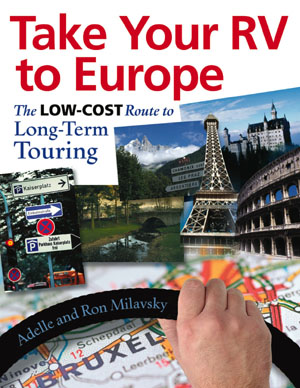
Take Your RV to Europe book cover
My plan has been to spend a solid year traveling and living in the conversion full time. The book makes it clear that Europe is very friendly to recreational vehicles, much more so that is the United States. In most medium and large European cities there are RV parks, unlike in the US. For example, there are large RV parks in London and Paris. The one in Paris is walking distance to a Metro station… just outstanding. There are no RV parks in San Francisco, where I live, one of the most popular tourist destinations in the world… just awful.
Take your RV to Europe makes a strong case that shipping your RV to Europe is the least costly way to travel for an extended time in Europe.
Fuel is costly in Europe, granted, but distances are short compared to the US.
Restaurant food is costly, so being able to cook on board the RV saves a fortune compared to staying in hotels or even youth hostels. I stayed in a couple of different youth hostels in 2009 when I was in Amsterdam, Netherlands, and I recall paying around 40 Euros a night, which really adds up, particularly since you need to buy lunch and dinner on your own. If I were to do an extended tour of Europe, I would hope I had a new girlfriend or wife by then and would be able to bring her along.
While it may be a while before I embark on a European bus conversion adventure, I wanted to share with you my newest variant of my dream, which I am really excited about:
I want to elevate my trip from a mere road trip into a voyage to change the world.
As you know now from my frequent posts about my plans to build many green features into my beloved RTS, I am passionate about living efficiently. While I own a 1,600 square foot house in the center of San Francisco, California USA, I don’t use all that space for just myself. I rent out most of it to my 4 roommates. Divided evenly, that comes to 320 square feet per person, which is close to the area inside my bus conversion.
Most of the inhabitants of the world live in dwellings much smaller than the average US house.
There are many great advantages to choosing to live in smaller dwellings — interest savings, maintenance savings, time savings, energy savings and mental energy savings, for example.
My green bus will be loaded with technology that will showcase how green living can still be richly pleasurable and rewarding. Few people have ever stepped foot in a truly green home, in part because few such homes exist. They certainly don’t exist in every city and town in the US and Europe. But my green RTS can visit such towns and cities with relative ease.
I hope to be able to change the world by showing people my green bus and telling them about it. I am already working hard to develop my journalism skills by building up my audience for this blog at KevinWarnock.com. I am not scared to speak in public, and I’ve been interviewed on the radio before, while I was CEO at Hotpaper.com, my first Internet startup from the first dot com boom in the 1990s.
I envision arriving in a new city or town and parking my green bus conversion right in front of the venue I will be speaking at. There, I will spend the night. I will address the group assembled by my host and then invite the group to tour my green home. Since it will be my actual home for an extended period, it will be believable in a way that I think most model futuristic homes are not, because they don’t look lived in, because they are not lived in.
I will get my start on this public speaking circuit in the San Francisco Bay Area, where there are many receptive audiences for my green messages. As I build my blog readership and get speaking credits, I hope to get more radio interviews and then television interviews.
At this point, when my ideas are getting more attention, I hope that I will be able to recruit sponsors to help me pay for my eventual adventure traveling around Europe, which will cost perhaps $50,000 for the year. I have been thinking of getting sponsors for a while now, but I really decided to try to make it actually happen when I read the inspirational stories at PlanetSolar.org, which describes a solar electrically powered yacht circumnavigating the globe right now to help publicize the potential of solar electricity. The owners of the Planet Solar craft got sponsors to help pay for the project, which probably has a cost surpassing $20 million, since the boat alone reportedly cost $17.5 million. I first learned of the PlanetSolar project in National Geographic magazine, which my roommate Marie had on the dining room table last week. Thank you Marie.
I need to make friends with the Planet Solar team, including Patrick Marchesseau, the ship’s master.
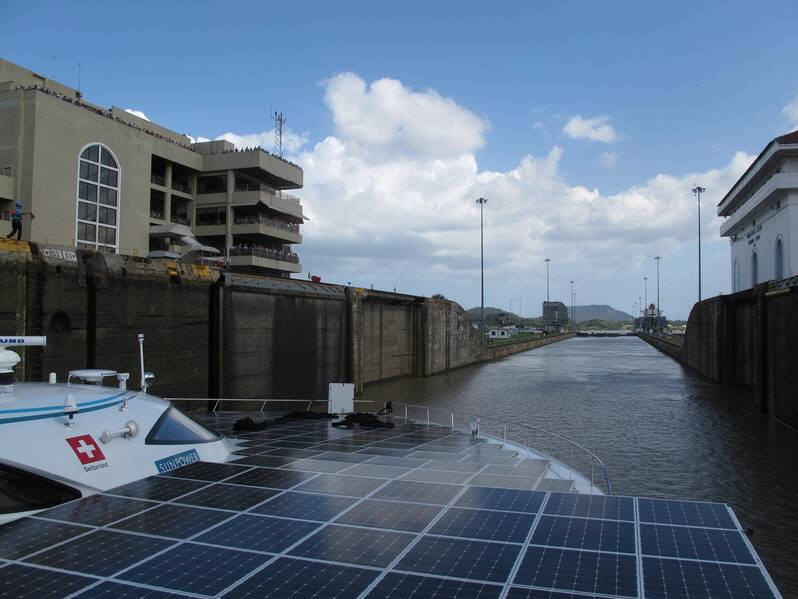
Planet Solar electric yacht navigating through the Panama Canal
My green bus conversion offers many opportunities for sponsorship. With slide out trays, I could probably fit $20,000 of solar panels on the roof, which would be enough to fully air condition the vehicle on a hot sunny day. For a large house, it might take $200,000 of solar panels to do the same, which is just too expensive for most to even consider. But if people could reduce their living space, all kinds of formerly cost prohibitive technologies become affordable. While $20,000 is still a lot of money, over time it’s not much, considering those solar panels will last for a quarter of a century. Electricity will cost a lot more then than now, so after inflation, the $20,000 really won’t seem like much. Right now I only have $1,000 worth of solar panels on the roof, due to budget constraints.
Buses routinely have billboards on their sides, so sponsors could show off their participation in return for their help. Such ads would help me spread the word as well, as they would draw attention to me and help me start conversations wherever I park.
When I downloaded the picture above of the Planet Solar craft navigating through the Panama Canal, I noticed the SunPower logo on the side. My friend Matt Campbell works at SunPower. Maybe he’ll introduce me to their sponsorship group? Are you reading this Matt?
Once I get sponsors, I would probably have to register my RTS as a commercial vehicle and begin paying commercial vehicle insurance rates. As a side note, I insure my RTS with Progressive Insurance, and I recommend this company.
I want to be perfectly clear that currently I accept no sponsorships and am not running any kind of a business with my RTS. Right now it’s my hobby with no business angle whatsoever. It actually costs me a lot, as you might well guess. Commercial insurance is expensive, so I would love to one day get an insurance company as a sponsor, so they could insure it as part of their sponsorship.
Why would an insurance company care? I suspect that solar panel insurance is going to be big business one day, as having tens of thousands of easily re-sellable and highly durable panels just sitting on a roof makes them a target for thieves.
With the right sponsors, I might one day even upgrade the vehicle drivetrain. It is a bit ridiculous to be advocating super green living while driving a vehicle that gets only 11 miles to the gallon on the freeway. It would be much better to use a modern electric drivetrain, from one of the innovative startups working hard on such things, such as Motiv Power Systems, which recently received a 7 figure government grant to develop electric power-trains for shuttle buses. These drivetrains are expensive for non transit system use, but with a sponsor they could be practical. If my green bus conversion were all electric, I could see getting featured on prime time network and cable television shows in every country I visit. I know the founders at Motiv Power Systems, and they are passionate about their dream to electrify transit buses. I’m not sure their drivetrains are suitable for intracity travel.
Once I tour Europe, I can then see touring Asia and the United States. I don’t plan to tour the US first as I’ve already driven across the US in my bus once, and the distances are so great I fear I would spend more time driving than speaking and showing, which I believe are key to changing perceptions about how much space is needed for a happy life. I also believe audiences in Europe and Asia will be more receptive to my ideas since their residents already live in smaller dwellings and pay much more for energy than residents do in the United States.
False 911 call apparently due to scratchy phone line at my house

ATT logo
I had a strange visit from the San Francisco Police Department today. The nice officer said she was replying to a 911 call from my land line phone. She said nobody spoke during the 911 call, but the dispatcher heard a scratchy noisy line. My phone line did have a loud scratchy hum on it the few times I tried to use it last week. I didn’t investigate at the time, as I had my cell phone and just used that instead.
I showed the officer around my room to convince her nothing was wrong, at her request. I told her about the scratchy line quality, but she didn’t ask to check it herself. She was quite pleasant and soon departed, but advised me to call ATT to find out what’s wrong.
I checked the line immediately, and it was still scratchy and noisy. I called ATT on that line, as it was still possible to speak and hear on the line. ATT said it was probably an issue on their end and advised sending a technician to investigate. They warned that if the problem was mine that they would charge me $55. I told them I wanted to do some more tests on my own before committing to a possible charge, and told them not to send a technician. I am glad I did, as I fixed the problem within minutes of ending that call.
I eliminated the scratchy line by removing from the circuit an adapter that converted 1 phone jack into 2 phone jacks! This adapter was plugged directly into the ATT access box in my inside garage. When I plugged my phone directly into the access box without the adapter, the line was suddenly ‘like new.’ Had ATT made that test, they would have likely charged me $55, because I don’t think anything was wrong with their circuitry.
I did a search online to see if a noisy line could trigger a call to 911, and I found accounts written by others that said that it could. I didn’t know that until today.
We have been experiencing intermittent high speed Internet service, also from ATT over the same wire pair my phone uses, so I hope that by removing the faulty adapter that our Internet connection stability improves.
Note that my phone number is listed in the telephone book, so I am easy to reach.
Solar electricity powered yacht circles the globe – features slide out solar panels like I plan for my bus conversion
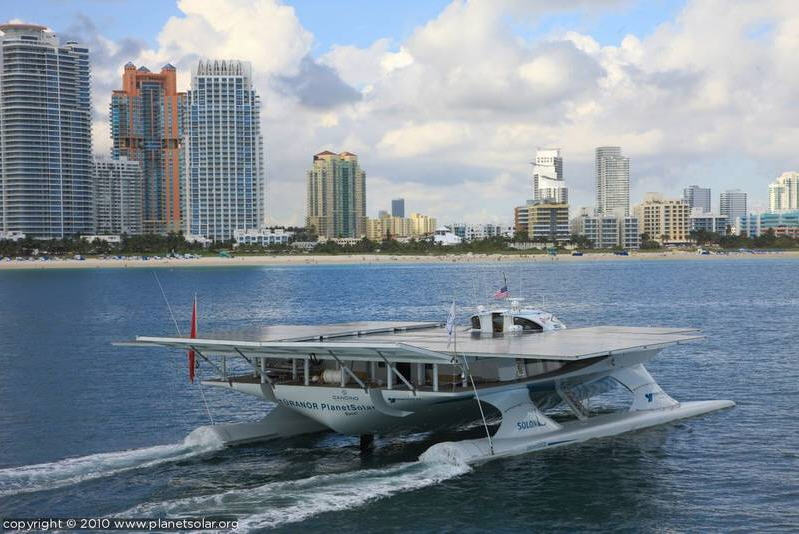
Planet Solar boat in Miami, Florida, USA
When I recently wrote about adding slide out solar panels to my bus I’m converting to a green home on wheels, I wondered if I was the first to think of putting solar panels on slide out roof panels on a bus conversion.
It seemed like such a simple idea that I couldn’t have been the first to think of it.
I still don’t know if I am, but I was excited this week to learn that someone has already built a solar powered yacht with slide out solar panels.
This yacht, named TÛRANOR PlanetSolar, is currently being piloted around the world, propelled exclusively by solar photovoltaic generated electricity.
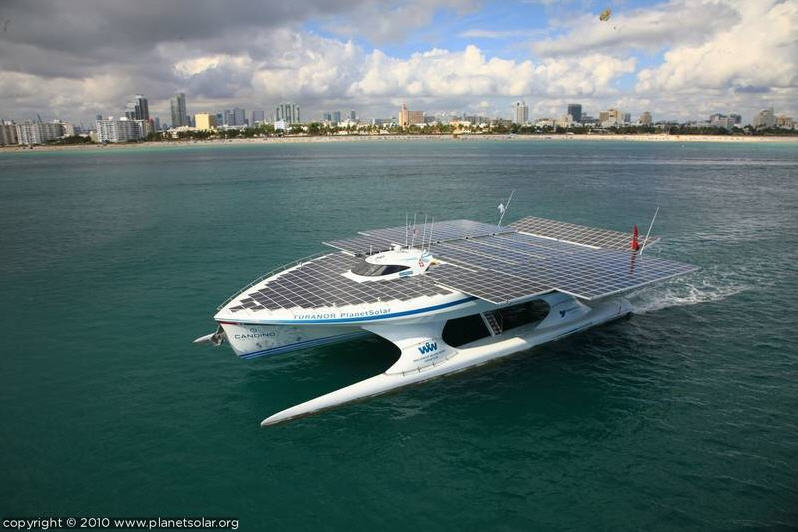
planet solar boat showing slide out solar panel 'wings'
The outbound ‘wings’ that hang over the sides of the vessel slide out to give more surface area for solar energy collection.
I plan to add similar but smaller wings to my RTS bus conversion.
Have a look at the planet solar website… it’s impressive. They have sponsors and issue press releases frequently. It’s inspirational to me.
Perhaps I can recruit sponsors to help me quickly finish my RTS bus conversion and circumnavigate the globe on land, spreading the word about how possible it is with current technology to live well while consuming far less energy.
Oakland, California tells Novella Carpenter she needs a permit to sell produce she grows at home

One of my heroes is Novella Carpenter, author of Farm City: The Education of an Urban Farmer.
Carpenter inspired me to start my own urban homestead in San Francisco, California, where I live.
Today Novella is getting significant press coverage because she got caught selling chard from her backyard garden. Here are links to a selection of the stories, which have generated hundreds of user comments hours after publication:
- Oakland gardener questions need for permit to sell produce
- Popular produce stand in West Oakland shuttered until farmer sorts out permit issue with city of Oakland
- City of Oakland fines urban homesteading author Novella Carpenter
- Yep, Novella Carpenter still needs a permit if she wants to sell produce from her garden
- Iconic urban farmer Novella Carpenter
- Oakland cracks down on Novella
I’ve met Carpenter at the Commonwealth Club of California, after I saw her speak there January 25, 2011.
Oakland, California is demanding Carpenter acquire a permit to sell products from her homestead. Apparently such permits cost a few thousand dollars.
Since Carpenter is famous and has zillions of supporters, I suspect she’ll come through this experience just fine. A permit costs money, but she can raise the money from her fans and then be compliant with the rules. The result will be more visitors to her vegetable stand because she’s getting a ton of great press right now.
I learned from the press coverage she’s now receiving that she paid just $30,000 for the vacant lot behind her apartment that she had been squatting on until recently. She received this favorable price because the owner wanted her to own the land. Doing this probably made the past owner feel good, and gave her some bragging rights that she enabled Carpenter to really get serious about her urban homestead.
I admire it when people get famous by doing something interesting and passionately writing about it.
In case you missed my post from January 25, 2011, here’s a clip of Carpenter speaking at the Commonwealth Club of California:
Carpenter teaches homesteading classes, including on how to raise dairy goats. I plan to take that one as soon as it’s offered again.
Anthem Blue Cross of California voice response system information leak?
I suspect there is an information privacy security hole in the voice response system for customer support at Anthem Blue Cross of California. I alerted them to my suspicion some months ago, and nobody followed up with me to reassure me that there is not a privacy leak.
As of today, April 1, 2011, the system still operates in the same way that provoked my suspicion. This post is not an April Fools joke… I am serious.
I need your help to verify if my suspicion is correct, and if you’re a health insurance customer of Anthem, you can provide this help to me in about 2 minutes.
Here’s the suspected Anthem Blue Cross of California privacy breach:
When one calls the US phone number (800) 333-0912, which is the ‘customer service’ number printed on my insurance card, a voice response system asks me to enter my social security number. After I do this, the system asks me my birthday, and then it gives instructions on how to enter this information on the telephone keypad. This would be fine except that the voice response system uses an example date that contains the exact year in which I was born.
Perhaps this is pure coincidence, but I doubt it, thus this post.
What I suspect is happening in their software that drives the voice response system is that it looks up the social security number and pulls the year of birth associated with that number and uses that year to compose the example language.
Why is this a potential problem?
It allows anyone with the social security number of an Anthem Blue Cross of California customer to quickly find out approximately how old that person is.
Since Anthem Blue Cross of California has millions of customers, this exposes a lot of ages.
How can you help me verify my suspicion?
If you’re a customer, call (800) 333-0912 or the number on your insurance card and key in your social security number, and listen to hear if the voice response system says the year of your birth. If it does, and the year is not my birth year, then there may be a widespread information leak.
Please take 2 minutes to help me out. You may leave a comment to tell me the results.
Thanks.
Dodo bird sculpted from a log with a chainsaw
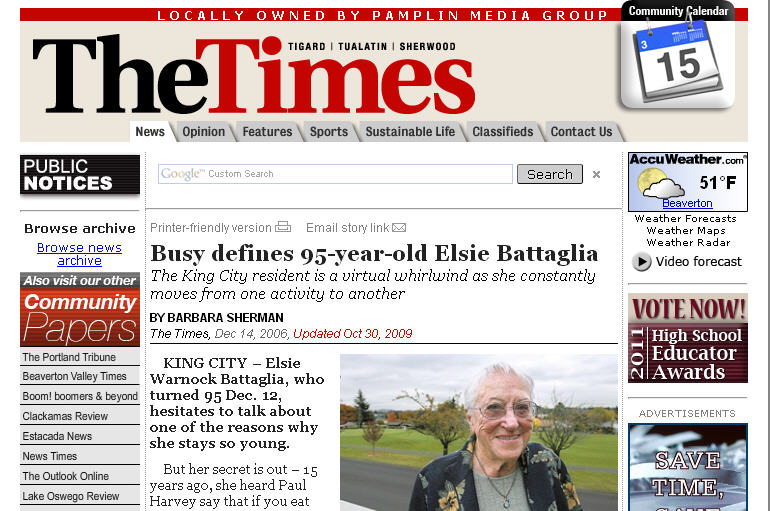
Elsie Battaglia in The Times, December 14, 2006
My grandmother Elsie Battaglia is 99 years old.
One of her prized possessions is the wood sculpture dodo bird pictured below. It was carved by a young man with a chainsaw perhaps 40 years ago. Grandma loves telling the story of how she knew of this young man for years, and how he had not been motivated much in life, and hadn’t accomplished anything noteworthy. Then one day, someone gave him a chainsaw and some logs, and he taught himself to produce sculptures. He went into business for himself and did a brisk business selling his creations.
This dodo bird means a lot to me because it’s one of the few items that Grandma took from house to house with her as she’s moved over the years. I remember it from when I was a young child.
This picture was taken on March 9, 2004 when Grandma lived part of the year at her house she then owned in Desert Hot Springs, California.
My Grandmother is slowing down, and she recently stopped exercising regularly at Curves, the health club chain. I believe she only joined as a member at about age 93 or so. Her friends would pick her up and take her to Curves since she chose to no longer drive a car some years back.
On a recent visit, I made copies of all her photo albums, some 16 gigabytes, and she gave me permission to post them. There are thousands of pictures going back decades, and I’m not yet sure how to approach this big project. Stay tuned.
My grandmother was on the Internet daily with WebTV in 1997, and thankfully I saved all of her emails. She only signed off permanently years later because she was getting too much spam to handle. WebTV was slow and cumbersome, and I can understand her frustration with all the unsolicited email.
I love my grandmother, and I’m going to visit her next month.
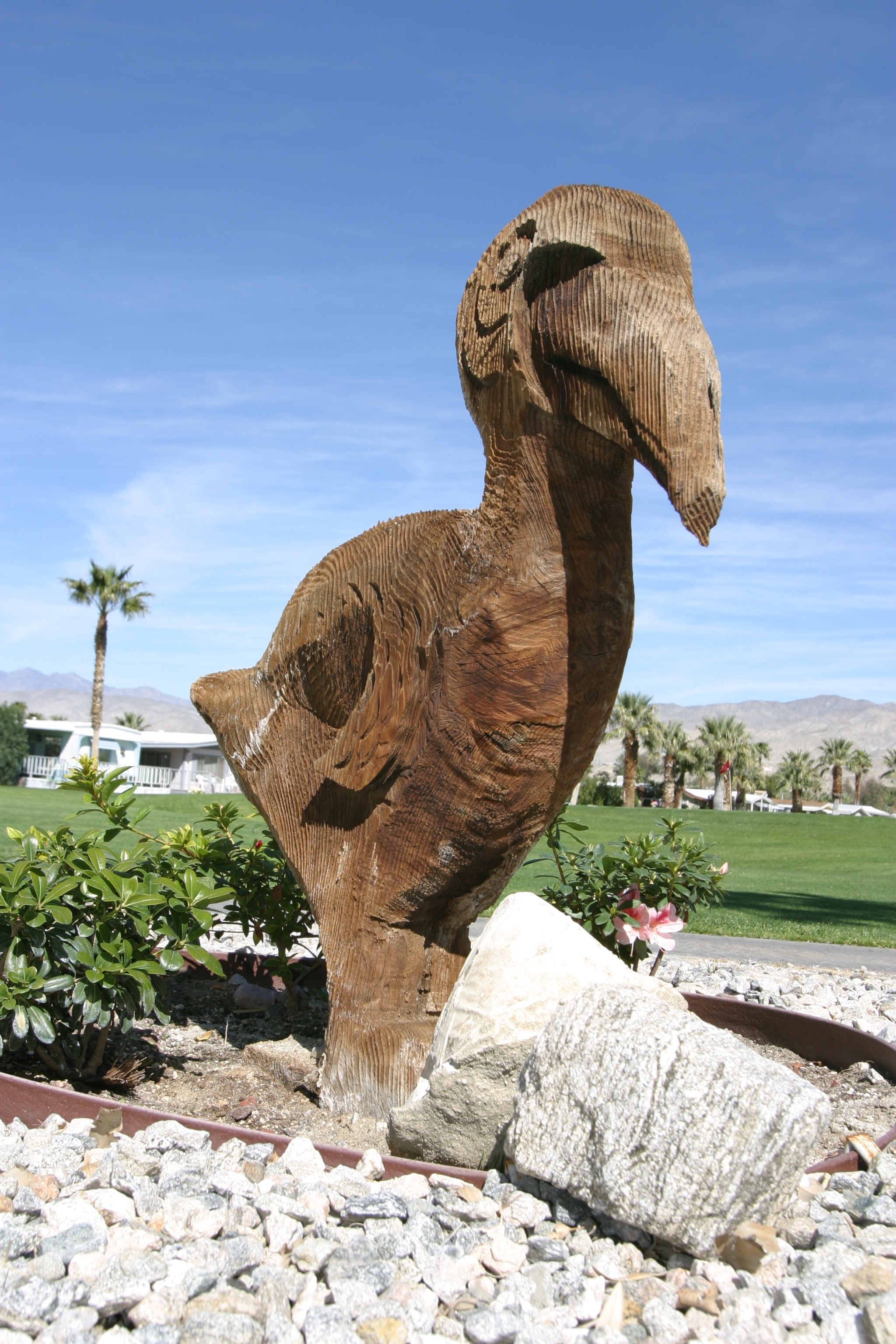
Kevin's grandmother's dodo bird
I cooked rabbit for the first time

Rabbits
I have ordered rabbit occasionally from restaurant menus. I’ve enjoyed eating rabbit, but I never have cooked it.
I shop for meat at Guerra Meats at 490 Taraval Street in San Francisco, California, where I live. This charming store was opened by Mark and Battista Guerra in 1954, and I often hear the butchers greet their customers by name.
On March 28, 2011 when I was shopping there for boneless chicken breast, I saw that a full rabbit only cost $1 more per pound. I purchased the rabbit and the butcher cut it up on a floor mounted serious looking band saw with no blade guard protecting the 12 inches of exposed blade. His fingers were quite close to that blade as he made about 10 cuts in short order. I cringed watching him work as I am so much more careful when working around power tools, and my neighbor told me a story only weeks ago where a butcher friend of his was cutting frozen meat on a band saw and cut a handful of fingers off and didn’t know it because his hands were so numb from the cold. His coworkers alerted him when they saw blood everywhere. Ouch!
Yesterday, March 29, 2011, I made two meals from the rabbit. I cut off about 4 ounces of meat and made one of my Chinese recipes, with snow peas, mushrooms, zuchinni, onions and red bell pepper. The result was delicious. Rabbit is close in taste to chicken. It’s a bit more substantial I found.
Later, I fried the remaining rabbit as if I were making fried chicken. This was even better than the Chinese dish. I found the rabbit to be more flavorful than chicken, so much so that it really was finger licking good. It was scrumptious.
Now I’m wondering if I could ever bring myself to raise rabbits for meat. The book Urban Homesteading that inspired me to try urban homesteading makes it sound easy. Rabbits are so cute and cuddly I don’t know if I could ever kill one to eat.
Have any of my readers killed a rabbit, duck, chicken or quail for food to eat personally? If so, please write a comment describing how it felt and how difficult it is.
Profile former pipe bending machine – I want one
I am continuing to work on my RTS bus conversion on weekends and in the evenings.
My current project is designing a sliding window shade that insulates the window when closed. Sadly, the RTS has single pane windows, and double pane windows are not available. For most conversions, one can buy factory new double pane replacement windows from Motion Windows. You send them a tracing of the original windows and they ship you a wooden crate with double pane windows that fit perfectly. That is possible because most buses used for conversions have flat glass in the side windows.
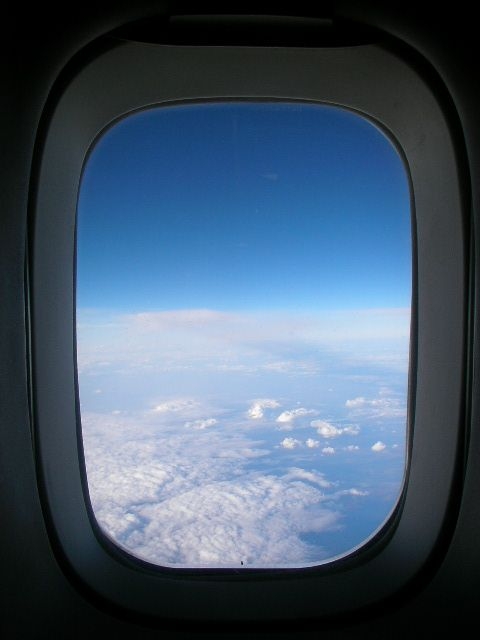
Airplane window. Photo by Hajime NAKANO.
But my RTS was designed by General Motors, and they wanted a curvy modern shape to the vehicle like a car would have. The glass panes are curved, and Motion Windows can’t make a double pane curved pane window.
As a result, I will make sliding window shades that fit in a track lined with wool felt. Passenger airline windows are the closest example of what I envision. When you raise the shade, the shade disappears up into the inside of the ceiling, so that most of the shade is parallel to the roof when raised.
I built a prototype some time back, and the idea worked, but the sliding of the shade was stiff, and it sometimes got stuck and needed to be lowered and raised again in one smooth action. The cause of this was the complete lack of suitable bearings on the shade, which was a piece of unmounted countertop Formica plastic laminate.
My new version uses Delrin ball roller bearings on the sides of a 1/32″ thick sheet of 5052 aluminum, which is bendable such that it can conform to the curve where the wall meets the ceiling.
I envision that the bearings will roll against 3/8″ square aluminum bar on the left and right of the shade, perpendicular to the floor. What’s been troubling me for a long while is how will I form the gentle yet variable radius bend into the aluminum so that I can install it. Today on YouTube I discovered the machine I need. I don’t know if TechShop has one of these, but if they don’t I suspect some machine shop in San Francisco has one and that I could have them bend the 20 pieces I’ll need to complete the shades. It would seem these could all be bent in an hour or three by someone who knows how to use the machine.
It may also be quite practical for me to simply build a wooden bending form that incorporates the varying curves I need, and just bend them with my own arms, as 3/8″ is not that thick. I suspect this is the way I’ll go. However, the machine I found is so impressive I wanted to write a post about it and show you the video.
I will insulate the aluminum shade with Reflectix brand reflective ‘bubble wrap’ style insulation. This insulation looks like bubble wrap sandwiched between two layers of aluminum foil. It’s very flexible, and the foil part is a plastic foil, not real aluminum foil, so it can be bent many times without cracking. Reflectix is also thin, so it will be able to glide up into the ceiling cavity without binding. This tight fitting shade with its Reflectix backing will probably insulate as well as the costly Motion Windows, and I get a built in window shade that should look high tech and sleek. My prototype certainly looked sleek, and I believe the improved aluminum version will be quite handsome. I’ll keep you posted on my progress.
Why not turn off electricity when smoke detector activates on a bus conversion?

Linear actuator
I’m in the middle of converting an RTS bus to a motorhome. I read Bus Conversions Magazine to learn construction techniques. The discussion forum hosted by Bus Conversions Magazine is outstanding, and I visit this forum daily.
Sadly, some bus conversions burn to the ground.
What a tragic event that would be if it happened to my bus conversion.
These things really represent a lot of work, and getting a check from the insurance company would still mean you’d have to duplicate a lot of work to make a new one. Yes, you could buy an already finished conversion, but there won’t be another conversion anywhere in the world like mine when I’m done with it, it’s going to be that unusual.
So I want to make it very unlikely my bus will ever burn to the ground. I’ve already talked about putting the generator on the roof in a previous post. That should help a lot since many bus fires start in the generator compartment, typically in a storage bay, and burn up from there. If any fire started on the roof, it would be hard for it to burn down, especially since the box I will put the engine in will be made of metal and lined with cement board and rock wool type insulation that can’t burn. I will also put auto closing trap doors on the air inlet and exhaust, so that if there’s a fire, oxygen to the box will be shut off in seconds, which should snuff out any fire almost immediately.
Another big source of bus conversion fires are electrical fires. To limit the chance of an electrical fire, I am not going to install many wires in the ceiling and exterior walls, which will be insulated with spray foam. Spray foam is highly flamable, and when it burns, it makes toxic gas that can kill you very quickly. So I will keep most of the wires I add inside metal conduit elsewhere that’s not close to spray foam.
The manufacturer of my RTS, TMC Corporation, ran several large bundles of wire in the ceiling, and these are required for the vehicle to run at all. There are perhaps 100 conductors, and it would be risky to try to make them longer so I could run them somewhere else, so I will leave them in place. However, I am looking into encapsulating them in a fire stop product.
The above precautions are straight forward. What I’m going to write about today is less straight forward, and I would like comments as to whether what I’ve dreamt up would be a good idea to implement.
I’m considering installing smoke detectors that include a relay to control unrelated circuits. If the alarm trips, a totally separate electrical circuit can be closed or opened, depending on how you wire the relay.
What I am thinking about doing is using the smoke detector to control a set of motorized linear actuators that would be installed next to and attached to the actuation paddle of each of the master circuit breakers and master battery disconect switches on board. When the actuator is engergized, and motor inside it turns some gears which cause a plunger to move in a straight line for x number of inches. When the polarity of the energizing power is reversed, the actuator plunger moves in reverse. In this way, formerly manually operated switches and circuit breakers are now electrically controllable.
My RTS before the conversion was started had 2 master battery disconnect switches, in the battery compartment. These switches take some effort to push, thus my selection of an actuator that can push or pull 100 pounds. I would not allow the actuators to operate these main vehicle power switches when the bus conversion engine is running, since it could be dangerous to shut down the engine while underway, even if there’s a fire on board somewhere.
My RTS after conversion will additionally have 3 master circuit breakers, as follows:
- AC shore power master breaker
- 24 volt house battery bank master breaker
- 12 volt house battery bank master breaker
If all 5 breakers were shut off in the event of fire, it would seem that an electrical fire might not get as far as if there were power flowing. What I don’t know though is if an electrical fire has caused enough smoke to trigger a smoke alarm, does that mean that even if the power is switched off that it will accelerate or continue burning?
Of course, it could be traumatic if you’re cooking dinner at night, set off a smoke alarm and are plummeted into darkness. But I almost always have my phone with me, and that doubles as a flashlight, so I’m not that worried about that. In addition, the System Sensor manufacturer of detectors I linked to above offers a model that has two degrees of alarm severity — smoke and heat. A local alarm is triggered with smoke alone and a general alarm is triggered when the built in heat sensor is activated. This might be the model to install in the kitchen/living room compartment of my 4 compartment bus conversion. Many of the System Sensor detectors run on 12 or 24 volts direct current, perfect for a bus conversion, and can be networked together so they all make noise when one activates.

System Sensor brand smoke and heat detector with external relay
Another downside is a small fire might be safely extinguished with a garden hose, which will need the pump active to pump water. But I would make it easy to reverse direction of the linear actuators so I could turn the power back on quickly, and I could have a dedicated circuit for the water pump that wouldn’t be shut off in the event of fire.
There probably is a good reason not to implement this idea, because if it was such a good idea, why isn’t it implemented widely in buildings? Linear actuators are cheap and plentiful, as are networked smoke detectors that can switch external circuits. If this idea were required by code, the price of these items would plummet, like what must have happened with ground fault circuit interrupters, which are so inexpensive I can hardly trust them, given how critical it is that they work for decades without attention.
However, there’s a chance this idea hasn’t been seriously considered and tested. I would love to start a debate in the comments here or on the Bus Conversions Magazine discussion forum, where my member name is ‘Kevin Warnock.’
PS – I want to express my condolences to Mike Sullivan, the CEO and President of Bus Conversions Magazine, who lost his Mother Dorothy Sullivan today.
