Three dimensional television is coming soon
I saw three dimensional television for the first time tonight. It’s a remarkably captivating experience. I don’t know if it will ever take off, but it sure made an impression on the audience at the Intel Capital CEO Summit today in Huntington Beach, CA.
Here is a video I shot of a 3D television camera. It looks very expensive, perhaps in the hundreds of thousands of dollars. The flat panel TV in the video costs $8,500.00. When you put on the 3D glasses, look at the flat panel, and move your hand toward the TV camera, it looks to you like your hand is coming out of the TV screen. It’s stunning.
MC Hammer at Intel Capital CEO Summit
For the second year, I got to meet MC Hammer at the Intel Capital CEO Summit. MC wasn’t performing this year, like he did last year. But he was actively asking questions and meeting people. He grilled Sprint CEO Dan Hesse about Sprint’s plans for WiMax 4G broadband wireless service. MC sat at my table at dinner tonight after one of my table mates invited him to sit with us. At the end of dinner, I asked MC if I could have a picture with him, and he agreed. MC is particularly interested in website metrics and analytics, judging from the questions I heard him asking.
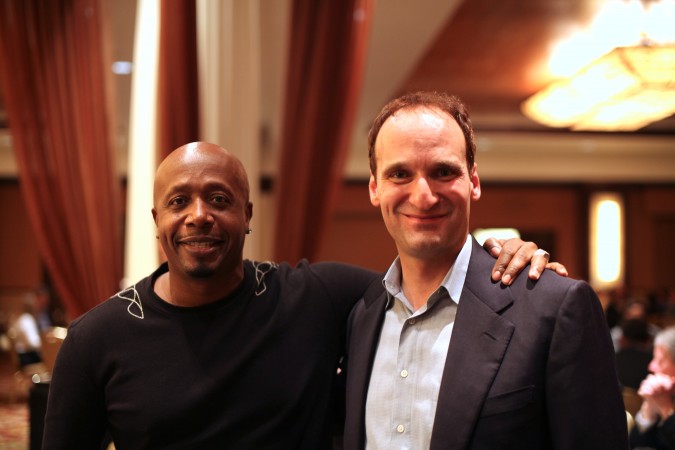
MC Hammer and Kevin Warnock at Intel Capital CEO Summit, 2009
Attending Intel Capital CEO Summit in Huntington Beach, CA
I am at the Hyatt Regency in Huntington Beach, California this week attending the tenth annual Intel Capital CEO Summit (http://www.intel.com/capital/entrepreneur/ceosummit.htm). The company behind my website gOffice is one of the 175 Intel Capital Portfolio Companies participating this year. The three day conference promises to be very exciting. At the conference last year I got to meet and talk with Intel CEO Paul Otellini and Intel Capital President Arvind Sodhani.

Hyatt Regency Huntington Beach, California, November 16, 2009
One of the high points at the conference last year, in San Francisco, was an appearance by the musician and entrepreneur MC Hammer. He spoke about his company DanceJam.com, which was acquired earlier this year. I got to meet Hammer the next day when I was getting a glass of water when he said “Hi Kevin.” I was startled. He was standing by the refreshment table in one of the session ballrooms, and I just happened to be there at the same time he was there, and he read my name from my badge. We had a nice conversation, and I commented on how well he speaks in public. He told me his other work as a minister helped him hone his speaking skills.
It turned out DanceJam was funded in part by Ron Conway, who invested in my first Internet company, Hotpaper.com, through his angel fund at the time. Ron was actually at the Intel summit last year as well, as a guest of Hammer.

Huntington City Beach, Huntington Beach, CA
UCSF Forest Remediation Plan

Forester Ray Morit explains University's proposed plan
I went on the walking tour today that University of California at San Francisco conducted to solicit community feedback about its plan to make its forested lands less prone to wildfire. The University had an actual Forester conduct the tour, and I feel I learned a lot. There were about 20 people there including the representatives from UC.
The information I was most surprised to learn is that when trees are cut down they will usually grow back if left unchecked. The regrowth can be stopped by applying a herbicide. We were told the herbicide can be applied with a paint brush or roller directly to the cut stump, and that only a cup of herbicide is enough to kill a stump about two feet across, which would be a large tree for this relatively young forest.
Here is a short video clip that I shot. It shows an example area on UCSF’s property that is already in the shape they plan to get the rest of their property in using in part the FEMA grant money they are applying to the United States Federal Government for. What I was impressed with is how good this area looks, and how safe it appears to me.
This clip is in true 1980 x 1020 high definition, and if you click on the Vimeo logo on the video above, you will be taken to Vimeo.com, which handles the video display on this blog. In the lower right corner of the Vimeo page that displays this video, there is a link where you can download the full resolution HD file, which is 316 megabytes. If you save it on your computer, you can just click on the file and watch the full HD version, which shows much more detail than the 1280 x 768 version you see here on this blog page. In any event, be sure to watch this video full screen, which you can enter by clicking the icon that looks sort of like a capital X in the lower right corner of the video player window.
Mobile Phone Rate Arbitrage Using Free Mobile To Mobile Minutes
About two months ago I came up with the following idea to lower mobile phone bills.
In the United States it’s common to select a cell phone rate plan based on the number of ‘anytime minutes’ which are typically weekday daytime minutes. If you go over your allocation, the extra minutes are quite costly, and one can rack up a really big bill of hundreds of dollars if one is not careful.
Many carriers in the US offer free mobile-to-mobile minutes, where callers on that carrier can call all other mobile phones on that carrier without using up anytime minutes.
My idea is to modify a mobile phone so that it can be connected to an unmetered conventional or VOIP phone line. The phone could be programmed to answer calls, give the caller a dial tone so they could type a phone number and then dial that number over the landline or VOIP phone line. Once the called party picks up, the calls would be conferenced together, and the mobile caller could talk with the remote party for free forever, no matter the day or time of week.
Think of this as similar to a calling card, but with a cap on the charges. For example, a Vonage line is $24.95 a month and an extra mobile phone line through AT&T is $9.95 a month, plus taxes and service charges, for a total of about $20 a month. So, for $44.95, one could have unlimited anytime minutes on a cell phone. The carriers charge much more, about $99.95 a month per phone, without the taxes and charges included. Those charges probably push the total to $125 a month.
The cost savings of my idea are even more substantial if a family has several phones, as one modified phone could serve multiple phones out in the world. If the modified phone is busy, the caller can hang up and dial directly, using up plan anytime minutes. But a lot of the time, the modified phone would be available to cut minute usage.
The called parties would see the caller ID value of the conventional or VOIP phone line, not the number of the phone in the hands of the caller. This might be an advantage, since conventional and VOIP lines support name display as well as number display. There might be a software solution to this issue, to optionally allow the originating cell number to carry through to the called party instead.
This cell phone arbitrage might be possible with just a software application on a fully open phone platform. I could see software being written that would answer calls only from pre-programmed numbers, and then use a VOIP application on the same phone to place the outbound call. If the phone is left at home or at the office where there is WiFi, the VOIP call can go out over the WiFi connection.
I suspect there are no mobile phone platforms out there today that are open enough to permit this. It just seems unlikely an application can be written to answer the phone automatically and verify the user is authorized before placing an outbound call. But I suspect there are development cell phone platforms available that are fully programmable. I would imagine these being used by companies for example building home automation systems where the homeowner might want to call in to turn on the air conditioner via the mobile network.
Mobile carriers could block my arbitrage idea by requiring phones to be moved regularly. If they sensed one phone was being used in one place all the time, they could discontinue free mobile-to-mobile minutes for that phone, ruining the cost advantage.
The rate arbitrage works for receiving calls as well. Just ask your contacts to call the conventional or VOIP number instead of your actual cell number. The modified phone could be programmed to answer inbound calls from the conventional or VOIP line and then dial your cell phone out in the world using the modified cell phone to carry the call. Then, when you pick up, the two calls are conferenced together. If the modified phone is in use, the inbound call goes straight to voicemail. Sadly, I see no way for call waiting to be implemented, unfortunately, unless two modified cell phones were used. Then the second modified phone could be used to place another call to you in the world, and the call waiting feature on that phone would activate and you could toggle the two calls. The two modified phones could collaborate via WiFi with each other.
The advantage to running most calls in and out of a conventional or VOIP line is that that line can also be used conventionally when one is near that line physically. It could be a normal home or office line.
I like this rate arbitrage idea, but I have no plans to pursue it. I don’t know enough about phones to attempt it, and I think this idea will have a lifespan measured in just a few years. I think all mobile phones are headed towards unlimited pricing that’s affordable. Once that happens, there will be less reason to work with extra phones. However, I would like to see a discussion develop about this idea, and I’m open to working on this idea if it can be shown to be long lived.
Method to reduce speeding
On November 9, 2009 a driver of a large freight truck plunged off the roadway of the Oakland-San Francisco Bay Bridge and died. According to news reports, he was driving ten miles over the posted speed limit. There has been discussion in the media about how to slow drivers down before they get to the tricky new S curve on the bridge, which was installed recently as part of the big project to replace the bridge with a more earthquake resistant version.
I thought of an idea that might help slow people down a lot.
Many bridge commuters carry so-called FasTrac electronic toll passes. These passes charge the users’ accounts when they pass through a toll booth.
My idea is to put sets of FasTrac sensors on the section of the bridge where the speed limit is reduced due to the S curve.
The first sensor would capture the ID of the FasTrac device. The second sensor would capture the ID and calculate how long it had been since that same ID had been captured by the first sensor. If the time interval was short enough to prove speeding, the account holder would be charged a speeding fine immediately and the device would beep to tell the user their account had been hit. A sign on the bridge could advertise the size of the potential fine to discourage speeding. The fine could increase each time the account holder violated the speed limit. An email copy of each FasTrac speeding ticket could be sent to the account holder to further prod drivers to slow down.
My idea does not require extra police patrols, and would help slow drivers down at all hours. The tragic truck accident happened around 3 in the morning, when few police patrols are practical.
While my idea may raise legal issues, I think it has the chance to save lives at relatively low cost. It would certainly get a lot of publicity as people debate the idea of immediate fines the driver learns about instantly. In Europe I understand that traffic cameras identify speeders, but the drivers learn about their infractions days later by postal mail. I think if a driver knows they will definitely get a ticket every time they speed on the bridge, their speed will drop dramatically and with more assurance than any other method I’ve heard of.
Yes, drivers can put their FasTrac device in a special bag to avoid detection, but the act of taking the device off of the windshield and hiding it may be enough to remind drivers they could fly off the bridge if they drive too fast.
Woodside Priory School Show and Dinner
My wife Monika went to high school at Woodside Priory School in Portola Valley, California. Her biology teacher Father Maurus Nemeth, a Hungarian monk, officiated at my wedding to Monika. Tonight Monika, her parents, brother and sister went to a fundraising show and dinner at The Priory.
I can’t remember the name of the piano player, but he was interesting, so I shot a video of one of the pieces he played, above.

Woodside Priory dinner November 7, 2009
Haas Gala at The Palace in San Francisco

Haas Gala November 6, 2009, The Palace Hotel, San Francisco, CA
Tonight I attended the Haas Gala at the Palace Hotel in San Francisco. Haas is the graduate school of business at the University of California at Berkeley. This year there were 650 people in attendance at the sold out event. Among the awards presented was the Lifetime Achievement award, this year given to Richard C. Blum, MBA ’59. Blum is Chair and CEO of Blum Capital Partners and is also the husband of United States Senator Dianne Feinstein. I got to meet Richard after his remarks. I missed the gala last year, where Shantanu Narayen was awarded the Lifetime Achievement Award. I met Shantanu at Haas in about 2005. He made my day because he said he had used my website gOffice.com.
The highlight of the gala this year was getting to see Haas Professor Oliver Williamson speak. Professor Williamson recently won the Nobel prize in Economics. I shot video of Professor Williamson’s remarks, shown above.
My friends Enlai Chu, Michael Berolzheimer, Jerry Engel, David Charron and Nibha Aggarwal were also at the Gala, and it was good to see them. Michael is leading the Haas Entrepreneurs alumni Special Interest Group.
I shot video of Richard’s acceptance speech. His biography from the gala program is interesting, so I’m retyping it here:
Richard C. Blum received his BS in Business Administration in 1958 and and MBA in 1959 from the University of California, Berkeley. He is widely respected for his ability to produce dramatic results, and focuses his considerable energy on big challenges that range from turning around troubled corporations to alleviating global poverty.
Dick is a strong business leader who brings innovation to every venture he tackles. He is Chairman and CEO of Blum Capital Partners, a private equity firm he founded in 1975. He is also Co-Chairman of TPG Capital, Co-Founder of Newbridge Capital (now part of TPG Capital), and Chairman of the Board of CB Richard Ellis Group, Inc. He is also a director of Fairmont Raffles Holding International, Current Media, LLC and Myer Pty. Ltd.
Active in a number of nonprofit organizations, Dick is heralded as a philanthropist of enormous vision. He is Founder and Chairman of the American Himalayan Foundation (AHF), established 25 years ago to help the people and ecology of the Himalaya. In 2006, he provided the seed funding to create the Blum Center for Developing Economies at UC Berkeley, which implements scalable technologies to improve the well-being of people in need, while educating and inspiring students as a new generation of global citizens. He also founded the Global Economy and Development Center at the Brookings Institution and the Brookings Blum Roundtable Conference to develop policy research strategy.
Dick is the former Chairman of the University of California Board of Regents and now serves as a Regent. He has played a pivotal role as a member of the Haas School Board since 1984. He is also a trustee and a member of the executive committee of The Carter Center, and on the boards of The Wilderness Society and The California Academy of Sciences.
He received the Haas School of Business Alumnus of the Year Award in 1994 and was recently honored with the Berkeley Medal by Chancellor Robert Birgeneau in the presence of His Holiness the 14th Dalai Lama. Dick is married to United States Senator Dianne Feinstein.
After cocktails but before dinner a band came on stage for few minutes to entertain the guests.
Pumpkin shopping in San Francisco
My wife Monika and I went pumpkin shopping today at 7th Avenue and Lawton Avenue.
I took a lot of pictures of the scarecrows, which were all different. I thought they were all handmade by children, but Monika tells me that the art supply store named Michaels sells scarecrows just like these. Here is a link to my shots on Flickr. I uploaded them at very high resolution, and I shot them at f 1.4 for very shallow depth of field.
San Francisco is beautiful
I am going to start posting video of San Francisco. When you live here it’s easy to overlook the beauty of the place. So I’m going to start taking my camera with me on routine errands to capture everyday life in the City.
This first video is taken in Yerba Buena Gardens, which is a block sized area that begins at 4th Street and Mission Streets. It’s right next to Moscone Center, the City’s largest convention center, and where Oracle World is going on starting tomorrow.
The website for Yerba Buena Gardens is yerbabuenagardens.com
One of the fun things to do at Yerba Buena Gardens is to ride the historic merry-go-round. This ride was saved from the famous old San Francisco amusement park called Playland at the Beach. It’s been restored so well you would think it’s almost new. I bought a ticket and took a ride just to make an interesting video. You can read about Playland at the Beach on wikipedia.
Finally, here’s a video of the waterfall close up. It’s a huge waterfall, half a city block long. This is just a section of it, and I don’t move around, so you can just admire the beauty and sound of the running water.
