Memorial service for Lee Frederic Benton, October 6, 2012
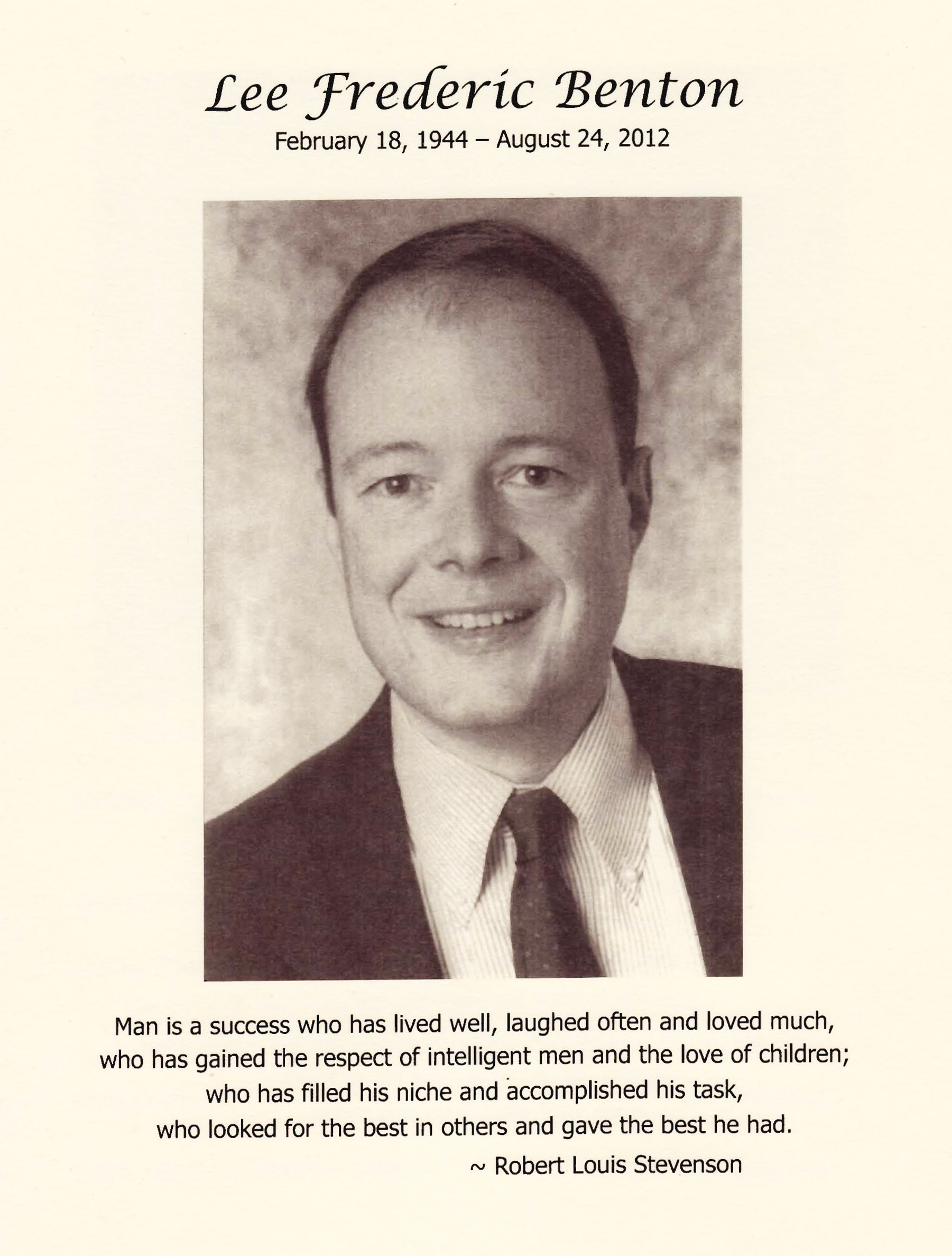
Cover of the program for the memorial service for Lee Benton, October 6, 2012
My birthday was yesterday, October 6, 2012.
I will long remember this birthday because I attended the memorial service for Lee Frederic Benton, held at Holy Trinity Church, 330 Ravenswood Avenue, Menlo Park, California, USA.
Benton was born February 18, 1944 and passed away unexpectedly August 24, 2012.
I did not know Mr. Benton well, but he played a major part in my life. I was able in 2007 to tell him the facts that lead to this conclusion, but, sadly, I don’t believe I thanked him for his pivotal contribution to my success in life. Thank you Lee Benton.
In about 1991 I went to the offices of Analytic Legal Programs, Inc., founded by Eric Little. Analytic Legal Programs made a document assembly software program called WorkForm. At the time, I worked at Cooley, LLP, then named Cooley Godward Castro Huddleson & Tatum. Cooley had purchased a firm wide license for WorkForm, and had asked me to lead the project. Associate attorney Jeff Zimman was to program the first set of documents, a set of 17 documents to incorporate a company in California.
Since neither of us knew the WorkForm software, we both attended a several day training session at the offices of Analytic Legal Programs in Palo Alto, California USA.
Zimman left a voice mail for Benton during our training, and the subject was Zimman’s compensation at Cooley. From that I have guessed Benton supervised Zimman, and gave Zimman his assignments. I have further guessed that Benton authorized Zimman to spend the hundreds of non-billable hours that he would eventually dedicate to the document assembly project. Without Zimman, there would have been no document assembly project, because Zimman was the only attorney at Cooley that showed any interest in document assembly back then. Without Benton letting Zimman stop billing hours to clients for a time, there also would have been no document assembly at Cooley. As a result, without Benton, I would have never become an expert at document assembly, and I would thus have not started Hotpaper.com, Inc., the first Internet document assembly platform, in 1995. Had I not started Hotpaper, I would not have sold it in 2000, and I would not have been able to buy the house I am typing this post in, or to live my life I treasure so much that I write about on this blog.
Starting an Internet company that gets acquired is very difficult. I needed every advantage along the way to get to where I am today, and Lee Benton gave me a huge advantage. He freed up hundreds of hours of time of a rising star attorney, which ended up launching my career in high technology. I simply don’t think I would have gotten into the Internet business had it not been for Lee Benton and Jeff Zimman.
When I was at Cooley, Benton had not yet led the entire firm, but I knew that he would, because Helen Gaffney, since passed, told me so. Gaffney ran the firm’s Information Technology infrastructure at the time she said this, about half a decade before Benton became Managing Partner, the title the firm then used for its top leader. The firm now uses the title CEO for its top leader, and I learned yesterday that Cooley’s current CEO Joe Conroy, joined Cooley while Benton was Managing Partner, and that Conroy greatly admired Benton. Conroy attended Benton’s memorial yesterday, but I did not see him.
Lee Benton’s memorial service was very touching to me. I recognized some of the attorneys that were at Cooley when I left in 1994, including Frederick Baron, Pam Martinson, Alan Mendelson, Gordon Atkinson, Kenn Geurnsey, Paul Renne, James Gaither, Craig Dauchy and my own current attorney Eric Jensen. That this group attended was amazing to me, because I actually received material help on my project in the 1990s from Baron, Martinson, Mendelson, Guernsey, Renne and Jensen. I hadn’t seen Martinson, Dauchy, Atkinson or Gaither since 1994, but I recognized all of them, and they appeared to recognize and remember me when I greeted them. Sadly, Martinson and Mendelson left before I got to say hello to them. I most recently saw Mendelson by chance at Nordstrom in 2008 when I was trying on tuxedos for my wedding.
My friend Tom Kintner was also there, and I learned Kintner worked with Benton and others on the USD $621 book Venture Capital & Public Offering Negotiation. ‘This book is the leading authority on the legal aspects of venture capital funds and of private financing and initial public offerings for technology companies,’ per Cooley’s website. I have known Kintner for over a decade, and I never knew he knew Lee Benton until yesterday.
When I said hello to Paul Renne, I had the great pleasure of meeting his wife, former San Francisco City Attorney Louise Renne.
Benton was revered when I was at Cooley, and although I only spoke with him perhaps half a dozen times in the five years I worked at Cooley, I always knew he was extremely influential. I once had to modify the California Incorporation document set to incorporate his changes, and I vividly remember thinking at the time that they were the most impressive set of edits I had yet seen from any attorney. Even though I am not and have never been an attorney, I had by then developed an ability to identify precise and impressive edits, and Benton’s were outstanding. His dozens of edits made the documents more conclusive without being stern.
Frederick Baron spoke at the memorial. His written remarks were poignant and lovely — so much so that I suggested he post them online for posterity. If he finds this post and thinks this is a suitable place for his remarks to live on, I invite him to forward them to me for incorporation into this post, which I am happy to revise.
One of the stories Baron relayed was so sweet that I am going to relay it here.
Baron told the story of how he arrived at Cooley. He moved to the San Francisco Bay Area and knew of Lee Benton’s stature. He heard Cooley had just opened an office in Palo Alto, its first branch office. The firm was founded in San Francisco. Lee Benton was part of the first group of Cooley attorneys that opened the Palo Alto office. Baron applied to Cooley and got an interview with Benton himself. The story takes a charming turn when Baron told us yesterday that his son, age 4 at the time, rode in a car pool to school starting the day before Baron’s interview with Benton. Using more descriptive language than I will here, Baron described his 4 year old son as a boisterous handful. Baron was alarmed when he learned the night before his big interview with Benton that the driver of his child’s car pool was Lee Benton himself.
As you can guess, the interview went well and Baron was hired despite his fears that his rambunctious son might have harmed his chances. Frederick Baron went on to lead a department for decades.
Baron and Benton and their wives all became dear friends.
One of Lee Benton’s clients, Bob Plaschke, also spoke. He told a series of stories that elicited hearty laughs from the audience. He also spoke affectionately about Benton’s laugh, which he described as infectious, distinctive and highly memorable. I never heard Benton laugh because in total I probably spent no more than 30 minutes speaking with him, the most recent 10 minutes at a party at Cooley in 2007, when I got to have a very nice conversation with him despite the absence of laughing.
Plaschke told a great story about when one of his companies was doing a closing for a transaction. The closing happened on a weekend, and Benton dropped by the Cooley office where other attorneys were completing the work. However, Benton wanted to pitch in and help, and he asked a young associate how he could contribute. Plaschke said this young female associate tried meekly to decline Benton’s offer, but Benton persisted. Finally, using her hands that were trembling with fear, she handed a document she had written to Benton and asked him if he would review it for her. Benton enthusiastically attacked the document with his red pen, and when complete, there was red ink on every line of the four pages. Plaschke said Benton was so pleased to be able to help, and that he saw Benton commend the young associate on how well she had handled the delicate representations and warranties section.
This is such touching story for me, so much that it brought tears to my eyes as I wrote it. Benton clearly didn’t even need to be at the office for the closing, since there were others there already handing things. But Benton cared for his client’s interests, and wanted to make sure things were OK. He insisted on helping, and used the opportunity to do well for his client and to help train a young attorney, who no doubt remembers that weekend encounter with Benton.
We are all here on Earth for such a short time. How well we treat others defines how we will be remembered. How we treat those far below us in rank particularly defines how we will be remembered. All of the speakers yesterday conveyed that Lee Benton was an exceptionally kind, humble and conscientious man. He got a lot done in life while warming the hearts of those around him. Many others get a lot done while trampling over people without remorse. I consider Lee’s approach by far to be the gold standard for how to live.
Thank you Lee Benton for all that you accomplished and all the love that you extended during your exceptional time on Earth.
Here is the obituary for Lee Frederic Benton, as published in the San Francisco Chronicle newspaper on September 9, 2012:
Lee Frederic Benton
Lee Benton passed away in Palo Alto on August 24, 2012 at the age of 68 due to complications following surgery.
Born on February 18, 1944 in Springfield, Ohio, Lee was the son of the late Robert and Candice Collins Benton. He was a graduate of Oberlin College and received his J.D. from The University of Chicago, where he served as the Executive Editor of The University of Chicago Law Review. Lee was a teaching fellow at Stanford Law School before joining the San Francisco office of Cooley, LLP in 1970.
Lee was a founder of Cooley’s Palo Alto office in 1980 and was managing partner from 1996 to 2001. He was a partner at the firm from 1975 until 2006 and then served as senior counsel. During his distinguished legal career he focused on the formation, financing and growth of high technology companies. While at Cooley he also served as general counsel and a member of the senior management teams of two publicly traded technology companies.
In addition to being an accomplished practitioner, he was a dedicated mentor to a generation of lawyers who value his legacy. Reflecting on what Lee stood for in his life and work, one colleague wrote, “success does not have to come at the expense of decency and humanity or be coupled with the sacrifice of principle or soul.”
Lee was a deeply thoughtful, kind, and caring man. In recent years he faced several health challenges with an indomitable spirit. Drawing from these experiences and the expertise he acquired, he was tireless in extending his help to individuals and institutions. He served on the Board of Directors of the National Headache Foundation, as a Strategic Advisor to the California Institute for Quantitative Biosciences (QB3).
He took great pleasure in his unique array of hobbies. Some of his extensive collections and research included commercial aviation, single malt scotch, classical music, and country music. He was, as well, an avid and vocal follower of sports and politics.
Lee was a loving husband and father and is survived by his wife Susan, sons Timothy and Matthew, brothers Marc (wife Trish) and Bruce (wife Andrea), and brother-in-law David Wann.
On Saturday, October 6 at 1:00 pm, a memorial service to celebrate Lee’s life will be held at Trinity Church, 330 Ravenswood Ave., Menlo Park. For contributions in his memory, the family suggests the National Headache Foundation, 820 N. Orleans, Suite 411, Chicago, IL 60610.
Here is the August 27, 2012 press release from Cooley’s website:
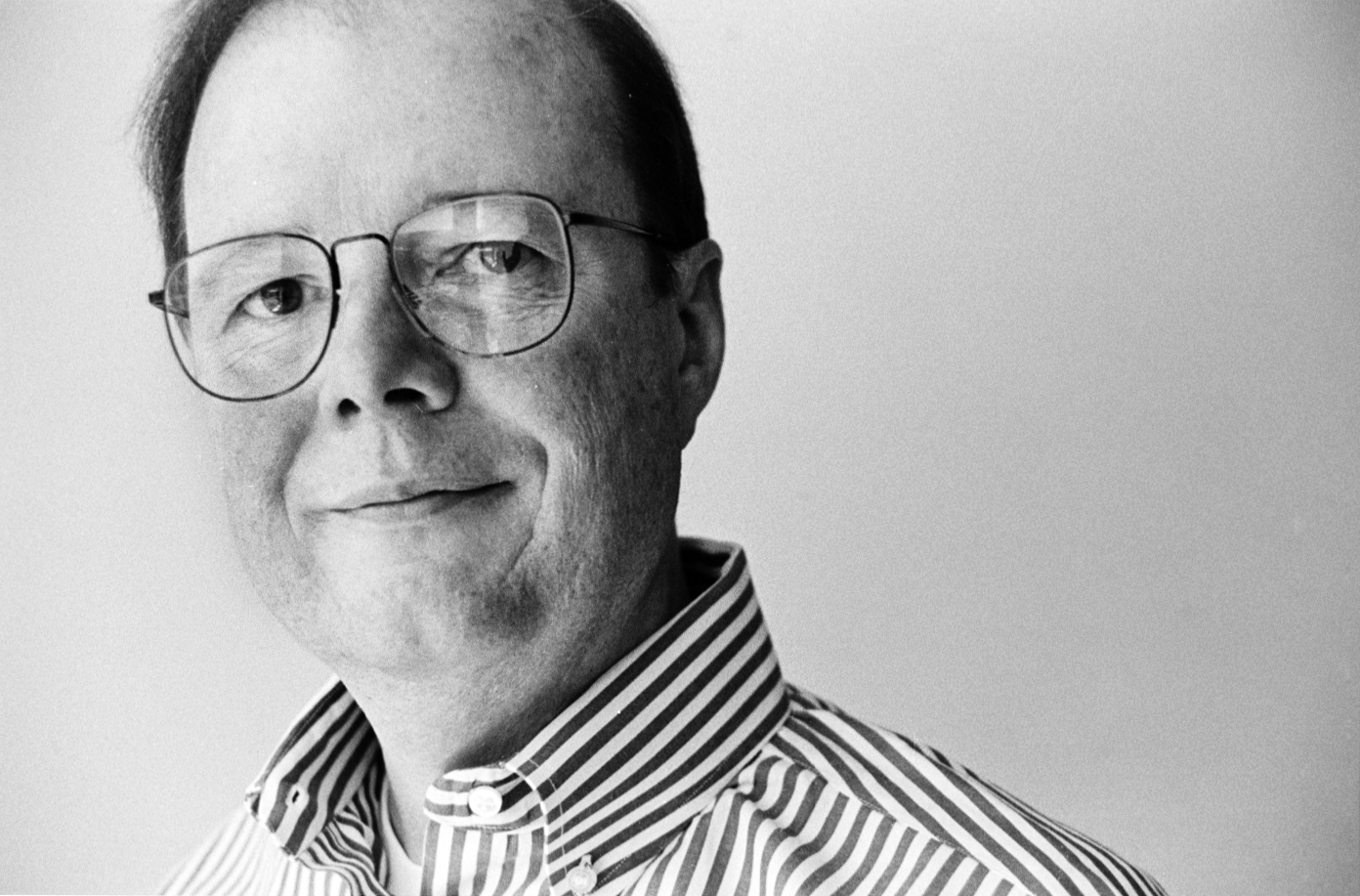
Lee Benton - Photo by Julie Stupsker, July 17, 1996
We are saddened to announce that Cooley former Managing Partner and long-time colleague Lee F. Benton passed away last week.
Lee began his career at Cooley in 1970, and was a partner of the firm for more than 30 years. He served as Chair of the Business Department from 1994 to 1996, and was the Managing Partner of Cooley from 1996 to 2001. At the time of his death, Lee was Senior Counsel to the firm.
In addition to his formal leadership roles, Lee played a significant part in establishing Cooley as one of Silicon Valley’s most respected and important law firms. Lee was among the first of our lawyers to move from San Francisco to Palo Alto to open our first office there in 1980.
Lee was a brilliant practitioner and a highly regarded speaker on the topics of securities law, venture capital, mergers and acquisitions and strategic partnering. He took immense pride in his work and was a great teacher of generations of Cooley lawyers. He devoted himself to the success of his clients, even serving as general counsel and a member of the senior management teams of two publicly traded technology companies. Lee also served on a volunteer basis as Strategic Advisor to the California Institute for Quantitative Biosciences (QB3) and on the Boards of Directors of Sonim Technologies, Inc. and the National Headache Foundation.
Lee was truly instrumental in building the firm we are today. His legacy will be a lasting one and he will be deeply missed.
Our thoughts and prayers are with his wife Susan and their family during this difficult time.
Here is Lee Benton’s biography from Cooley’s website, as of October 7, 2012
Lee F. Benton was a partner in the firm from 1975 until 2006, and then served as senior counsel in the Securities Regulation group until his death in 2012. He was the managing partner of the firm from 1996 to 2001 and chair of the firm’s business department from 1994 to 1996. He commenced his career in Cooley’s San Francisco office in 1970 and founded the firm’s Palo Alto office in 1980. He is listed in The Best Lawyers in America, in “The Best Lawyers in Silicon Valley” in San Jose Magazine, in Marquis Who’s Who in America and in Madison Who’s Who in the World.
Mr. Benton’s practice encompassed a broad spectrum of fields related to the formation, financing and growth of high technology companies. He represented high technology firms from their inception through maturity as publicly-traded corporations. Mr. Benton also represented a large number of venture capital firms. His particular areas of expertise included strategic partnerships, equity incentives, initial public offerings, securities law, mergers and acquisitions, and cross-border transactions.
While at the Firm, Mr. Benton also served as general counsel and a member of the senior management teams of two publicly-traded technology companies.
Mr. Benton was the executive editor of The University of Chicago Law Review from 1968 to 1969 and a teaching fellow at Stanford Law School from 1969 to 1970. Mr. Benton authored numerous articles and lectured extensively for the Practicing Law Institute, California Continuing Education of the Bar and Aspen Law and Business Inc. His topics included securities law, venture capital, M&A and strategic partnering. He is a co-editor and co-author of Venture Capital and Public Offering Negotiation (Aspen Law and Business, Inc., 2002). This book is the leading authority on the legal aspects of venture capital funds and of private financing and initial public offerings for technology companies.
Mr. Benton served on a volunteer basis as a strategic advisor to the California Institute for Quantitative Biosciences (QB3) and on the boards of directors of Sonim Technologies, Inc. and the National Headache Foundation.
Education
- University of Chicago Law School
JD, 1969, Order of the Coif - Oberlin College
BA Government, 1966, magna cum laude
Admissions
- California
Memberships
- American Bar Association
Here is Lee Benton’s obituary published August 28, 2012 in The Recorder newspaper (link):
SAN FRANCISCO — Lee Benton, a former managing partner of Cooley during the heady years of the dot-com boom, died Friday due to complications following surgery. He was 68.
Benton had been with the firm for more than 30 years and held several top leadership positions. He chaired Cooley’s business department from 1994 to 1996 and served as managing partner from 1996 to 2001. He was senior counsel at the time of his death.
Benton was a dedicated, meticulous and well-respected attorney who played a key role in establishing and building Cooley’s presence and reputation in Silicon Valley, long-time colleagues said. He was among the first group of lawyers who relocated from San Francisco to open the firm’s first Palo Alto office in 1980.
“He really is one of a handful of people who reshaped our firm into what it is today,” said Frederick Muto, chair of Cooley’s business department who’s been with the firm since 1980. “He helped establish us as one of the Valley’s most important law firms. And he was just a great lawyer and a terrific mentor.”
Benton, who helped take Genentech Inc. public in 1980, was considered an expert on securities law, venture capital, mergers and acquisitions and strategic partnering. Thirty years ago, he co-authored a groundbreaking treatise on the legal framework for venture capital financing that’s still used today, colleagues said.
“He was regarded as truly a lawyer’s lawyer,” said Cooley litigation partner Frederick Baron. “He was puckish and brilliant. He was a person of tremendous attention to detail, and clients loved the fact that he turned over every stone to identify and minimize every conceivable risk.”
He was also fiercely committed to helping Cooley grow. As head of the business department and managing partner of the firm, Benton not only helped it become a major player in Silicon Valley. His leadership also helped the firm weather the tough times after the dot-com bubble burst and several high-profile attorneys departed, said James Fulton Jr., co-chair of Cooley’s clean energy and technologies group.
Benton was devoted to both clients and colleagues alike, Fulton said. He was one of the first lawyers at Cooley to take a leave of absence to serve as a general counsel to his clients, such as Santa Clara-based Ungermann-Bass, one of the earliest large computer networking companies.
“He was a beloved counselor,” Fulton said. “People didn’t come to Lee time and again just because he was a good lawyer. So many people who worked with him were personally touched by him. There was his willingness and ability to mentor, on nights, weekends.”
And Benton always made time to help young lawyers, said Wilmer Cutler Pickering Hale and Dorr corporate partner Daniel Zimmermann. Benton began mentoring Zimmerman when he was a young associate at Cooley, and they’ve been friends ever since, he said, sharing practical jokes and conversations over breakfast whenever possible.
“He was someone who always took a difficult situation and turned it into a lesson,” Zimmermann said. “He was just a very kind person who was incredibly meticulous about his work and his relationships.”
A memorial service for Benton will be held Oct. 6 at 1 p.m. at Trinity Church in Menlo Park.
Editorial note: Normally I place many hyperlinks in my posts. I have chosen not to do that for this post, except that I did link the The Recorder article, where I encourage you read the text I copied to this post. I copied the obituaries so that they will be readable for decades, even if the original sources disappear. I hope that the authors of the text I copied do not object. My goal is for this post to endure in its entirety.
Intel CEO Paul Otellini is interviewed by Haas School of Business Dean Rich Lyons, October 3, 2012 at University of California Berkeley
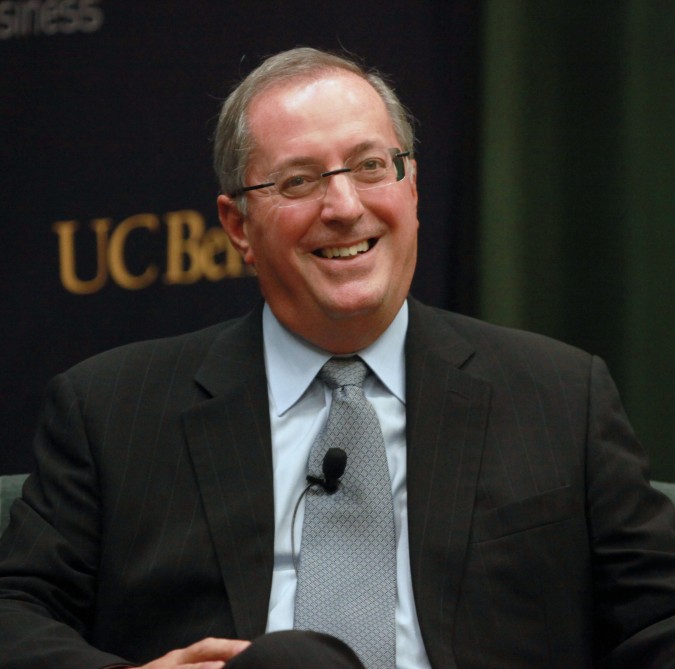
Intel CEO Paul Otellini at University of California Berkeley, October 3, 2012. Photograph by Kevin Warnock.
Yesterday afternoon, Wednesday, October 3, 2012, I attended the Dean’s Speaker Series at the Haas School of Business at the University of California Berkeley, in Berkeley, California USA.
Dean Richard Lyons interviewed Paul Otellini, the Chief Executive Officer of Intel Corporation. The question and answer session was held in the Anderson Auditorium, a venue I am very familiar with because it’s the same hall where the Berkeley Entrepreneurs Forum is usually held. I have attended the Forums for 20 years.
The interview was captured by a professional videographer, and the video will be soon made public on the Haas website page for the Speaker Series.
I have highlighted my favorite parts of Otellini’s remarks in my comments that follow.
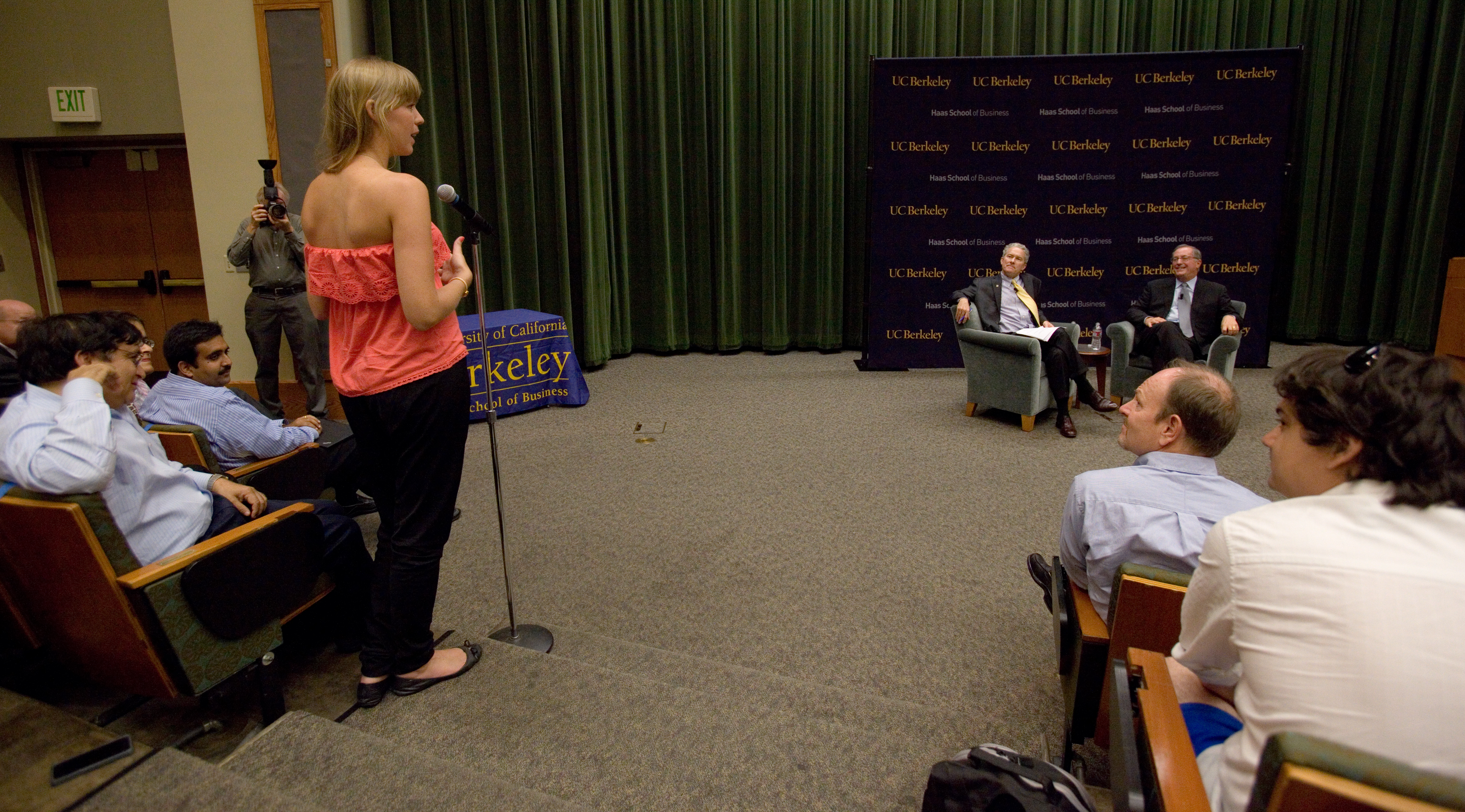
Haas School of Business student asks Intel CEO Paul Otellini a question October 3, 2012 at University of California Berkeley
Otellini completed his undergraduate studies at University of San Francisco, and received his Master of Business Administration from the Haas School of Business, though at the time it was named the Berkeley Business School. Otellini got a job at Intel in 1974 with his freshly minted MBA degree. Even though Otellini was a finance specialist, his first job at Intel was to program a Digital Equipment Corporation PDP-10 minicomputer to perform cost analysis. This must have been an intense introduction to Intel for an MBA because mini-computers were not easy to program. I programmed a Digital Equipment Corporation VAX minicomputer in 1990, and it was difficult then, so I can only imagine how much more pesky and complicated it was to work 16 years earlier on the ancestor to the VAX.
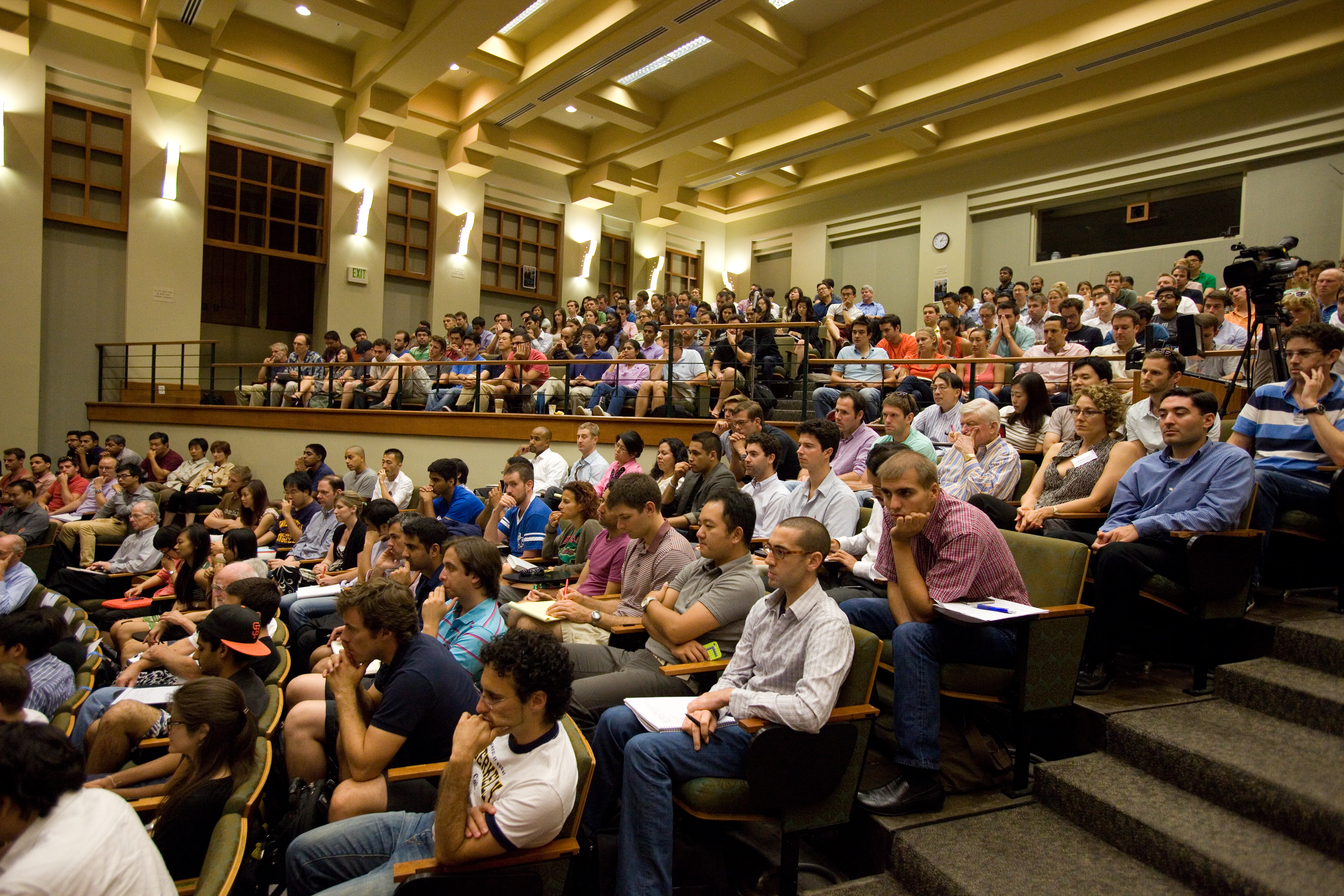
Audience watches Rich Lyons interview Intel CEO Paul Otellini, October 3, 2012 at University of California Berkeley, in Berkeley, California USA
When Otellini became CEO in 2005 he assessed that Intel was not organized correctly for where he saw the market heading. At the time, Intel had 105,000 employees. Otellini eliminated 25,000 jobs. The company is today back up to 103,000 employees. His advisers in 2005 were asking why he wanted to go into ‘the phone business’ when Intel was making money hand over fist at the time. Otelllini said he had many sleepless nights when he was contemplating letting 25,000 people go. He said he will never feel good about that, but he is grateful that he made the change well before the world financial collapse of 2008, so all the people let go were able to find jobs quickly.
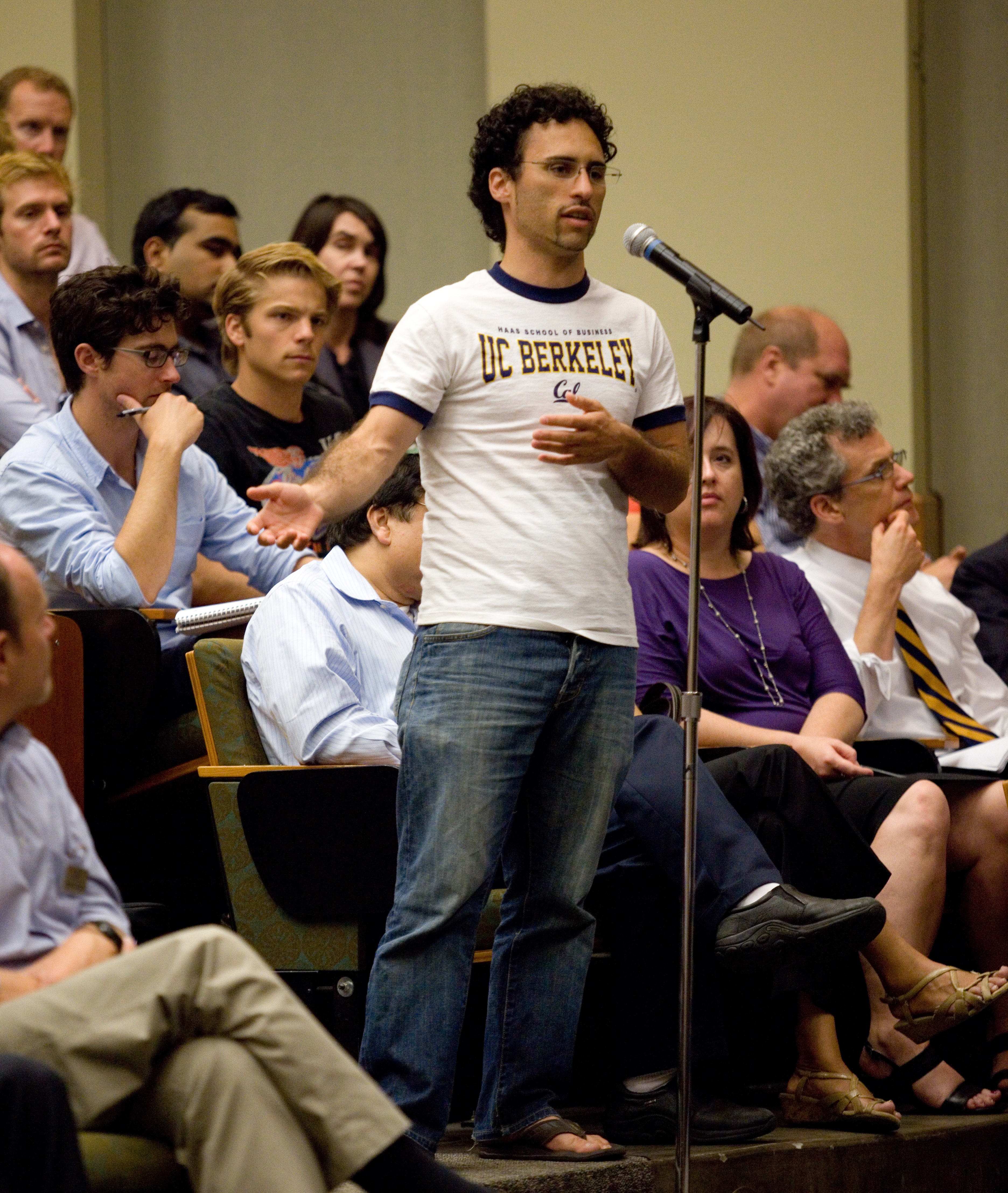
Second year Haas student Michael Vladimer asks Intel CEO Paul Otellini a question, October 3, 2012 at University of California Berkeley. To the right of the student, seated: Jill Erbland and Andre Marquis.
I was surprised to learn that Intel is the world’s 4th largest software company in the world based on the number of computer programmers that it employs.
Otellini advised to get work experience in different geographic locations prior to starting a family.
Otellini said its chips are manufactured in three dimensions, which was forced upon it by the laws of physics, which prevented circuits from being made much smaller. To keep making more capable chips, transistors had to be stacked as well as placed side by side. This technology took Intel 10 years to perfect, with thousands of PhD holders working on the effort.
I wonder if they considered adding a ‘Now in 3D!’ tagline to their famous ‘Intel Inside’ stickers.
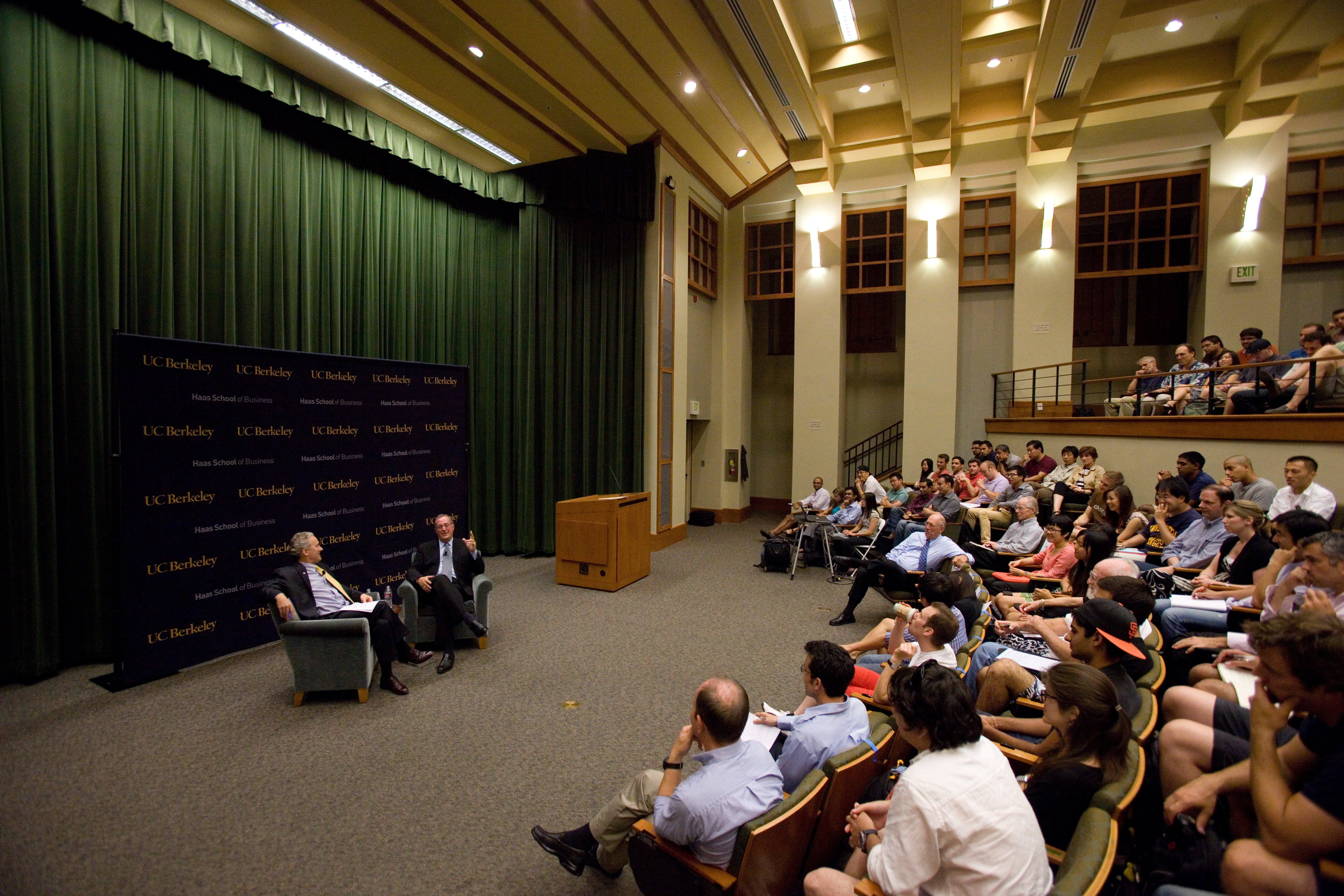
Audience watches Rich Lyons interview Intel CEO Paul Otellini, October 3, 2012 at University of California Berkeley
Otellini emphasized the high risks inherent in running Intel.
To illustrate, when Intel breaks ground on a new chip fabricating factory:
- the technology hasn’t been developed yet
- the products haven’t been designed yet
- the markets for the products don’t exist yet
These factories take 3 1/2 years to build and cost USD $5,500,000,000 each, and Intel starts construction on two or three of these per year.
That sounds like a great definition of high risk to me.
Intel makes hardware reference designs that it provides to its customers so that they can get products to market more rapidly. Otellini said personal computer makers don’t spend that much on industrial design, so they like and need Intel to provide these turn key designs they can modify to make them unique.
Otellini had a mentor at Berkeley while he was a student in the early 1970s. That mentor worked at Bank of America, and tried to get Otellini to join that bank. Several years after Otellini had joined Intel, his mentor confided that Otellini had chosen the right company.
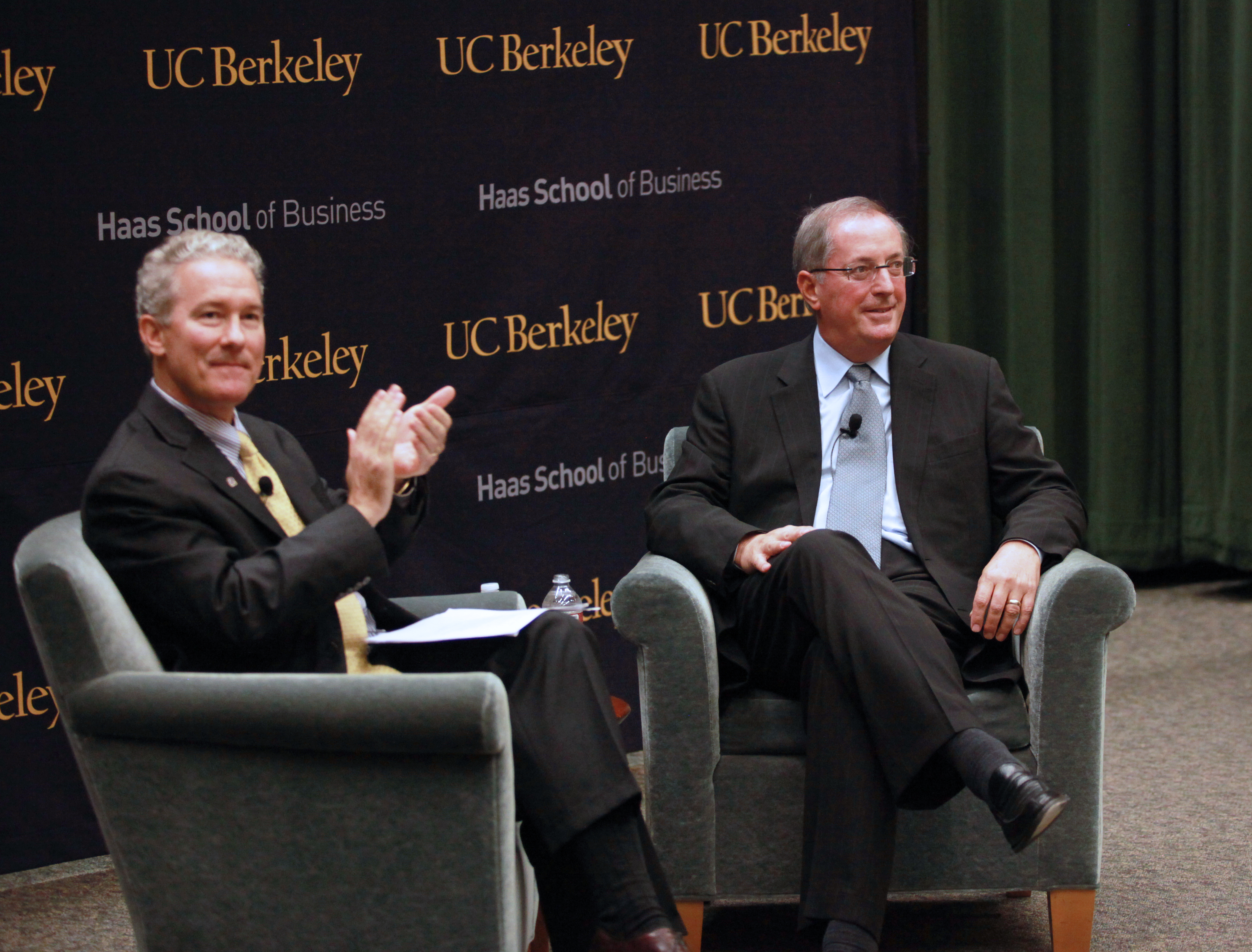
Haas School of Business Dean Rich Lyons and Intel CEO Paul Otellini, October 3, 2012 at UC Berkeley
Intel has put in place a system where they can identify the source of so-called conflict minerals. They can also track them, and Otellini said that Intel is likely to be able to say by January 2013 that Intel has built the world’s first ‘conflict mineral free microprocessor’.
Otellini said he had spoken in the morning with Robert Hormats, Under Secretary for Economic, Energy and Agricultural Affairs at the Department of State, who he said is very interested in [removing] conflict minerals from products. The Department of State, according to Otellini, wants to make Intel’s conflict mineral tracking system a so-called ‘best known method’ for the [semiconductor] industry.
Otellini said it recycles the chemicals used in its plants, and plans to recycle the water it uses to such a complete degree that its factories will be able to reuse the water they consume over and over, without needing to return it to the underground aquifers, like they do today.
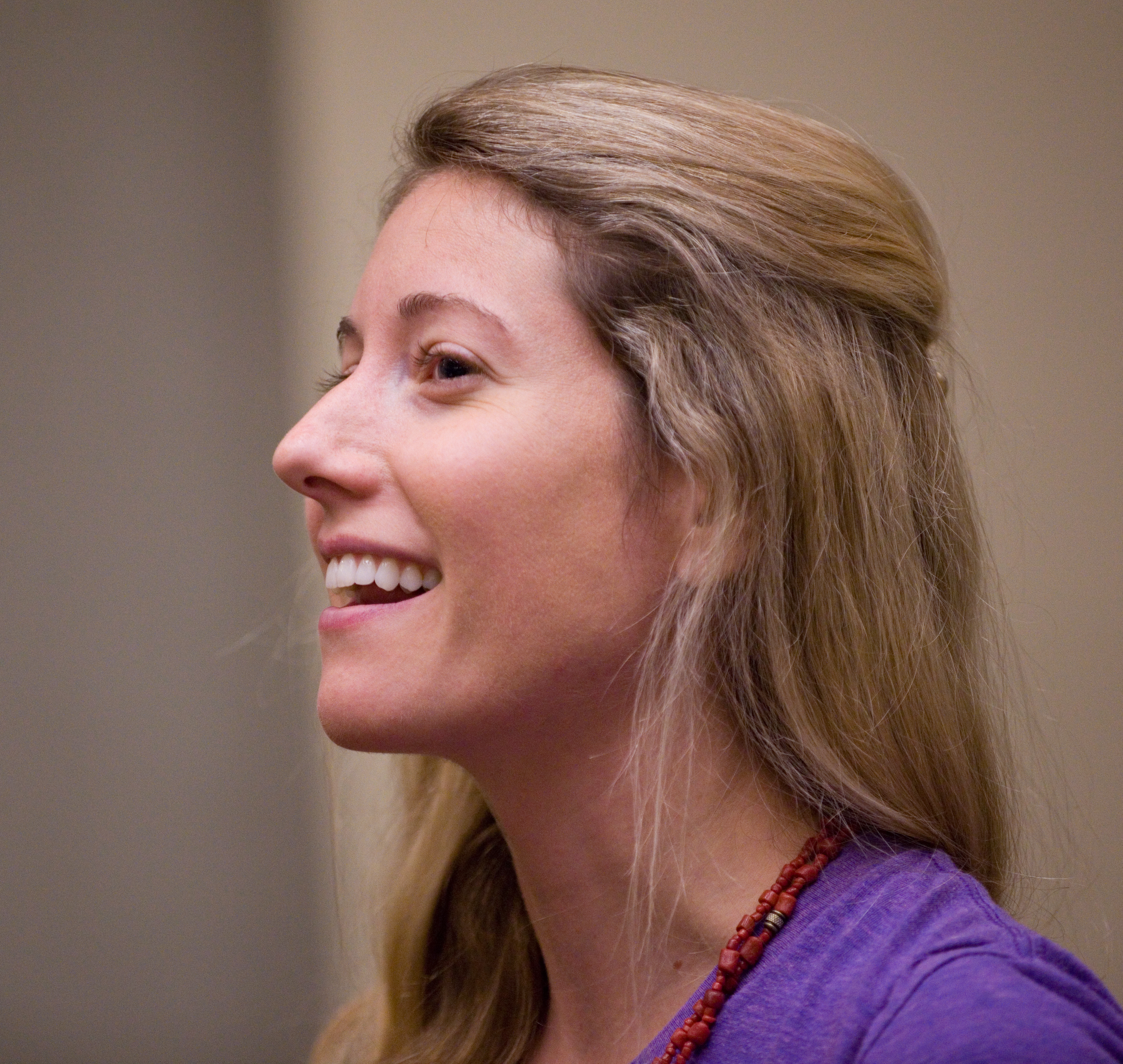
Audience member at Dean's Speaker Series with Paul Otellini at Haas School of Business, October 3, 2012.
Otellini spoke about manufacturing competitiveness generally in the United States, something he is qualified to speak about because he advises United States President Barack Obama about competitiveness.
He said many of the motivating factors that have led to outsourcing are disappearing. He said that it costs more for Intel to hire 1st and 2nd level technical managers in China now than it does in Santa Clara, California USA. For engineers with 3 or 4 years of experience, the costs to hire them are now the same in the US as they are in China and India.
Otellini said that the United States could improve its position by lowering its corporate tax rate [to a level consistent with the rate in competitive economies]. He suggested the US streamline its permitting procedures for building new factories. He suggested that job training be improved to provide a skilled workforce to work in the new factories. He pointed out that currency and political risks are low in the US, and stated there is no risk of a company’s factory being expropriated by the US government. In other countries, governments sometimes do take over privately owned factories.
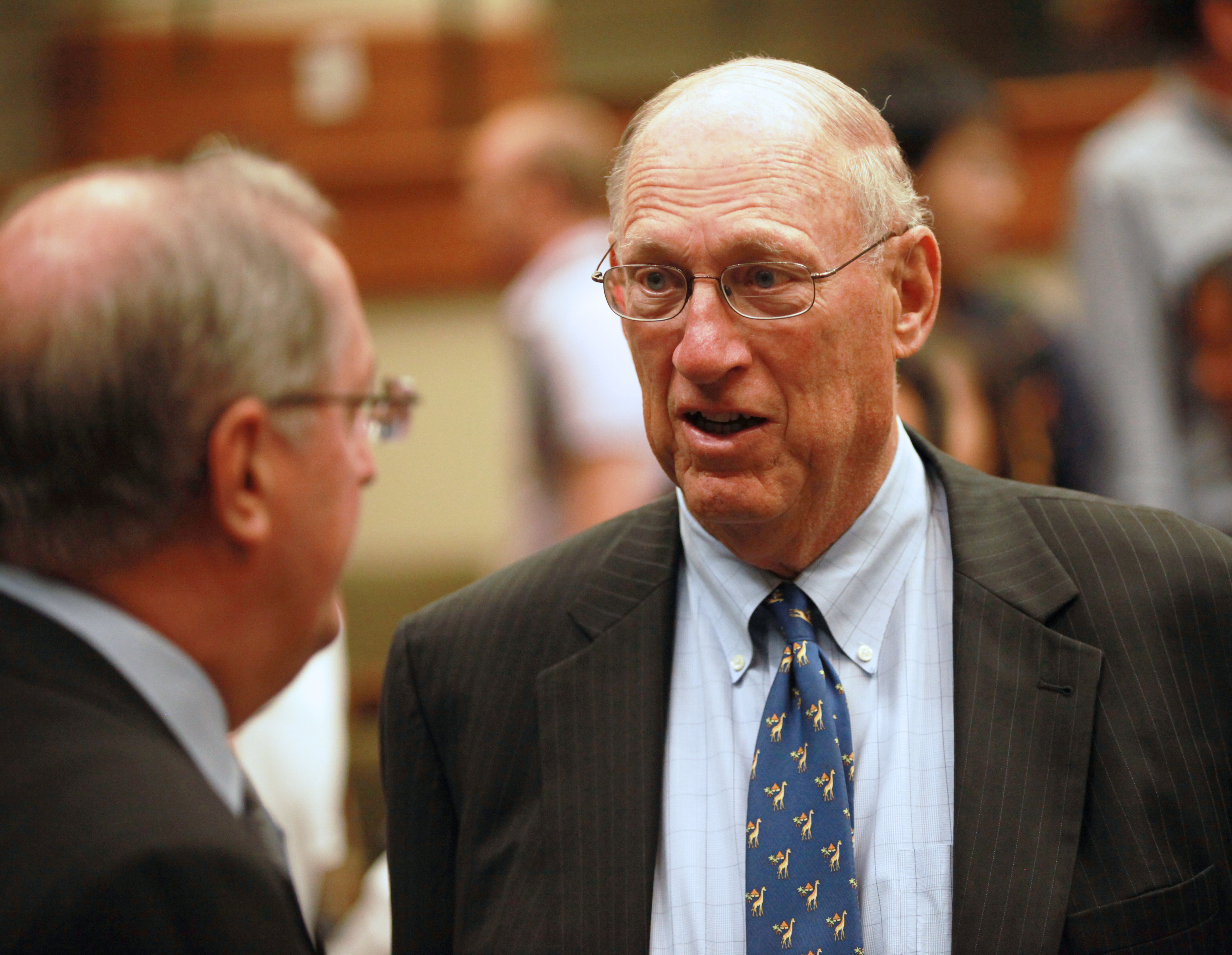
Paul Otellini speaks with Arthur Gensler at University of California Berkeley, October 3, 2012. Photograph by Kevin Warnock.
There were some famous guests in the audience.
Perhaps the most famous attendee was Arthur Gensler, the founder of M. Arthur Gensler Jr. & Associates, Inc. but commonly referred to as simply Gensler. I have been aware of this global architecture, planning, design and consulting firm since I was 23 years old at my first job out of college, at Newell Color Laboratory at 630 Third Street in San Francisco, California USA, since closed. Gensler was an important client. I suspect Gensler may be helping to design the new building Dean Lyons is being planned for the Haas School of Business campus.
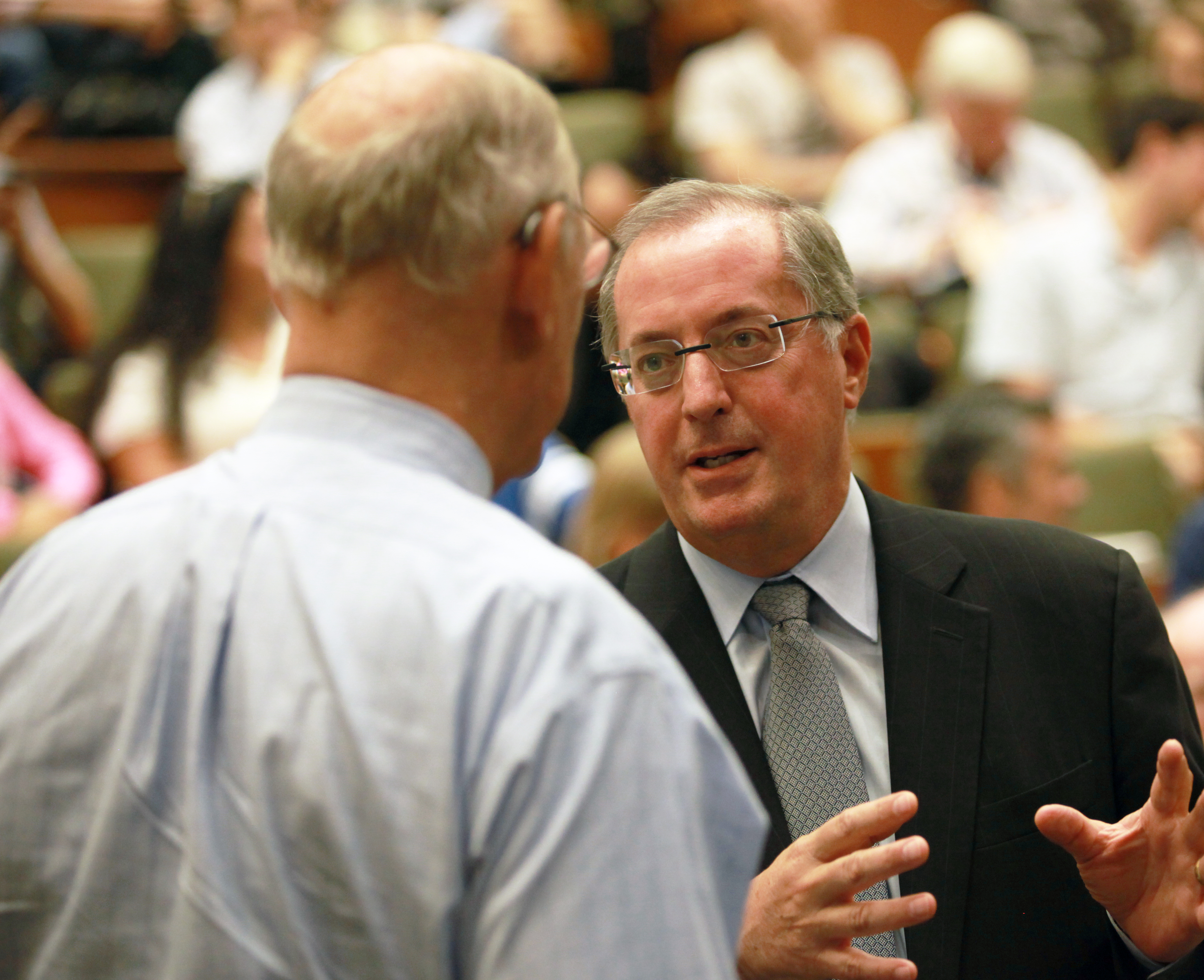
Arthur Gensler speaking with Paul Otellini, October 3, 2012 at Haas School of Business at University of California Berkeley
After the interview, Lyons pointed out Mr. Gensler to me — without his helpful comment, I would not have been able to write this acknowledgment of his visit. Gensler is a big deal — they employ 3,500 people in 42 locations. They count all 10 of the Fortune 500 top 10 companies as clients.
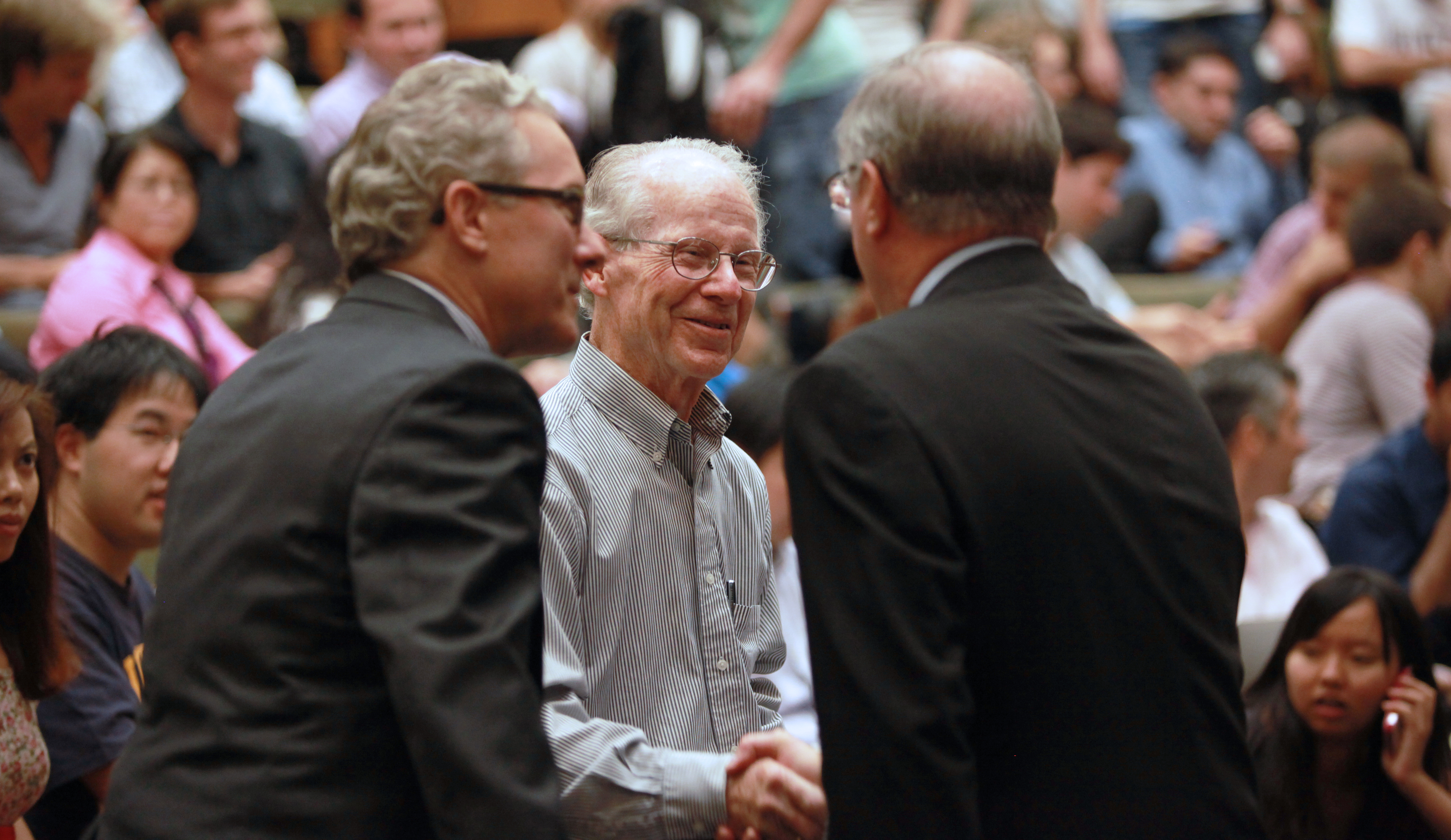
Haas School of Business Dean Rich Lyons, left, watches Haas Professor Emeritus and Nobel Prize winner Oliver Williamson shake hands with Intel CEO Paul Otellini at Haas School of Business at University of California Berkeley, October 3, 2012. Photograph by Kevin Warnock.
Perhaps the second most famous attendee was Oliver Williamson. Williamson is Professor Emeritus at the Haas School of Business. In 2009 Williamson won the Nobel Prize for Economics. I saw Williamson speak in 2009 at the Haas Gala, the annual party the school throws each November. I blogged about that gala and wrote about Williamson, who spoke at the event. I took a picture of Williamson shaking hands with Otellini, shown here.
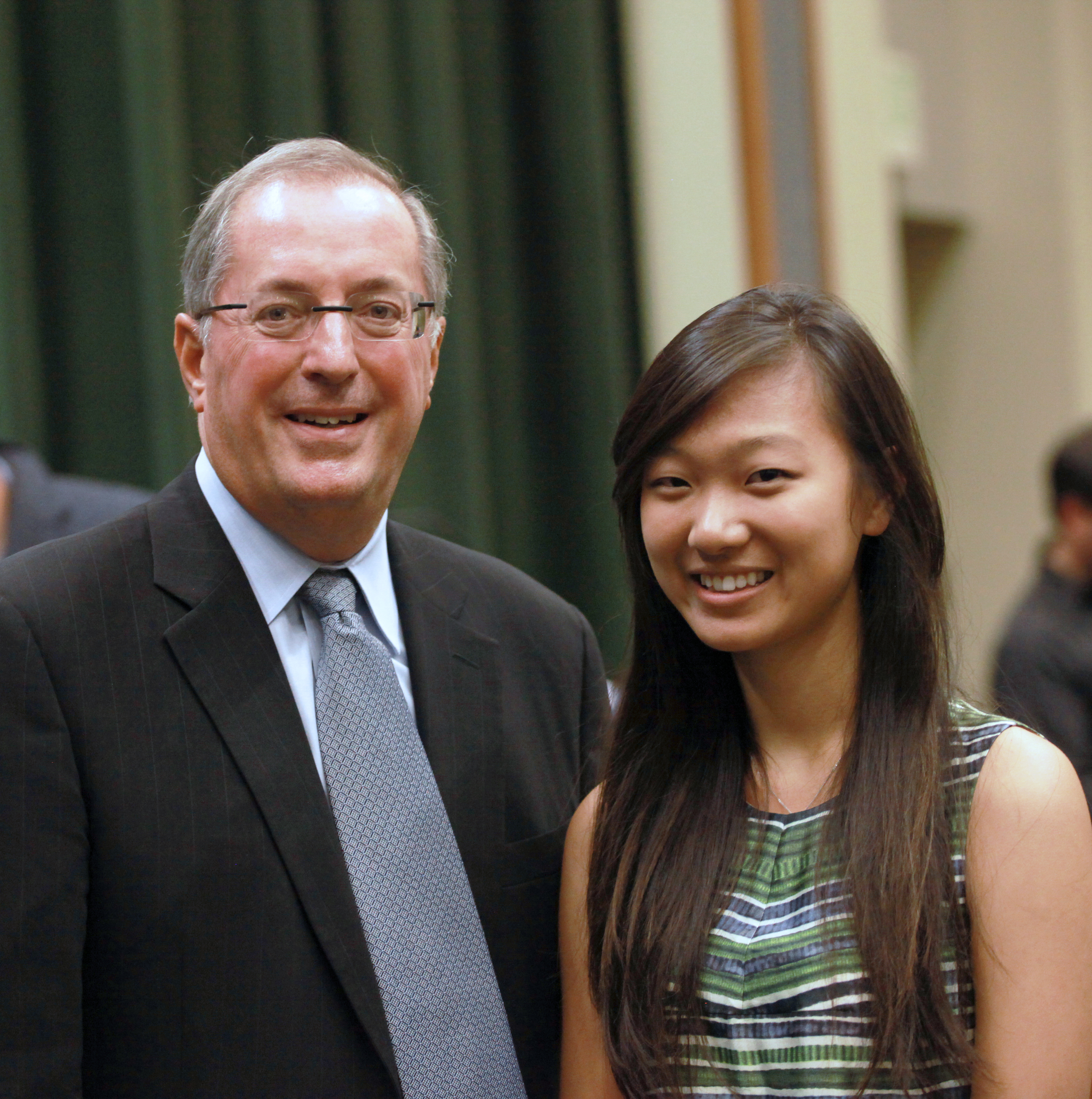
Intel CEO Paul Otellini with University of California Berkeley student Tammie Chen. Photograph by Kevin Warnock, October 3, 2012.
This last photograph of Mr. Otellini with Berkeley undergrad student Tammie Chen has an interesting story behind it.
I met Chen when she was an organizer for the 2011 Made for China Startup Pitch Competition. I was a judge for that competition. After that event, we became friends on Facebook, and she posted that she was going to be attending the Dean’s Speaker Series that is the subject of this blog post. I commented that I would be there as well, blogging. She asked me if I could take a picture of her with Otellini. I said I would. I walked up to him and asked him if I could introduce Chen to him and take a picture of him with her, and he readily agreed. They had a nice chat for a minute, and then they posed for this picture. Chen is a huge fan of Intel, and has visited their headquarters. She has a lot of friends that work at Intel.
I was surprised that no students approached Otellini to introduce themselves. This is the same behavior I saw at my first Dean’s Speaker Series event, in September 2012, when Lyons interviewed Randall Stephenson, the CEO of AT&T. There were students standing about 10 feet away from Otellini, in a large circle, but not a single student walked into the empty space to say hello. That made it easy for me to say hello to Mr. Otellini, who I have met and spoken with before, in 2008, at the Intel Capital CEO Summit [renamed the Intel Capital Global Summit] in San Francisco.
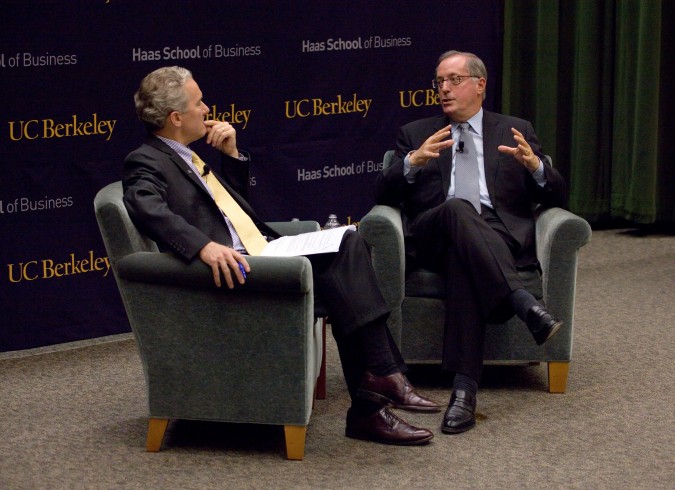
Haas School of Business Dean Rich Lyons and Intel CEO Paul Otellini, October 3, 2012 at University of California Berkeley. Photo by Kevin Warnock.
I like Intel. Their venture capital division Intel Capital was very nice to my company Silveroffice, Inc. by making it an Intel Capital Portfolio Company. Intel Capital invites me as their guest to Intel’s annual Intel Developer Forum, at which I get a new Intel Developer Forum branded laptop bag or backpack, which I use every time I leave my home with my Intel powered laptop. I hope to be appointed a judge for the Intel Global Challenge, a role I would be great at since I was a judge for the Berkeley Startup Competition for eight years through 2011. My application is pending, so please wish me luck! I love judging startup competitions, and so far I have judged four different competitions at University of California Berkeley.
I took all the photographs in this post. I used a Canon 5D Mark II camera with a Canon 80-200mm f:2.8 L zoom lens. Click on the images twice in delayed succession to see the images at full size. I uploaded the images at their full 21 megapixel resolution, at a JPG quality of 12. The light level was comparatively low, so I shot at ISO 2,500, without flash.
Thank you to Meg Fellner of the Dean’s Office for getting me a ticket to this sold out event.
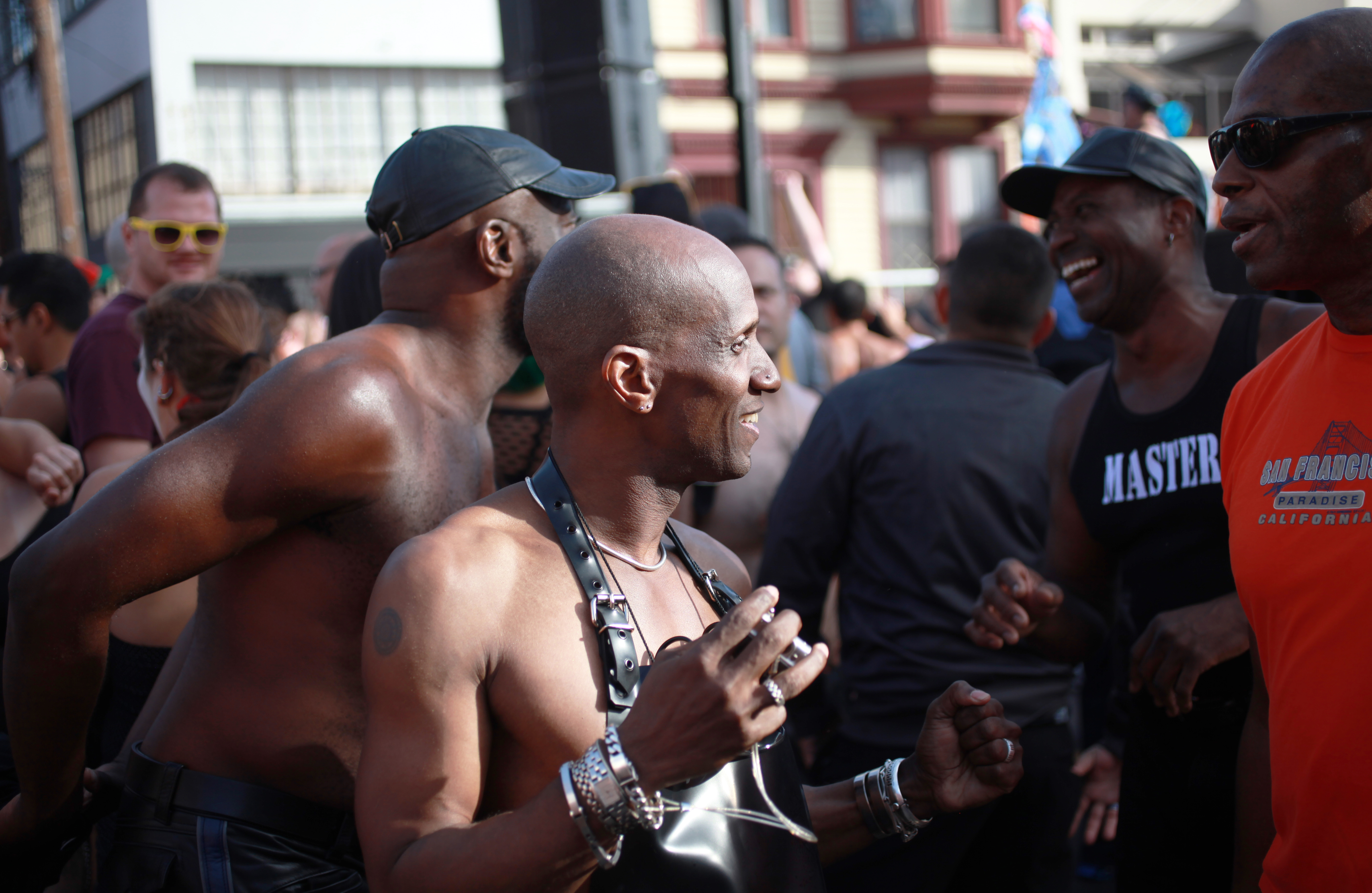
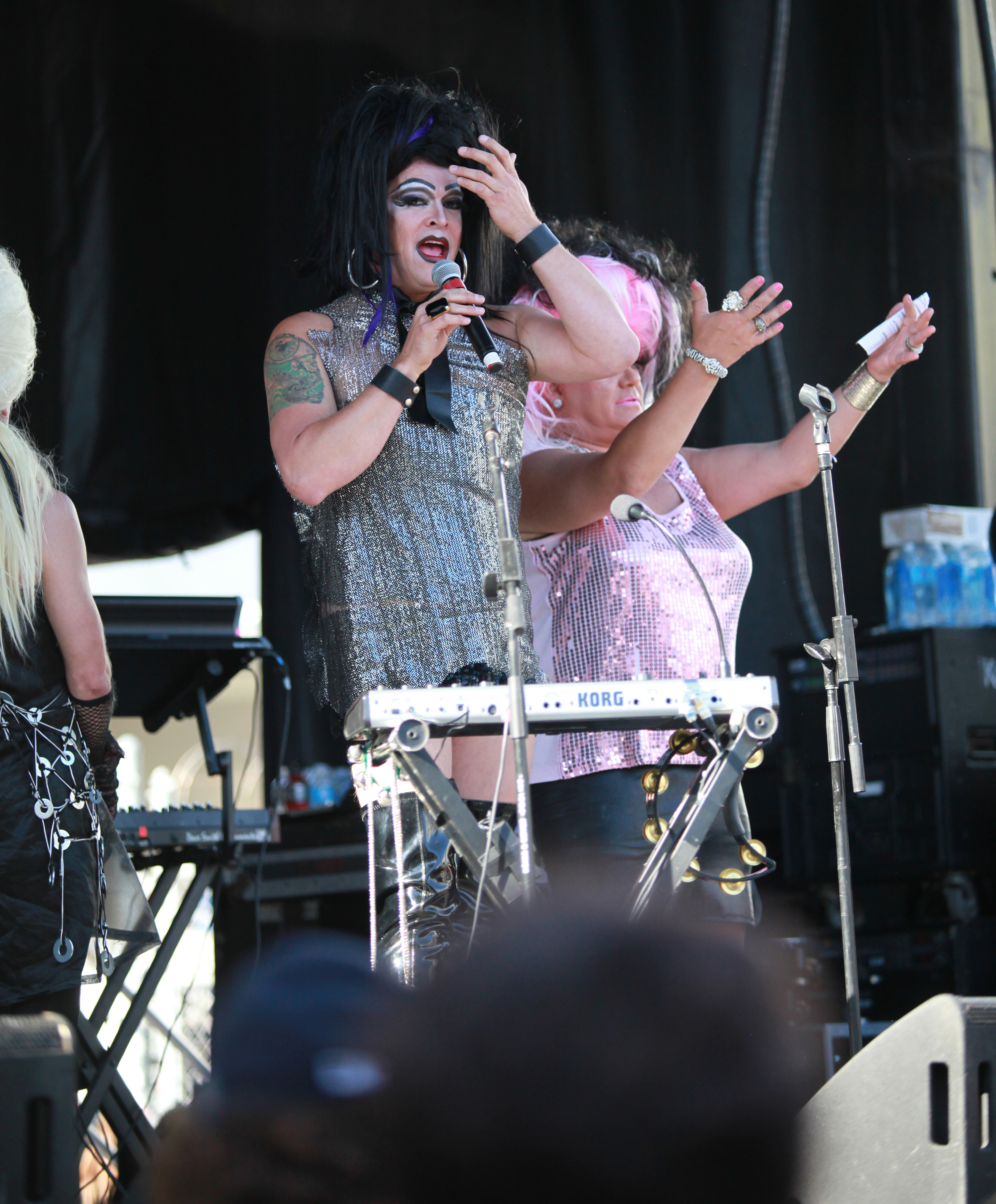
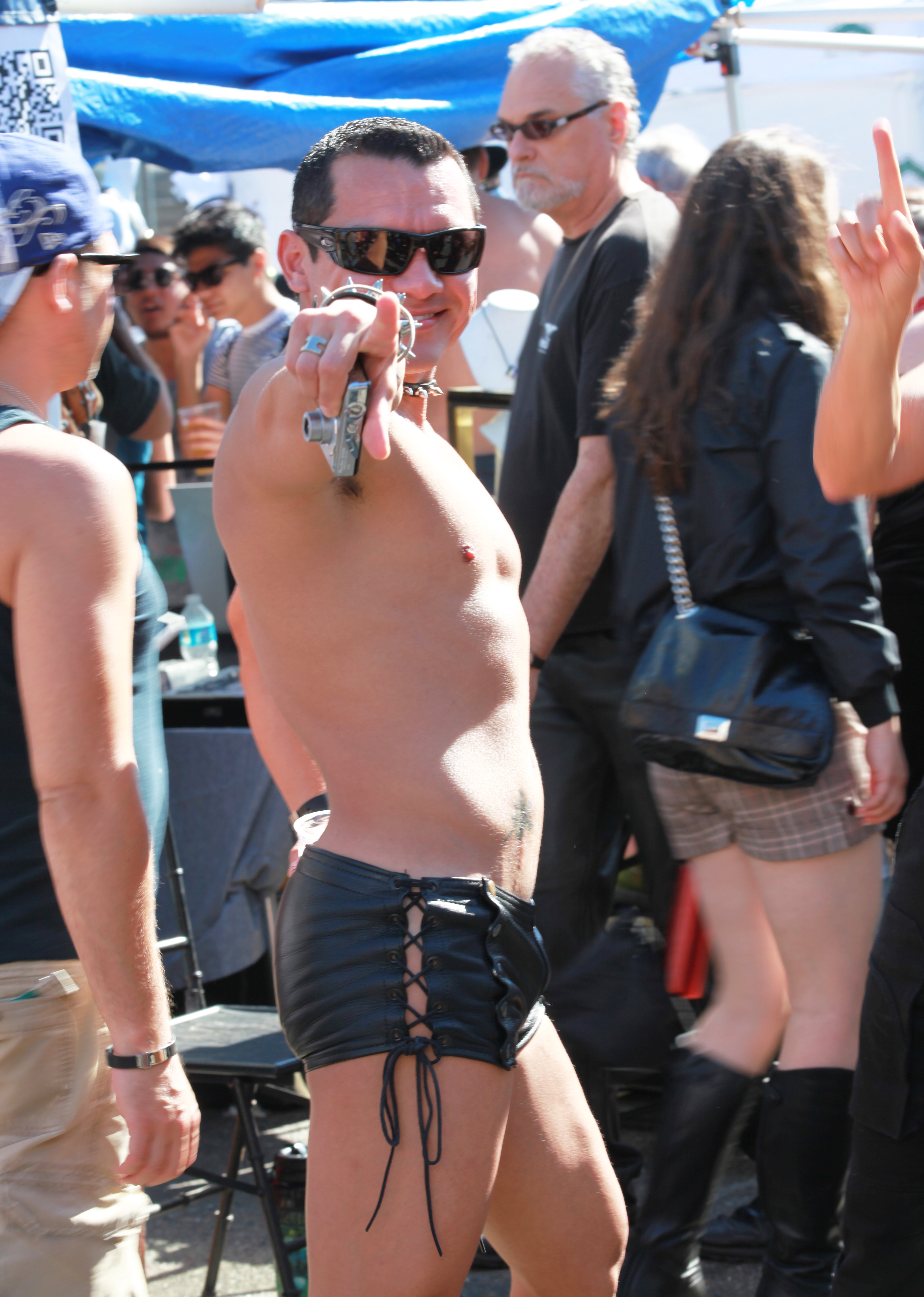
Photographs of Folsom Street Fair, September 23, 2012, San Francisco, California USA

Yesterday afternoon, Sunday, September 23, 2012, I attended the famous Folsom Street Fair in San Francisco, California USA.
The Folsom Street Fair is a BDSM and leather subculture street fair.
The organizer, Folsom Street Events, has a page on Facebook. There is a lengthy article on WikiPediA about the Folsom Street Fair — the largest fair of its type in the world.
This post contains photographs that might be rated PG-13 if this were a Hollywood movie. All nipples are covered in this post, but in some cases just barely, with pasties or adhesive tape. Please skip this post if you are squeamish about nudity or sexuality.
If, however, you want to see more outlandish photographs taken by other photographers, they may be found on Yahoo’s Flickr website. The Flickr pictures are by The Golden Gate Express newspaper.

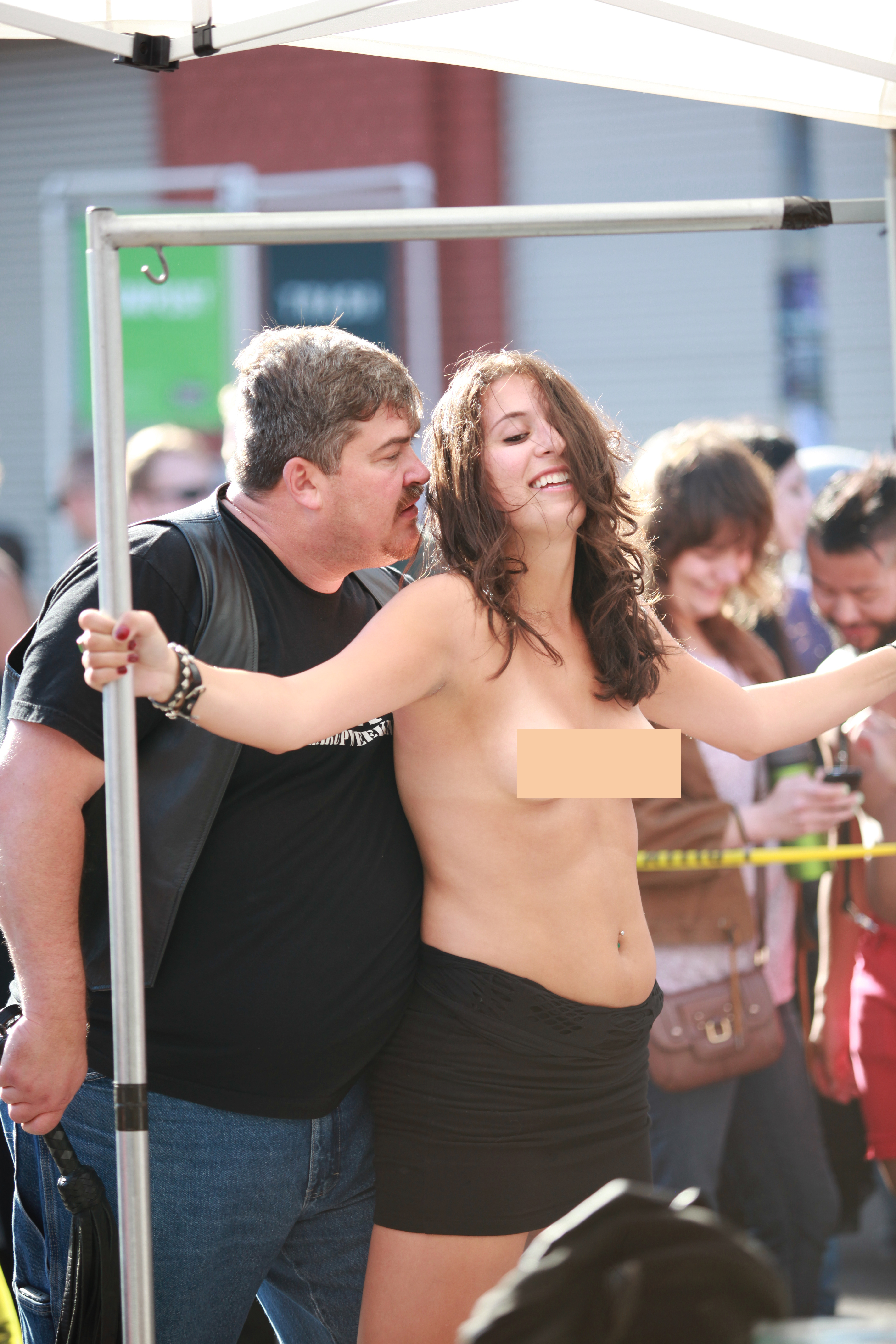
I took the pictures you see on this page with my Canon 5D Mark II. I used a Canon 50mm macro lens for some of the pictures, and a Canon 70-200 F:2.8 L zoom lens for the rest. Click on the pictures twice in delayed succession to see the images at full size. I uploaded the pictures at maximum resolution and maximum JPG quality of 12.

I have attended the Folsom Street Fair three times in my life — yesterday, in 2010, and in the 1990s.
I am not into BDSM or the leather subculture, but I enjoy the fair.
Yesterday was the first time I went alone, and the first time I brought a good camera with me. I was nervous about being a guy with a camera taking a lot of pictures, but there was no need to be. There were thousands of cameras there. I doubt anyone arrived without a camera. In so many instances, the subjects you see here were actively posing for photographers. Some groups had a dozen photographers at a time trying to photograph them.

There was a lot of full nudity at the fair, especially among the men. I estimate there were 200 completely nude men walking around. I only saw one completely nude woman walking around. There were dozens of topless women walking around, without pasties or tape over their nipples.

I am straight, so I focused more of my energies towards photographing the many attractive women in attendance. I photographed some men too to capture the ambiance of the event and out of fairness.
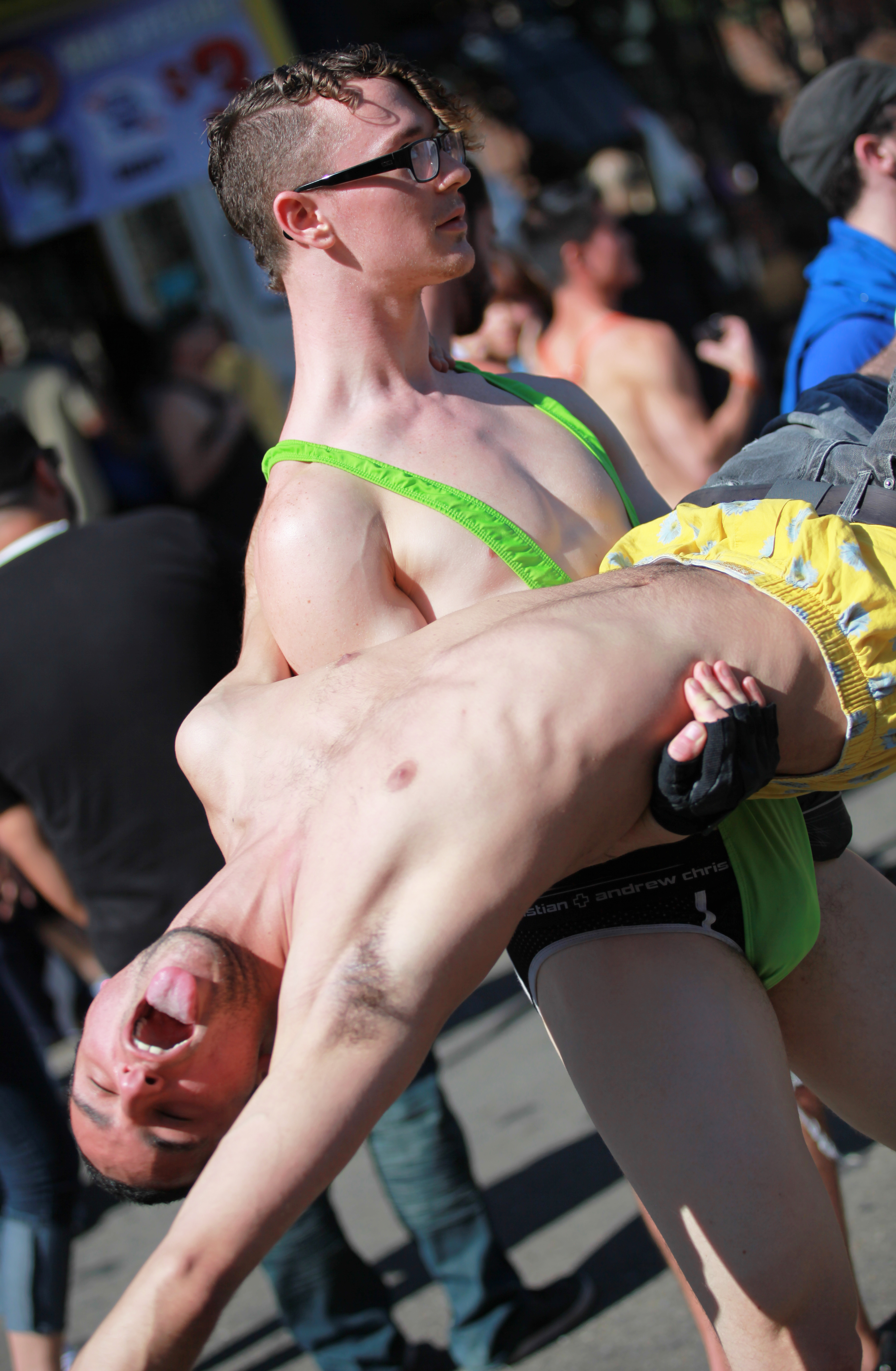
I gave my card to some of my subjects, and to my amazement, fully half the people I gave my card to emailed me and asked me to send them a copy of the picture I took of them. I happily obliged. Next time I go to the fair, I will offer my card to everyone I photograph, instead of waiting to be asked for it like I did yesterday. One of the women I photographed is a model, and I asked her if she would like to do a shoot with me, and she wrote back that yes, she would. For any of the other women that I have included in this post, I would like to schedule a photo shoot with you as well. You may contact me via Facebook. While you’re there, consider subscribing to my public posts.

I publish a photography blog in addition to this blog at KevinWarnock.com. I only publish results from my photo shoots to my photography blog, not candid images of strangers like you see here.

You may see my photography portfolio at the site ModelMayhem. Model Mayhem is like Facebook for models, photographers and related artists.
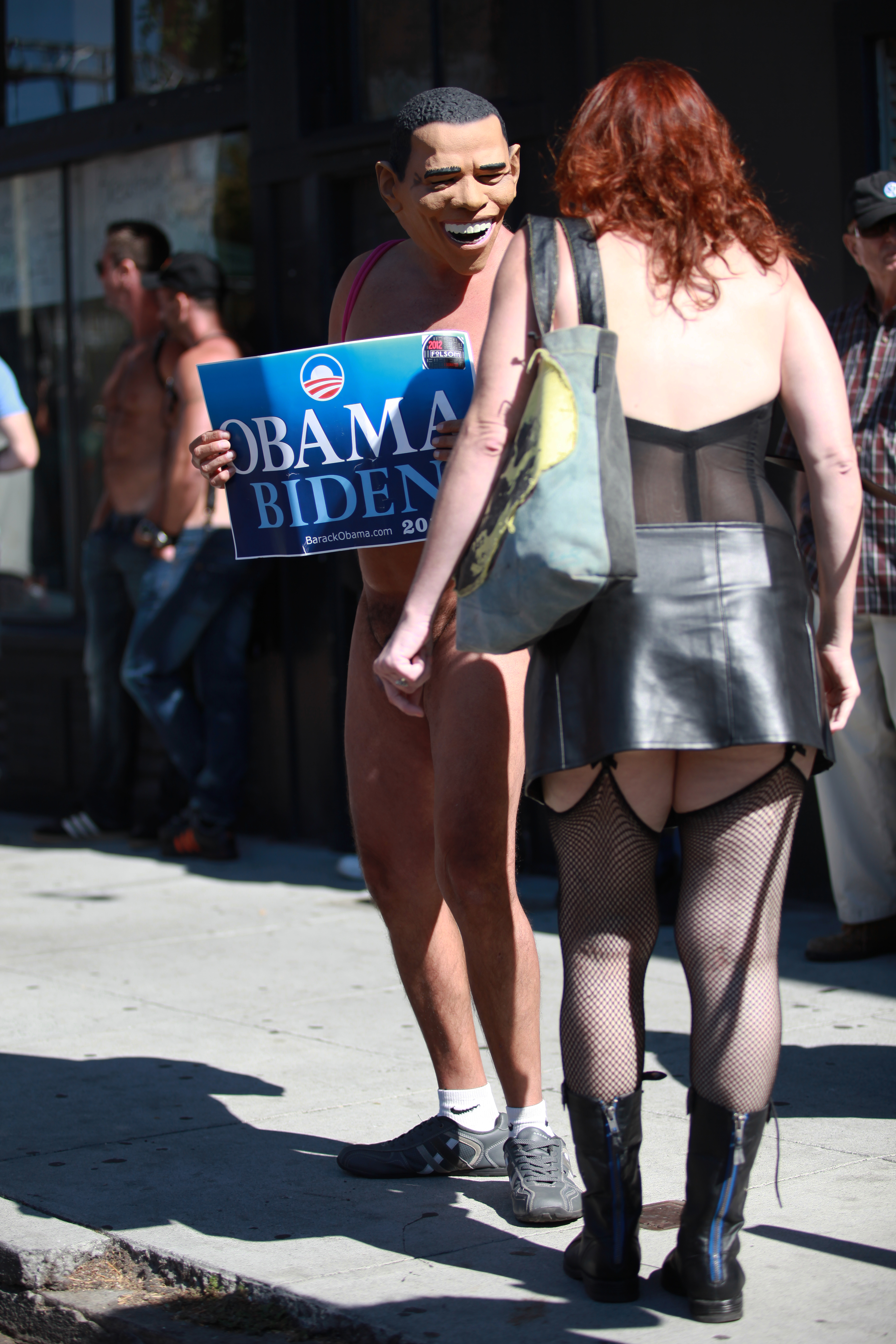
The craziest thing I saw at the Folsom Street Fair this year was a nude African American man wearing a rubber Barack Obama mask and holding an Obama/Biden campaign poster. He stood in the same location for hours, allowing himself to be photographed by hundreds of people. Barack Obama is the current President of the United States of America, and he is running for reelection in November, 2012, later this year.






















40th anniversary party for the law firm Fenwick & West LLP
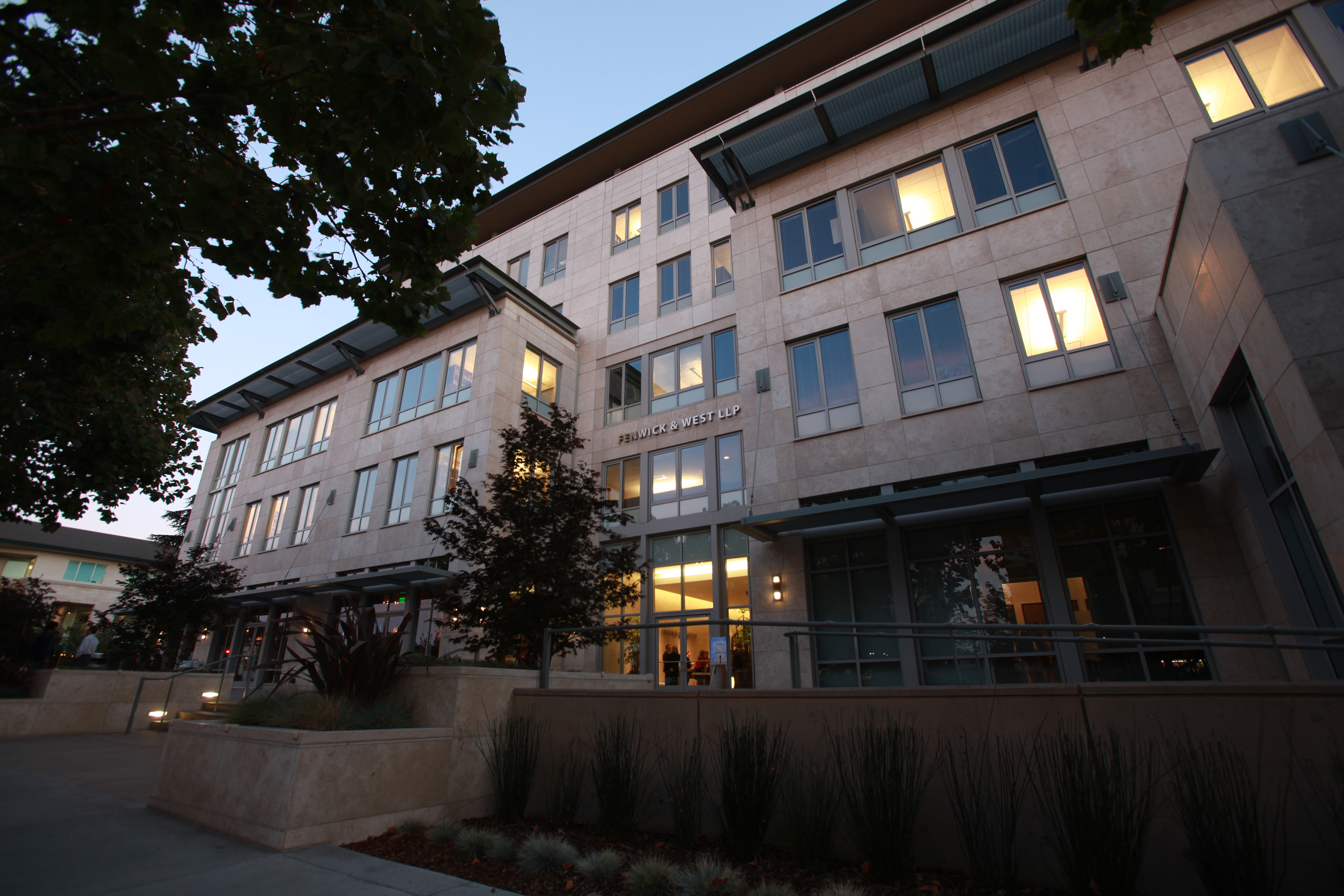
Fenwick and West LLP lawfirm 40th anniversary party September 19, 2012, Mountain View, California USA
Yesterday, Thursday, September 20, 2012, I attended the 40th anniversary party for the law firm Fenwick & West LLP at 801 California Street, Mountain View, California USA 94041.
My friend Sam Angus is a partner at Fenwick & West, and it was through him that I received an invitation.
I brought my camera but did not take it inside. This was a private party, and it didn’t seem right to attend as a blogger, which I typically do when I attend public events.
I did set up my tripod after I left and took this time exposure at dusk of the outside of the building. You can see the party through the front door. Click on this picture twice in delayed succession and you may be able to recognize the faces of the people by the door. You can certainly see the welcome sign on the stand outside the front door.
Fenwick’s chairman Gordon K. Davidson addressed the celebrants and shared some stories from the early days of the firm.
My favorite story was about Apple, Inc.
Fenwick’s first big client was Pioneer, the maker of entertainment electronics. I owned a Pioneer SX-1280 receiver from that era, though I bought it used for USD $100 years after it was manufactured, from my friend Dean Hinton. New it was over $1,000, far beyond my budget at the time. That receiver cranked out 185 watts per channel and weighed more than I did.
Pioneer engaged Fenwick to sue retailers for discounting its products, a type of lawsuit that was allowed back then.
One day Steve Jobs and Steve Wozniak came into their offices to incorporate their fledgling company Apple Computer. This was in the Apple I days — very, very early.
Founding partner Bill Fenwick had the good sense to take on Apple Computer as a client, and, I learned while researching this post, that Bill Fenwick did not charge for the incorporation work because he believed that Jobs and Wozniak couldn’t afford it.
I introduced myself to the hosts. I had a conversation with now retired founding partner Bill Fenwick, who asked if my father is John Warnock, the co-founder of Adobe Systems. I also spoke with current Fenwick & West chair Davidson. Both men were very gracious, and made me feel welcome. I can see how they were able to build a law firm that has become so well regarded.
Fenwick & West is one of the premier law firms in for technology companies.
I saw Dotty Damon Hayes, the mother of a friend, but she apparently departed early and I missed my opportunity to say hello to her again, which I regret.
The food, music, surroundings and guests were first rate. The Fenwick & West offices are understated and elegant. I was particularly impressed that the kitchen area occupies what otherwise would have been a sought after corner office. I spoke with many of the guests, and really enjoyed myself… thanks Sam for the invite.
Happy 40th birthday Fenwick & West!
11 years after 9/11
I am dismayed with how the United States responded to four plane crashes 11 years ago this day, September 11, 2012.
Wars were started that still continue. Trillions of US dollars have been wasted destroying much more than just property and life.
How much better would the world be if President George W. Bush treated the September 11, 2001 events as regular police matters.
Osama bin Laden still could have been found and brought to trial to determine his guilt or innocence, and we wouldn’t have wrecked our good will like we have with these needless and counter productive wars that are a drain on the world. Constant war is a drain on the mental energy of everyone in the world, I fear.
President Bill Clinton handled the 1993 World Trade Center truck bombing as a police matter, and I recall that some of the perpetrators were located, tried in civilian courts, convicted and punished. That’s the way to handle both daily criminal and infrequent catastrophic criminal events.
I believe the people behind the 9/11/01 attacks were upset with how the United States conducts itself on the world stage. I think a sane and proper response would have been to admit to the world that the United States does overstep its place more than it cares to admit. We should have attempted to open a rich and ongoing dialog with those who attacked us to solicit their advice on how the United States could tone things down in the future so that others wouldn’t be so hopping mad that they attack us.
Would such a polite and measured response have worked? I don’t know. But I think it would have cost less in every measure.
If a prestigious entity with world visibility were created where we would yearly sit with our attackers and those who think of attacking, we would have taken the wind out of the sails of our attackers to a substantial degree. The entity would need to have power, prestige and money for it to be seen as more than window dressing by those who might attack us. It would need to make sure action was taken after meetings so all those watching would know their voice was being heard and acted upon. This would be one heck of an organization, and I don’t know how to pull it off, but it needs to be built. We know how to build huge, costly organizations that can cause action. The US military is one such huge costly organization, for example. The organization for good I propose might need to rival the US military in size, scope, power and budget. That might sound crazy, but what really are we getting for our military expenditures now? I would argue a lot less than nothing. We are building negative equity like at no time in the history of the United States. We could fund the organization I propose by reallocating half the budget of the US military as a start. With just half its budget intact, the United States would still have a huge military, but we would also immediately have the largest organization for world change on the planet, and just by having made that commitment, I predict more than half our ‘need’ for a military at all would evaporate. Half of our military is still a lot, and think of the new friends we would make with the new organization for change I propose. Far fewer people would wish us harm if we were doing good on such an intense global scale.
Now prepare yourself for the most provocative text I’ve written in my life…
Soon after the September 11, 2001 plane crashes, United States of America President George W. Bush should have said something like this:
“The United States is profoundly sorry and embarrassed.
Without an invitation, the United States has been acting like the policeman of the world.
We recognize that there are other valid points of view on how to live life. We don’t want to be attacked like this again, so I ask those of you who wish us harm to please share with us how we can avoid such attacks. We are willing to make big changes, and we’re willing to spend a lot of money to be a nicer world citizen. To demonstrate our resolve to change and see the point of view of others, the United States today is contributing USD $100,000,000,000 to get the ball rolling towards a more fair and sane planet. We will spend to improve the lot of the people that attacked us.
On behalf of the United States of America, I am sorry that this country has acted such that you believe you had to attack it. While this country may not agree with your points of view, it does recognize that you view your points of view as valid and worth advancing. Clearly, we need to talk, and we will talk. I personally will talk face to face with your representatives.
The United States feels so strongly that it will learn to play nice on the world stage that beyond the USD $100 billion I just spoke of, I am committed to working with the US House and Senate to gain approval to spend up to USD $3,000,000,000,000 over the next decade to fix what’s wrong with the world.
The United States is not a vindictive nation.
The United States could respond by starting wars and destroying entire countries, but we’re bigger than that, and we will show our attackers that the people of the United States are your friends, not your enemies. War is terrible. Peace is golden. The United States stands for peace, not war.
On behalf of everyone in the United States, including the families of those who lost loved ones today, I appologize for our actions, attitudes and positions that led others to believe that they had to attack the United States so violently to get our attention.
With hard work and determination, today will be the last time that any people of the world should feel that they have to attack us to get us to change our overstepping ways.
The United States in fact is ashamed that it has come to this, that we have upset other people so dramatically and profoundly that they have responded by flying airplanes into our landmarks, ending the lives of so many earnest people in the process.
Let us spend the following ten minutes in silence to reflect on the enormity of the events of today. Let us imagine a world filled with peace, happiness and enough to eat and drink. Let us cast aside our revengeful impulses so that we can come together at a meeting table to plan how the people of the world shall overcome the horror of today in favor of the brightness of a more promising future for all of humanity.
To the friends and family of those who lost their lives today, if you want to be upset with somebody, be upset with me and the past Presidents of The United States of America. What happened today was a reaction to this country overstepping its place in the world. It simply is not nice to tell other people how to live while we consume such a disproportionate percentage of the resources of the planet. In the decades ahead, we will need to learn to share our bounty with others more than we have done so far. Look on this redistribution of wealth as your insurance payment for the future safety of you, your property and your loved ones, not as a handout. The United States has been acting like a rich, spoiled kid on the playground eating the finest candy and laughing while others nearby starve and have little. We can remain a wealthy and prosperous and happy nation while at the same time leveling the playing field. We are a nation of thoughtful and ingenious innovators, and if we put forth our full effort, perhaps 100 times greater than what was required to place a man on the moon, we can solve the really big problems the world today faces.
Three trillion dollars is a lot of money. We can spend that amount building peace, love and goodwill. We can also spend three trillion dollars killing hundreds of thousands of people and destroying countries.
I am certain that three trillion dollars of peace, love and goodwill is more valuable than three trillion dollars of rubble, hate and death.
May September 11, 2001 be viewed by history as the first day of the most kind and peaceful period the world has yet known.
For those of you that worship a higher power, may that higher power give you comfort on this historic day of new beginnings. Let us rejoice in the saved lives of the hundreds of thousands of people this nation will not kill in response to the events of today. Let us rejoice in the new lives of the hundreds of thousands of babies by coincidence born this historic day. It is tragic that the United States lost thousands of its residents today, but keep in mind more babies were born in the United States today than lives were lost in these four plane crashes.
The United States is your friend, not your enemy. The United States wants peace, prosperity and fairness for all the people of the world.
Tomorrow will be better.
I love you.”
Instead, President Bush said something genuinely and dramatically stupid:
“You’re either with us or you’re with the terrorists.”
This is such an unwise thing to say it sounds like something out of the mouth of a high school student at a third rate institution. Yet his short statement formed the basis for spending of even more trillions of dollars than I proposed the United States spend in my mock speech above.
The United States ruined itself by its unwise response to four plane crashes.
I don’t spend a lot of time delving into the deep details of world politics. I am not a historian. I am not particularly well informed about what I write about here. I admire Noam Chomsky and Dennis Kucinich. I think Chomsky and Kucinich would like what I have written here today. I hope to meet both men one day, perhaps in response to this post if I am really lucky.
I believe I possess a very fine and properly working moral compass. I am proud of and guard my moral compass. I’ve made profound and life altering changes in my life when needed to protect and guard and respect my moral compass, even when it would have been so easy for many others to compromise. Perhaps the above makes me look childish and unrealistic. Perhaps I will lose a friend or three by what I’ve written. But what I’ve written has been on my mind for ten years now, and today I decided to just say what I first thought starting about 2 seconds after I first heard about the first plane striking one of the towers of the World Trade Center complex in New York City, New York, USA.
The United States has ruined itself by its response to four plane crashes.
Why?
PS – I am sorry for the loss of the family and friends of those who lost their lives in the events of and following September 11, 2001. By writing this post, I do not intend to upset anyone who lost a loved one. My heart also goes out to friends and family of those who have been killed or injured in the response to the events of 9/11, including those serving in military forces on all sides. I love the United States, and I love people generally, from all countries. I am so sad that all this death and suffering and hate has happened. It’s all so unnecessary and wasteful. Thank you for reading. I love you.
Kevin Laurence Warnock
San Francisco, California USA September 11, 2012
Note: I published this post on September 11, 2011, the 10th anniversary of the 9/11 attacks.
Today, September 11, 2012, I published this post again, changing the first sentence from “I am dismayed with how the United States responded to four plane crashes 10 years ago this day” to “I am dismayed with how the United States responded to four plane crashes 11 years ago this day, September 11, 2012.”
I am proud of this post, and I plan to republish it annually on September 11th.
AT&T CEO Randall Stephenson is interviewed September 6, 2012 by Rich Lyons, the Dean of the Haas School of Business at University of California Berkeley
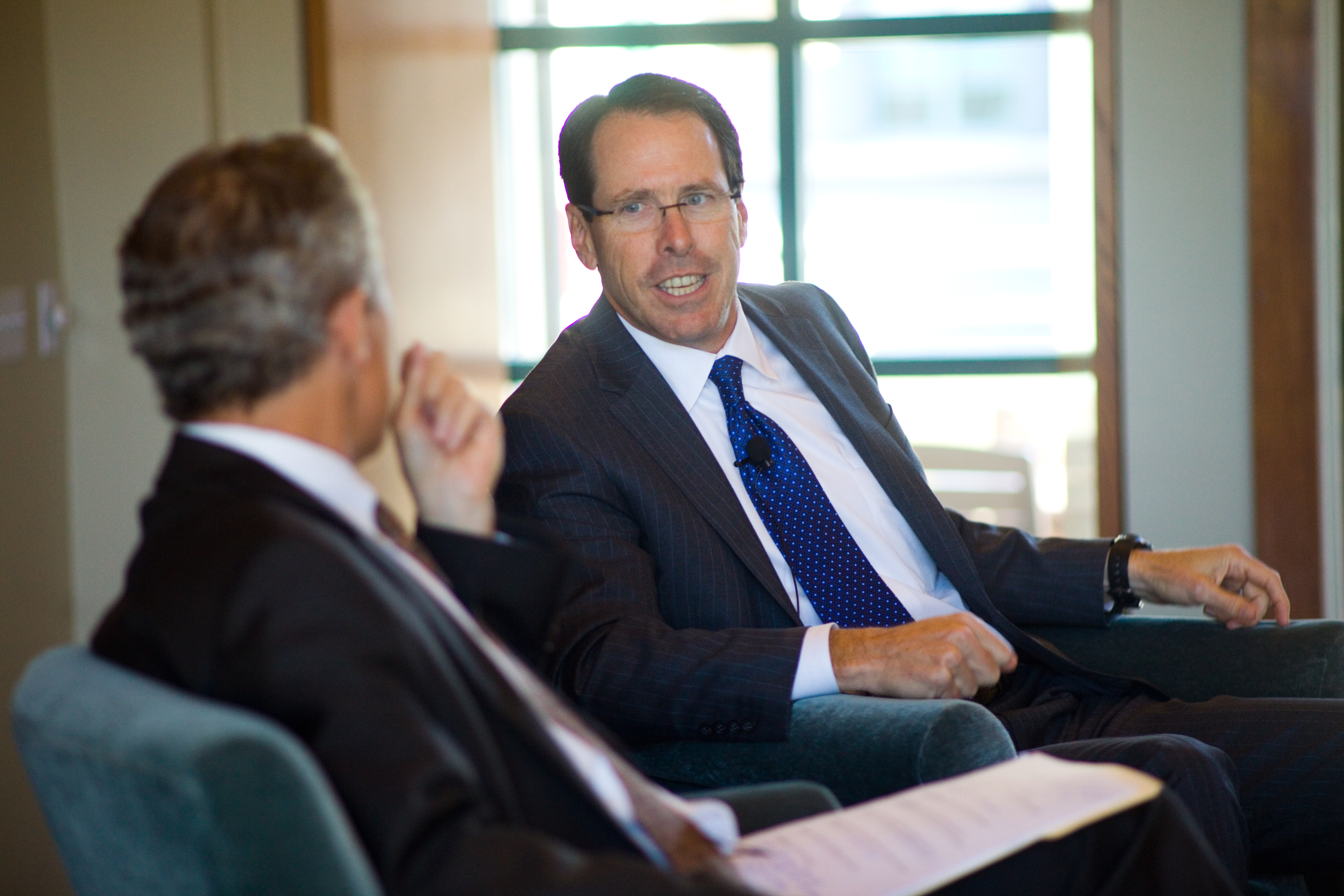
Rich Lyons, Dean of the Haas School of Business at UC Berkeley interviews Randall Stephenson, the CEO and Chair off ATT, September 6, 2012. Photograph by Kevin Warnock.
On Thursday, September 6, 2012, I attended the Dean’s Speaker Series at the Haas School of Business at the University of California at Berkeley, in Berkeley, California USA.
This was the first Dean’s Speaker Series I have attended.

Audience listens to ATT CEO Randall Stephenson speak, September 6, 2012 at UC Berkeley
I have been aware of this series for years, but I assumed attendance was restricted to friends of the Dean, Rich Lyons, because of the name of the event.
I’ve met and spoken with the Dean about ten times over the years, I estimate, including when he was the Acting Dean when Dean Tom Campbell took a leave of absence to help then Governor Arnold Schwarzenegger manage the finances of the State of California.
Rich Lyons, Dean of the Haas School of Business at University of California Berkeley, asks Randall Stephenson a question, September 6, 2012. Photograph by Kevin Warnock.
A couple of weeks ago I was looking over the Haas website and marveled at the outstanding list of upcoming individuals the Dean will be interviewing on stage. There in front of me were the magic words — the events are open to members of the Haas ‘community.’ I was pretty sure I qualified, since I am a sponsor of one of the school’s premier events, the Berkeley Startup Competition, and have been every year since 2000. I inquired and I got a seat — I was and am thrilled.
The Dean’s guest for this event was Randall Stephenson, the Chief Executive Officer of AT&T, the largest telecommunications company in the United States.
I am an AT&T customer, both for my home’s broadband Internet connection and for my wireless Apple iPhone 3GS, which I bought soon after launch. I no longer have a wired phone. I like AT&T’s service — I get great reception and few dropped calls.
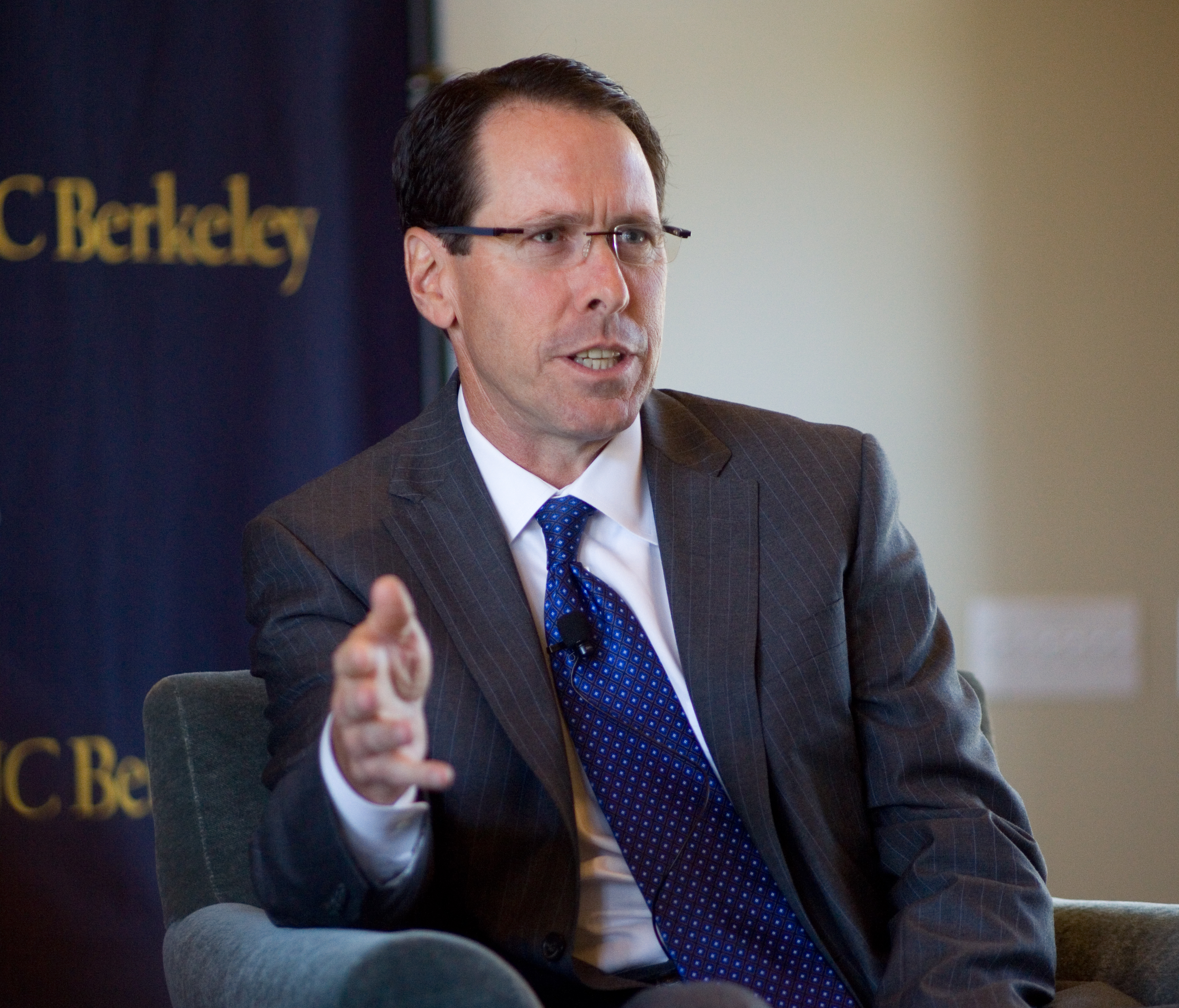
Randall Stephenson, Chair and CEO of AT&T, photographed by Kevin Warnock on September 6, 2012 at UC Berkeley
My regard for AT&T went up after listening to Stephenson speak for an hour. Stephenson was Chief Financial Officer and Chief Operating Officer prior to becoming Chair and CEO, among many roles.
He started at a job he called a ‘tape monkey’ at Southwest Bell Telephone in 1982 loading 19 inch diameter magnetic tapes of billing data onto tape drives. He did this work 12 hours a day — reading a video screen for instruction on which tape to load, finding the tape in storage, loading the tape and then pressing ‘Run.’
I did this same job, though not full time and not for 12 hours a day, when I worked at Cooley LLP. Thankfully I only had to do this role about two weeks a year, when the regular tape technician, Bill Calhoun, went on vacation.
Stephenson said he figured a way to rework his tape loading job to make it much more efficient and enjoyable, though he didn’t tell us the details of what he changed.

Rich Lyons, Dean of the Haas School of Business at University of California Berkeley, listens to Randall Stephenson answer a question, September 6, 2012. Photograph by Kevin Warnock.
During his introductory remarks, Rich Lyons said Stephenson worked in Mexico City as SBC’s Director of Finance.
At some point, Stephenson worked in Mexico for Carlos Slim, the iconic leader of Telmex. Stephenson did not explain how he came to work for Carlos Slim, who presumably was not an SBC employee at any point in his life.
Stephenson said Carlos Slim is ‘the most inherently brilliant individual that I’ve ever worked with.’
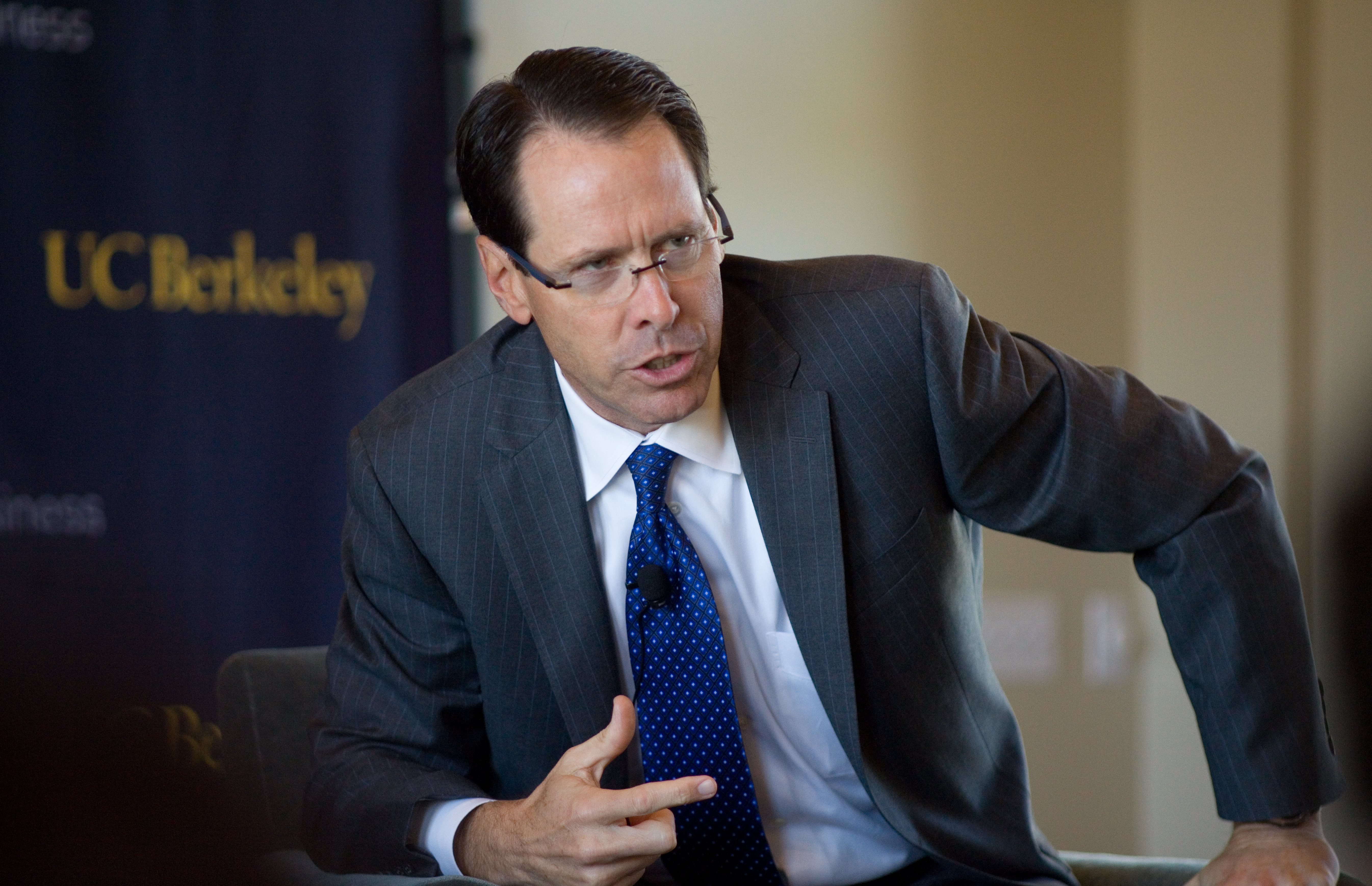
Randall Stephenson, CEO and Chair of AT&T, speaks at University of California at Berkeley, September 6, 2012. Photograph by Kevin Warnock.
Stephenson was in Mexico working for Slim in 1994 when there was an economic crisis that began December 19, 1994, when the Mexican government lifted all restraints on the Mexican Peso and let its value float. The Mexican currency lost 40% of its value in one day, Stephenson recalled.
Slim had 20,000 wireless subscribers in 1994, and thanks in part to the aggressive investments Slim made in the aftermath of the economic crisis of 1994, TelMex now has over 200 million wireless subscribers and Slim has made himself reportedly the wealthiest man in the world.
Stephenson took his job as CEO in June 2007 when ATT was a $100B annual revenue company with 300,000 employees, the same month that Apple launched its first iPhone. Stephenson invested heavily when the 2008 financial crisis came.

University of California Berkeley students listen to AT&T CEO and Chair Randall Stephenson speak, September 6, 2012
Stephenson said that 170,000 of AT&T’s employees actively participate in its TIP — The Innovation Pipeline — system conceived by the company’s CTO, a guy so tough to hire that it took ten years for Stephenson to do so. This system allows employees to propose ideas for the company to work on developing. People vote on the ideas and the best ones that float to the top are funded and pursued. In response to a question from a student in the audience, Stephenson said that apart from advertising the program to employees the company does little to promote participation. He said participation is quite good.
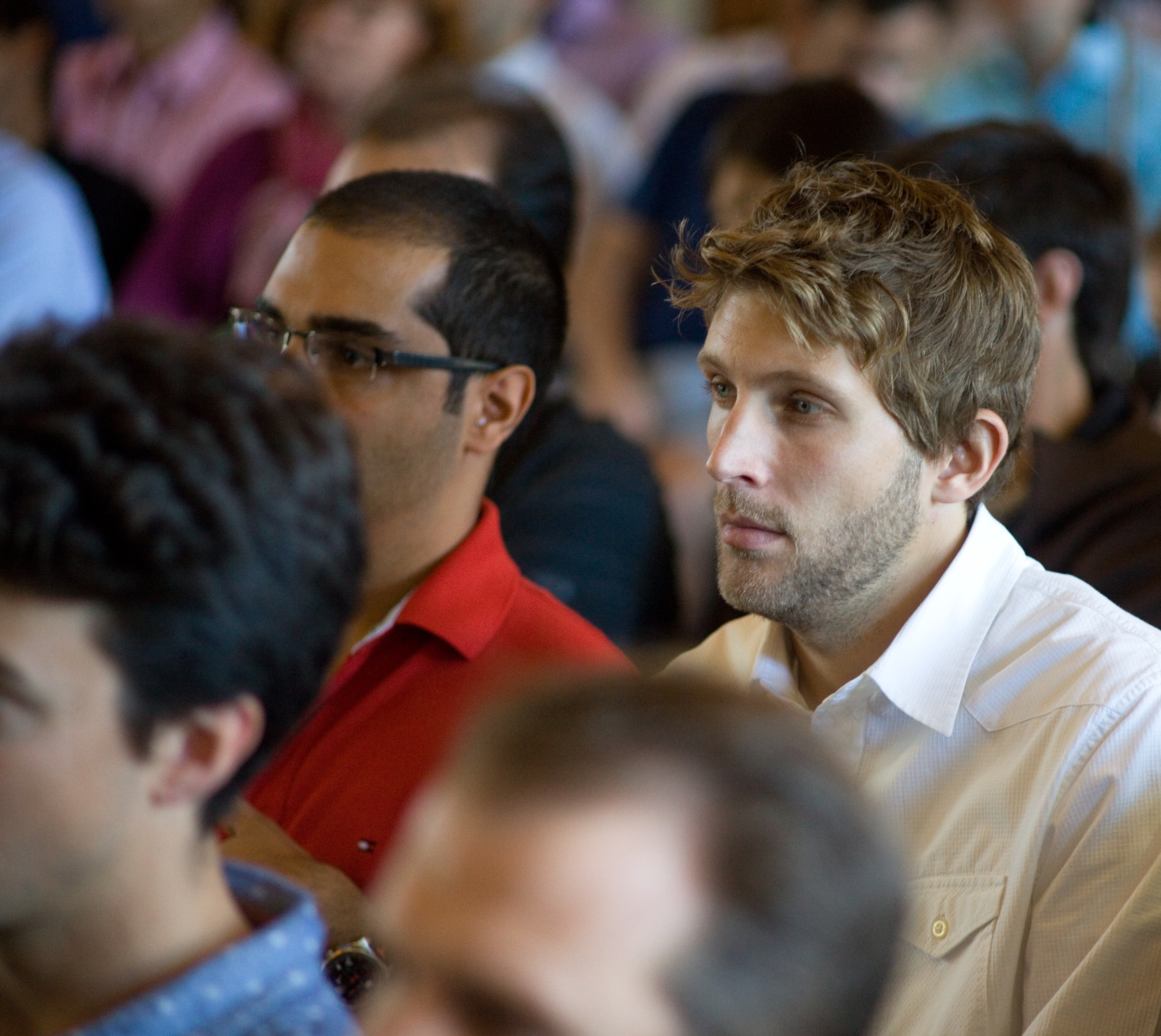
University of California Berkeley students listen to AT&T CEO and Chair Randall Stephenson speak, September 6, 2012
Stephenson and and his public relations person Larry (last name not mentioned) said they were so excited about a couple of their ‘tattooed up’ technologists in their Palo Alto, California research lab named the ‘Foundry’ that they put photographs of them in AT&T’s Annual Report. Stephenson divulged that competitors now are ‘coming after’ these programmers trying to hire them away from AT&T.
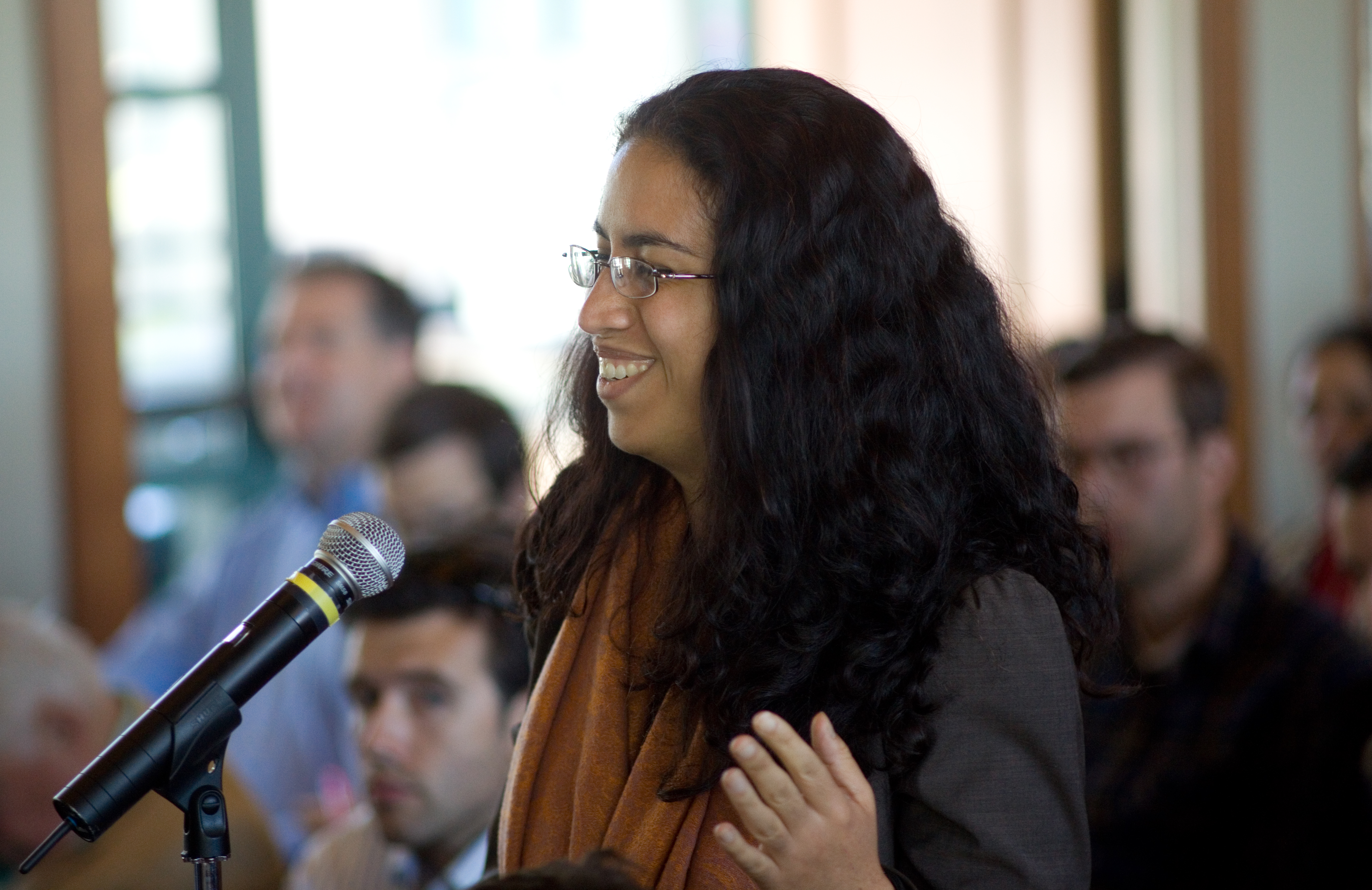
University of California Berkeley student asks AT&T CEO Randall Stephenson a question about AT&T's TIP suggestion system, September 6, 2012. Photograph by Kevin Warnock.
A student from the audience asked Stephenson to discuss wireless handset subsidies. Stephenson answered at length and concluded that the current system in the United States is overwhelmingly what customers want. He said AT&T performed studies where customers were asked if they would like to finance a phone via a separate finance contract, in exchange for markedly lower rates for service. Stephenson said customers did not like this proposal.
I think the survey respondents that answered this way are short sighted.
The way things operate in the United States, where one can buy a USD $700 iPhone for $200 because of the carrier subsidies, there is a perverse incentive to upgrade your phone exactly every two years. That is because contracts generally run for two years. If you keep a phone for three years, that final year you are paying much more than is warranted for service.
People should be encouraged to save money, not spend, so I admire the relatively new system reported by Stephenson to be the norm in Europe — phones are not subsidized and rates for service are [I hope] commensurately lower. Stephenson said phone sales dropped dramatically when this policy was implemented, but I say that is just what the world needs. People keep a home phone for decades. People keep televisions, stereos and other household appliances for years. Stephenson told me one-on-one after the event that fully 90% of his company’s customers upgrade their wireless phone every 14 months. Since contracts are two years long, 90% of its customers are paying early termination fees, which decline over time. That is a waste of the world’s resources, even in this day of a vibrant resale market for used mobile phones. I’m pretty sure a lot of people just throw their old mobile phones in a drawer, to benefit nobody. I understand mobile phones improve rapidly, and I do plan to get the latest iPhone when it’s available, having skipped the iPhone 4 and iPhone 4s. I just don’t approve of upgrading exceptionally frequently, which I consider 14 months to be.
I encourage AT&T and all carriers to offer unbundled rates for mobile service, as an option.
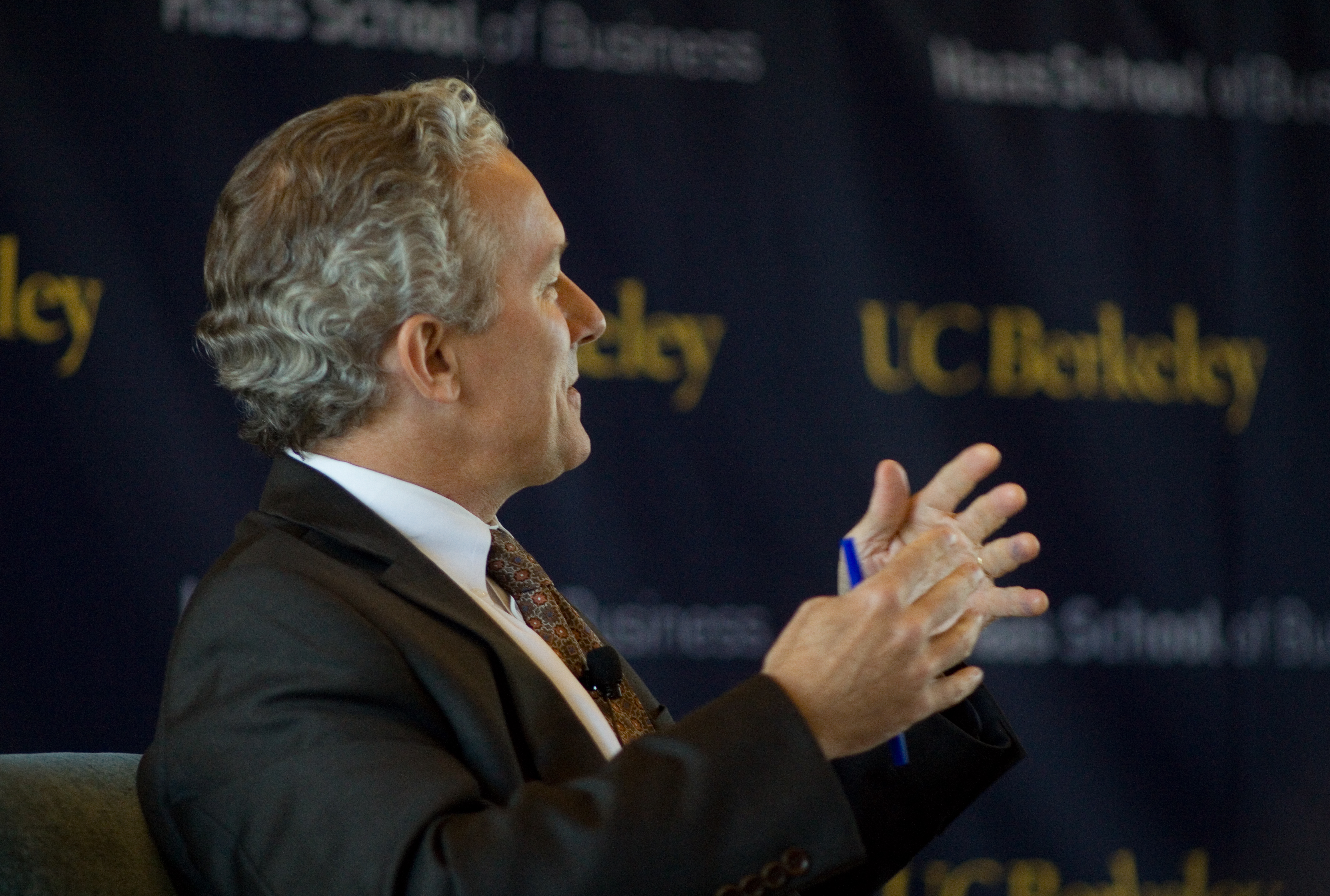
Rich Lyons is a good interviewer. The setting was photogenic — two handsome cushioned arm chairs on an elevated stage, with a small end table between the chairs. Lyons and Stephenson wore wireless lapel microphones. There was a backdrop behind the men that repeated the logos for UC Berkeley and the Haas School of Business, so the logos made it into every photograph of the people on stage. As a photographer, I applaud the Dean for creating such an inviting, warm and photogenic environment for his interviews. I look forward with enthusiasm to the next Dean’s Speaker Series interview, which I hope to be able to attend.
Former Haas Dean Dr. Laura D’Andrea Tyson is on the Board of Directors of AT&T, and presumably she helped Lyons recruit Stephenson to visit the Haas School. Tyson was Dean when I was a finalist in the Berkeley Business Plan Competition in 1999 with my company Hotpaper.
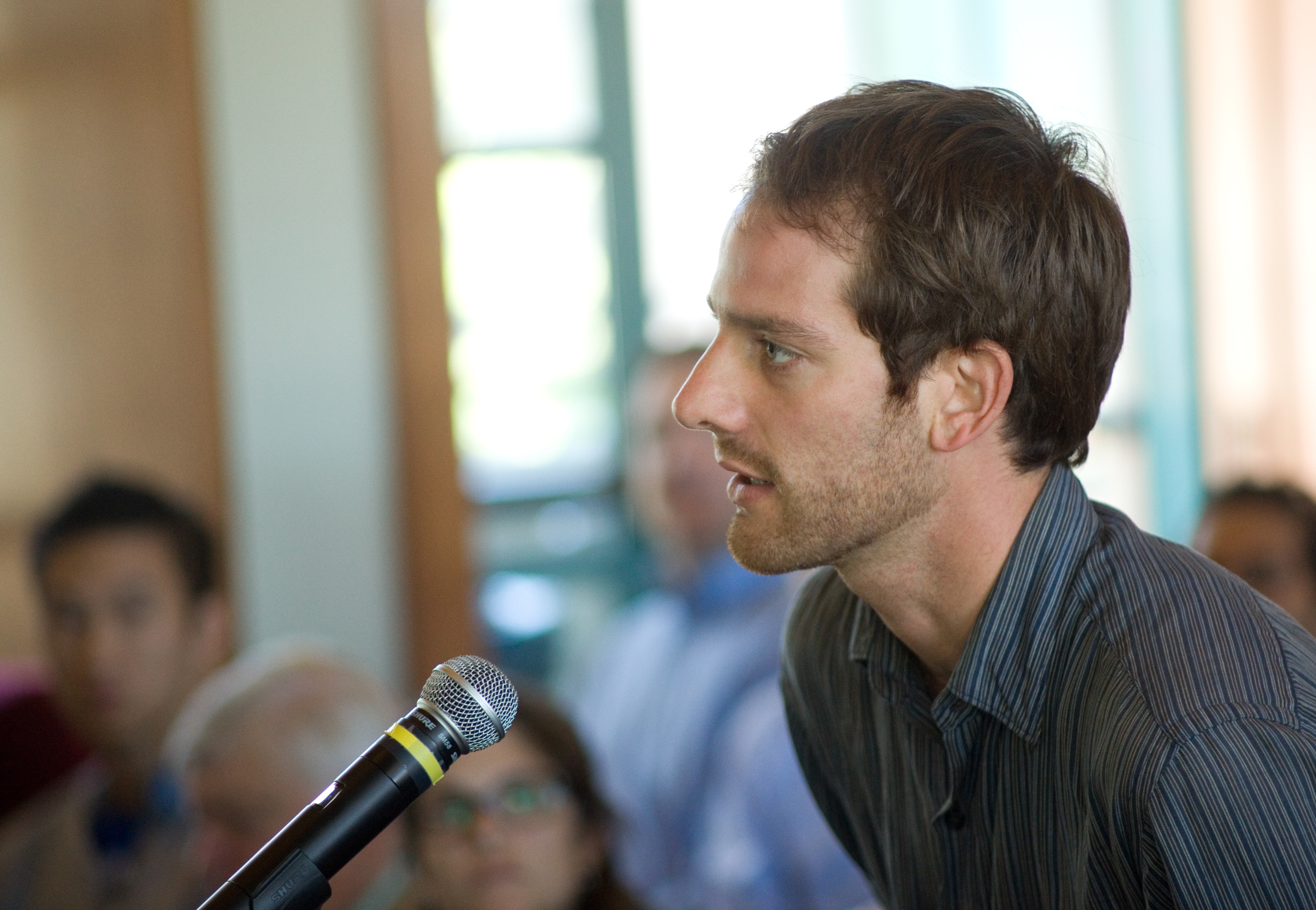
Student asks AT&T CEO and Chair Randall Stephenson a question about mobile handset subsidies, September 6, 2012, at University of California Berkeley
I took the photographs that accompany this blog post.
I used a Canon 5D Mark II camera with the following lenses: Canon 135mm soft-focus lens set to sharp, Canon 16-35mm L zoom lens. I upload pictures to this blog at maximum camera resolution at maximum image quality. Click on the photographs twice in delayed succession to see the full size images. If you would like to use these pictures, please send me a message. If the purpose is reasonable, I will allow usage. I enjoy having my pictures displayed elsewhere. I pursue photography only as a hobby, not as a profession.
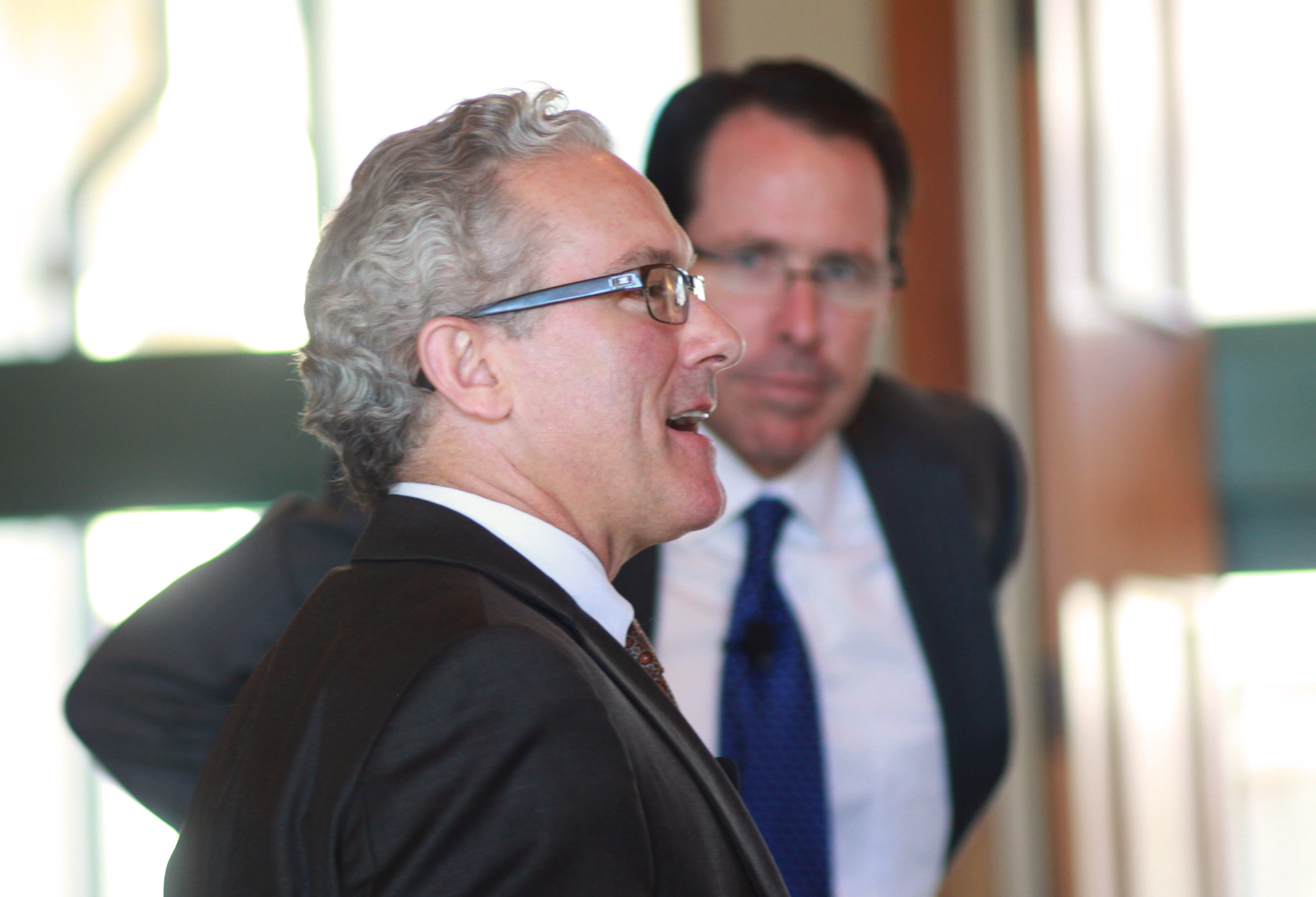
At the end of his interview, Rich Lyons stands with ATT CEO and Chair Randall Stephenson at the Haas School of Business, September 6, 2012. Photograph by Kevin Warnock.
Finally, I have some advice for Berkeley students reading this post — introduce yourself to the speaker.
I don’t recall seeing any students introduce themselves to Stephenson. I did see a professor and a president of a good sized company say hello, but that’s it. Stephenson spent several minutes talking with me because there was nobody waiting after me to speak with him. The room had rapidly cleared out. The interview was during the lunch hour, so perhaps the students had to be in class immediately after. It’s rare for so prominent a CEO to speak to such a small group — there were about 140 students in the room by my quick count. I’m sure Stephenson won’t be back this academic year. Make a point of meeting all such prominent speakers. In my mind, Stephenson should have been surrounded by dozens of students trying to shake his hand. Stephenson didn’t appear to be in a rush to depart, and I left before he did.
Art opening at D-Structure in San Francisco featuring art by Steve Javiel, Daniel Valadez and Megan Wolfe
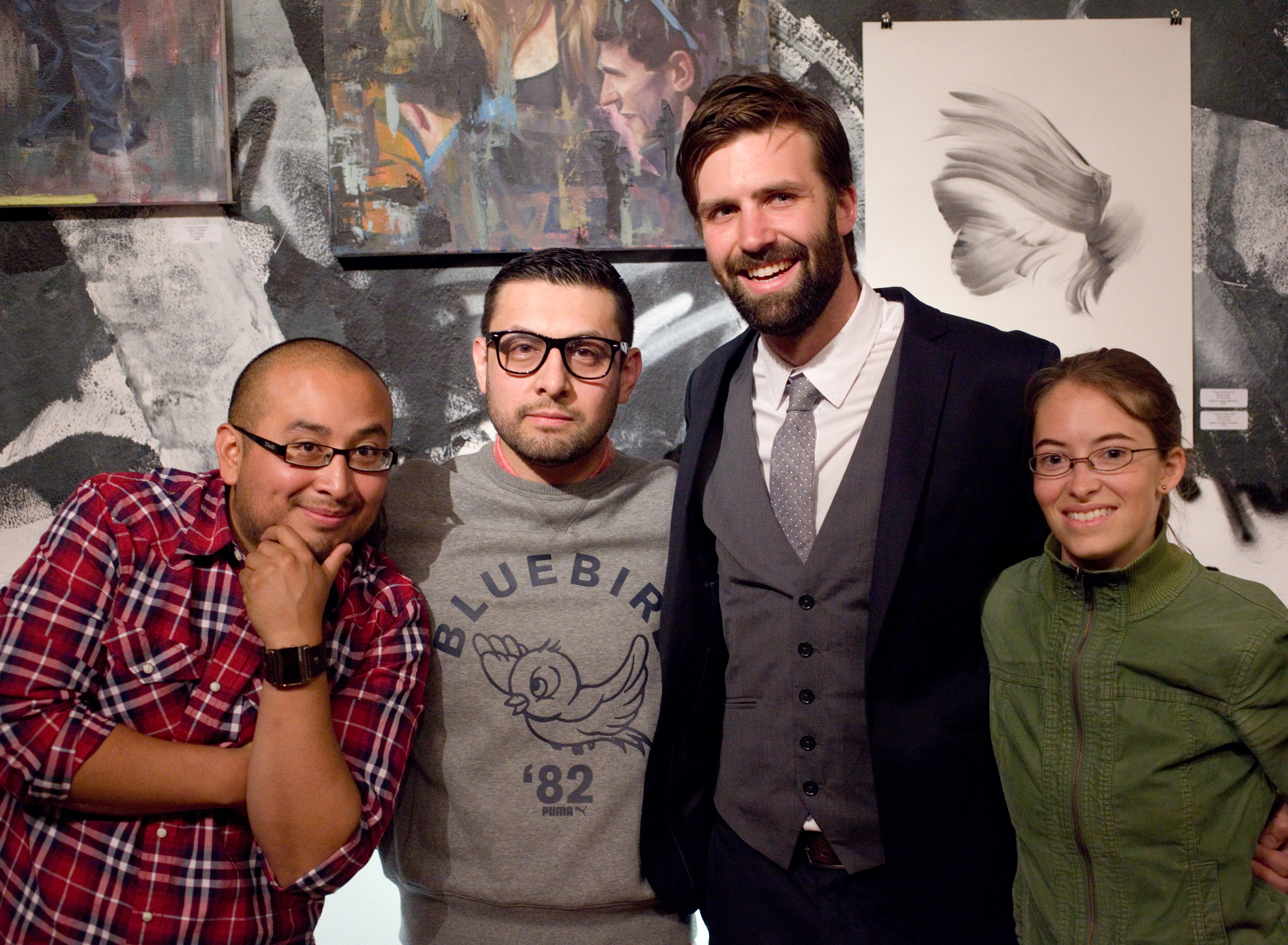
Steve Javiel, Daniel Valadez, Devon Chulick and Megan Wolfe at D-Structure, September 7, 2012. Photo by Kevin Warnock.
Yesterday evening, Friday, September 7, 2012, I attended an art opening at the hip clothing boutique and art gallery known as D-Structure.
I last wrote about D-Structure when the store hosted a trunk sale for Modify Watches.
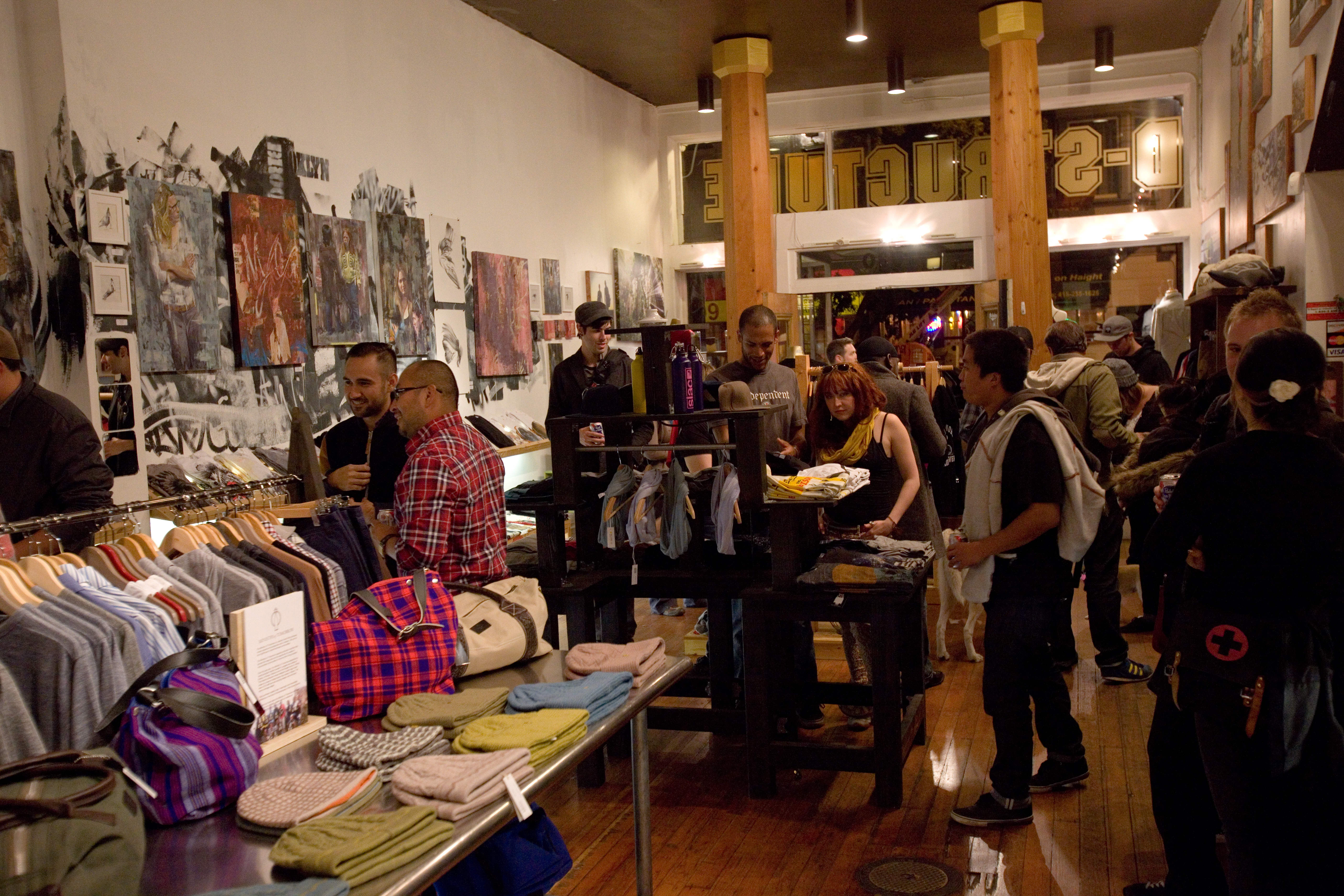
Art opening at D-Structure at 520 Haight Street, San Francisco, California, September 7, 2012. Photo by Kevin Warnock.
Devon Chulick, the new President of the Lower Haight Merchant Association, and the co-owner of D-Structure, introduced me to the artists — Megan Wolfe, Steve Javiel and Daniel Valadez.
The artists spent over 12 hours painting the wall that their artwork is displayed on, which you can see in the photographs above. Since this is original artwork, perhaps Chulick will find buyers for the drywall before this show is complete, to avoid having to paint over the large format piece. I loved the wall painting, as it tied the work of the three artists together, even though their styles are distinct.
I was in a rush to get to another art gallery opening, so I only spent about 45 minutes at the show. I didn’t get to interview the artists or really study the artwork, sadly, so I am sorry I can’t write a full blog post about this show. I like the art, particularly that by Javiel. I invite you to visit the websites of the artists, where you can see better quality photographs of their work. The color quality of the photographs I shot of their work is likely to be far off, as the lighting was not ideal for making accurate representations. The lighting was ideal for creating a warm and inviting atmosphere for an art opening.

Megan Wolfe at her art opening at D-Structure, September 7, 2012 at 520 Haight Street, San Francisco, California USA

Artwork by Megan Wolfe at D-Structure gallery, September 7, 2012
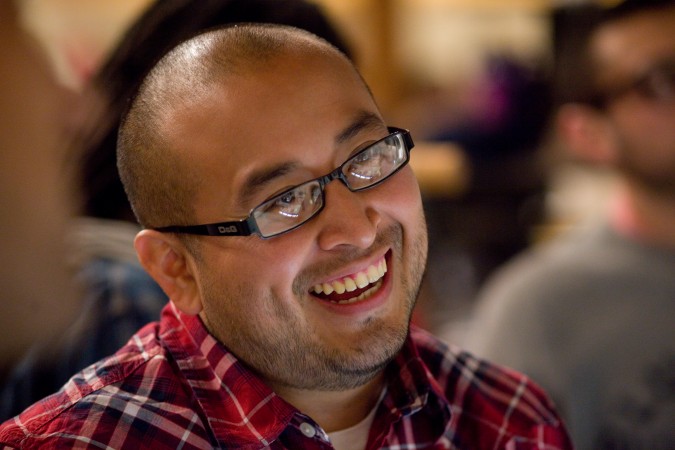
Steve Javiel at D-Structure gallery opening at 520 Haight Street, San Francisco, California USA. Photo by Kevin Warnock, September 7, 2012.
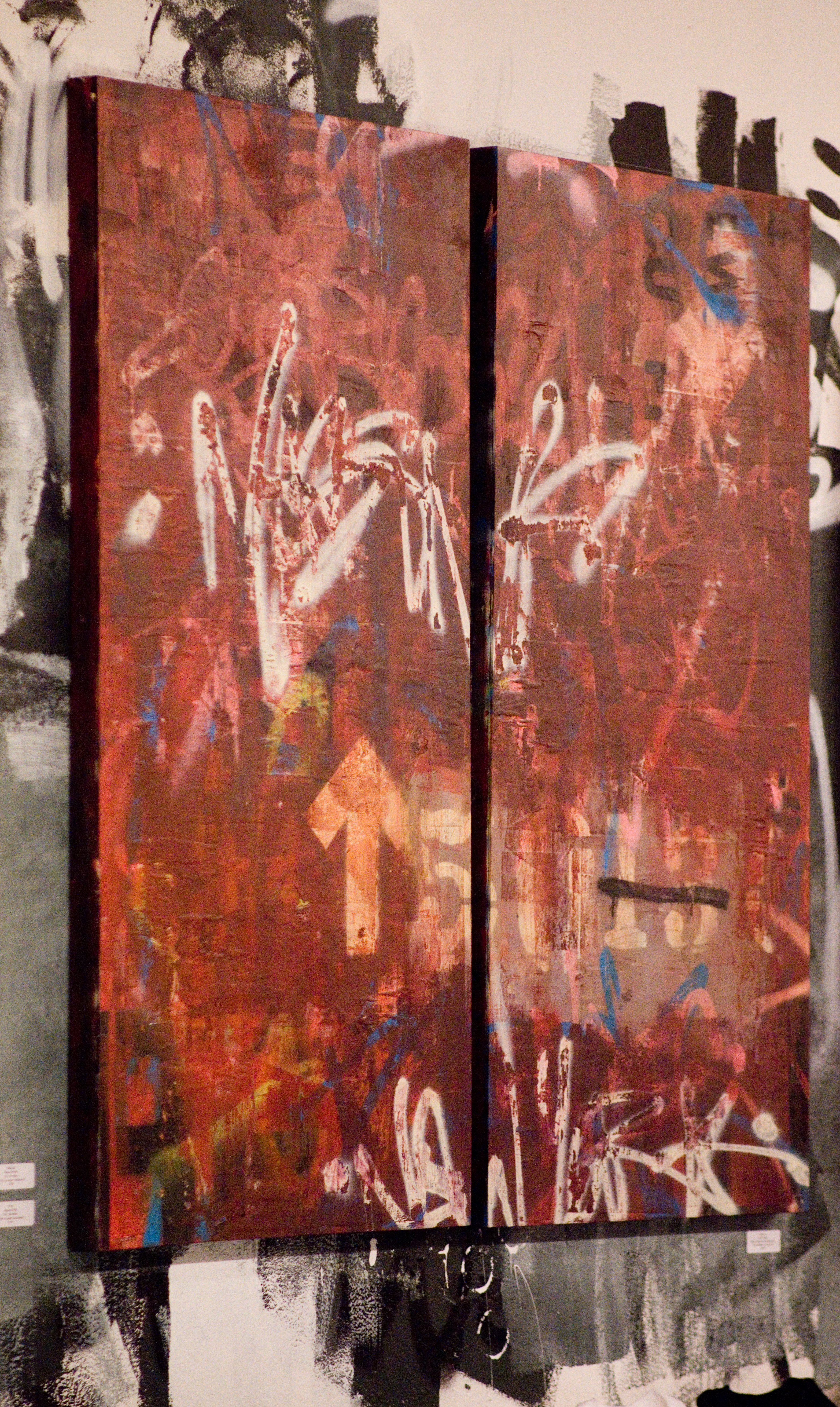
Artwork by Steve Javiel at D-Structure gallery, September 7, 2012
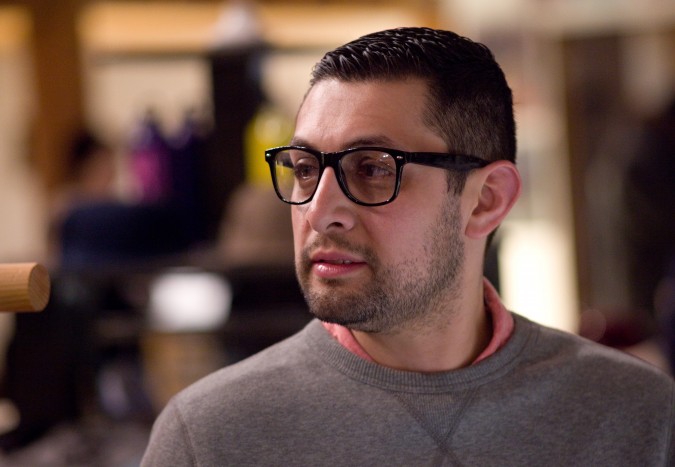
Daniel Valadez at D-Structure gallery opening at 520 Haight Street, San Francisco, California USA. Photo by Kevin Warnock, September 7, 2012.

Artwork by Daniel Valadez at D-Structure gallery, September 7, 2012, 520 Haight Street, San Francisco, California USA
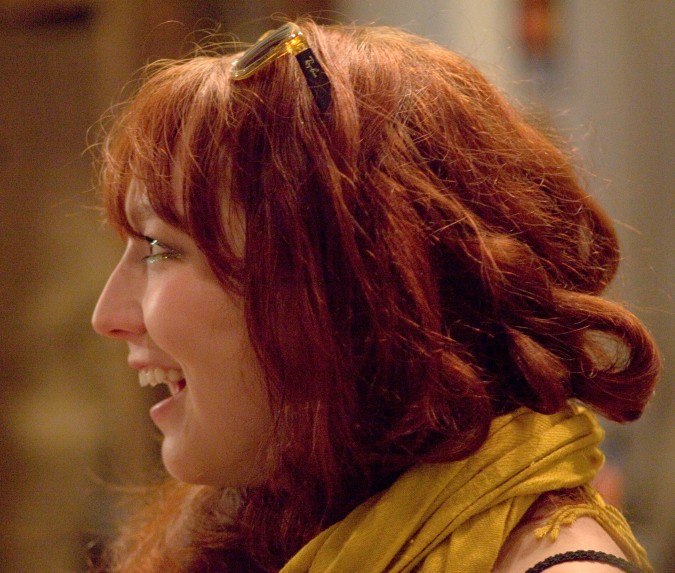
Jenya Rafi at D-Structure art opening at 520 Haight Street, San Francisco, California USA, September 7, 2012
To see these pictures at full resolution of 21 megapixels, please click on them twice in delayed succession. I used a Canon 5d Mark II camera and the following lenses: Canon 135mm soft-focus lens set to sharp, Canon 50mm macro lens, Canon 16-35mm L zoom lens.
Hana Alyssa Sidia gets the credit for my attending this art opening. I met Sidia at the Modify Watches event and she invited me to attend the art openings which she says D-Structure stages about once a month.
Click here to see all the posts I have published to this blog about D-Structure
Berkeley Entrepreneurs Forum, 2012-13 Angel & Venture Capital Financing Overview – August 30, 2012

The Berkeley Entrepreneurs Forum, August 30, 2012, held at Stanley Hall, room 105, because Anderson Auditorium was booked
On August 30, 2012 I attended the 2012-13 Angel & Venture Capital Financing Overview at The Berkeley Entrepreneurs Forum.
The August 30th Forum was the first of this academic year. The Berkeley Entrepreneurs Forum is a production of The Lester Center for Entrepreneurship & Innovation at the Haas School of Business at the University of California Berkeley.
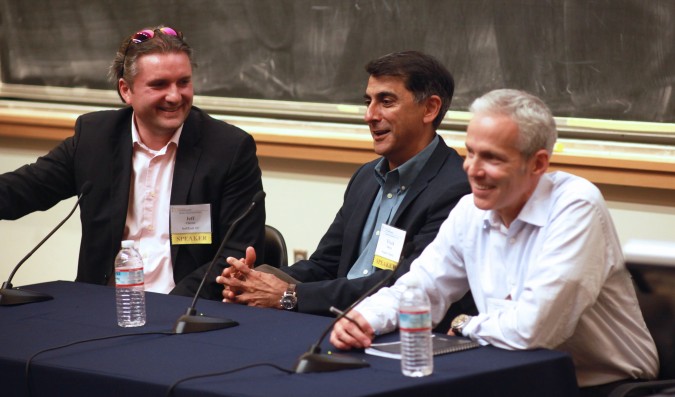
Panelists Jeff Clavier, Vivek Mehra and Jim Barnett at Berkeley Entrepreneurs Forum, August 30, 2012. Photo by Kevin Warnock.
The first Forum of the year for years now starts with Steve Bengston’s presentation of the Shaking the Money Tree report. I suspect Bengston has made this presentation hundreds of times, as he gives it not just at the Forum, but at many venues. In fact, I suspect it’s Bengston’s signature talk.
You can watch the full video of the Forum here to see what happened. I am a photographer, not a videographer. This is not the official video, which The Lester Center will publish in its entirety some weeks from now, I believe. I suggest you watch that version, because it will have professional sound from a mixing board, the slides will likely be full screen so you can read them, and the camera used is far better than the still camera I used that happens to also shoot video. I did not upload this video at full quality, since such video takes far longer to compress for Internet display.
There were some good lines from the speakers. I’ve transcribed my favorites here:
Steve Bengston:
“It [venture capital] finally got big in the mid to late 90s and now we worry when the venture business goes from $30B to $20B, but it never got above $20B until 1998 so the scale of the venture business is just much bigger than it’s ever been.”
“What about Series A, ‘didn’t that collapse?’ It is down certainly from the peak but you can see whatever that is there are $200M to $400M of series A deals each quarter just in Silicon Valley and that represents about 50 to about a 100 Series A deals in Silicon Valley each quarter.”
“The good news is there is a lot of money for your deal if you meet the certain metrics for an investor.”
“If you’re going to raise money which is still hard to do, you’re going to raise around $3M. That’s a typical deal. In this era, that buys you a lot more months of burn than it would have say ten years ago.”
“You have 300 to 400 M & A exits in the US a year in the US, much higher than the old days.”
“The top five or so [venture] firms are raising 80% of the money.”
“It begs the question ‘How many VCs do you need to find the 30 good companies every year?’ Right now the answer is about 3,000. For many people that seems high.”
“China has been the number one economy 15 of the last 18 centuries. So, just because they have had a couple of bad centuries you don’t want to count them out. They are used to being on top.”
Jeff Clavier:
“The challenge at the early stage is that even great founders can come up with really stupid ideas.”
“Do it because you are passionate about it, not because it’s cool.”
“I passed on airbnb that some showed me when it was called air bed and breakfast and I said ‘air bed and breakfast… are you f—ing kidding me?'”
Jim Barnett:
“One of the danger signs that all the partners look for is what we call ‘complexifiers’ — people that take what is otherwise a relatively simple business proposition or business idea and figure out how to make it complex.”
“The one thing I would say to those thinking about starting a company or planning to start a company is just go do it. Your idea really doesn’t need to be that great. It really doesn’t. If you’re great, it will get funded.”
“I want to dispell a myth that you learn more from your mistakes than you do from your successes. I think that is just a bunch of crap. I really do. I think you learn from watching success — pattern matching, whether it’s in sports whether it’s in business or anything else so for those of you that are in the audience that are MBAs or that are undergrads that are thinking about what do if they’re not going to start a company I would say ‘go work for a successful company and watch.’ You’ll learn a lot more than doing three failed startups.”
Vivek Mehra:
“I hate doing deals over the weekend. I have never done one and I hope I never have to do one. It’s just impossible to get to know the entrepreneur.”
“When there are very asymmetric equity assignments amongst the team you know what they really think about each other.”
Here is my succinct summary of this Entrepreneurs Forum:
- The venture industry is in trouble, but there is still plenty of money around.
- Lots of angel investors are making what will prove to be poor investments so this increases the chances that you can raise money even if you or your idea are not that good.
- There is a lot to be gained by just starting a company, so if you are passionate about doing so, then go for it. You won’t ruin your chances for future success by failing a few times.
- However, if you’re not going to start a company, you should work for a clearly successful company so you can pay attention and learn from the success of others.
- Surround yourself with high quality people.
- Don’t make things more complicated than they need to be.
- Have your role worked out with your founders before you pitch to investors. Lopsided equity divisions speak loudly to investors what you think of your co-founders.
- Increase your chances of getting funded by persistently pursuing entrepreneurship over years, so investors may gauge your actions over your words.
- Work hard and recognize that a lot of success may be attributed to your ability to forge healthy and respectful long term relationships with people in the community.
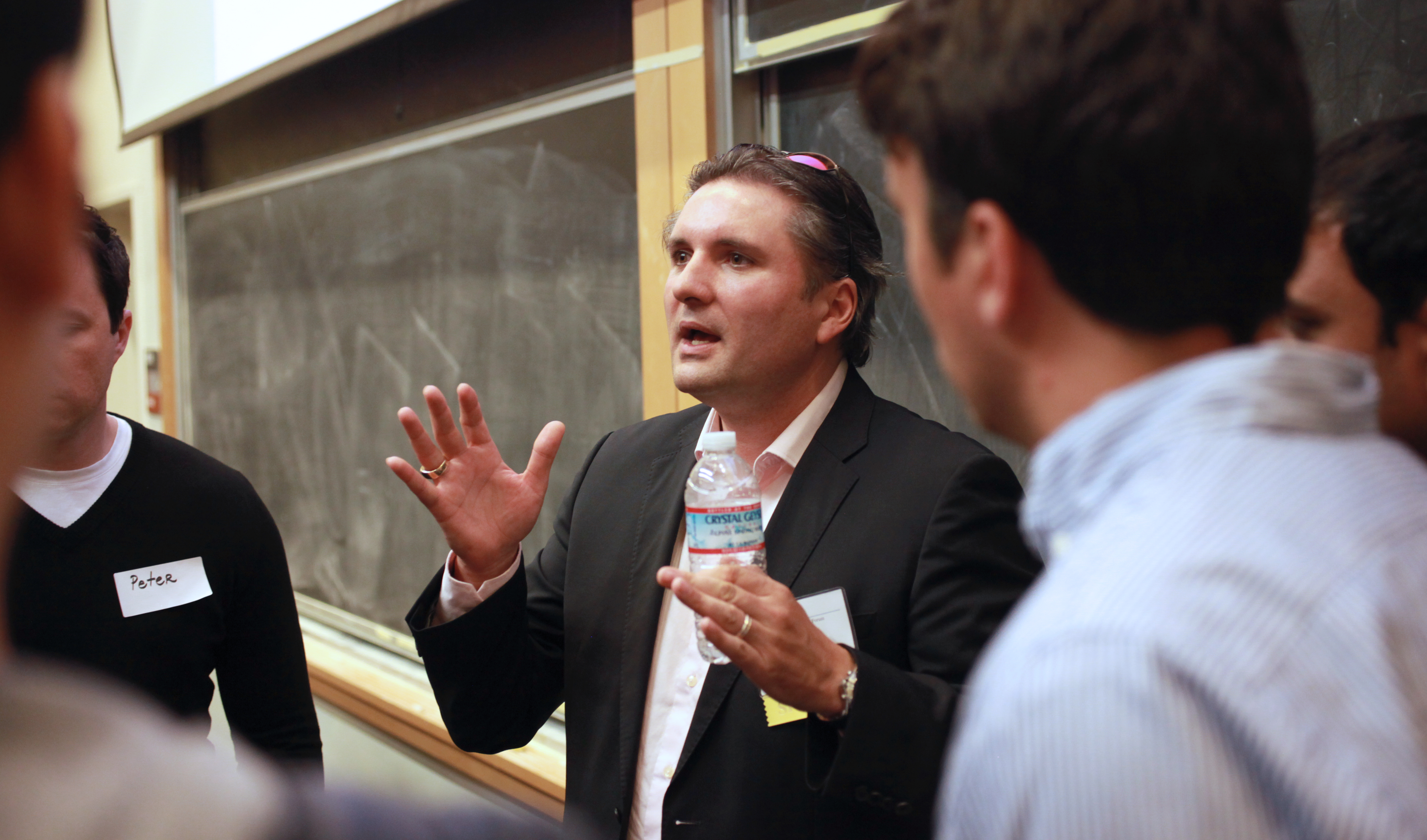
Panelist Jeff Clavier answers questions at the Berkeley Entrepreneurs Forum, August 30, 2012. Photo by Kevin Warnock.
From the Berkeley Entrepreneurs Forum website, here are the introductions for the moderator and speakers — I added the hyperlinks to make it easier for you to learn more about the panelists and their many interests:
Samuel B. Angus
Partner
Fenwick & West LLP
Samuel B. Angus is a partner in the Corporate and Venture Capital Group of Fenwick & West LLP, a law firm specializing in technology and life sciences matters. Mr. Angus is resident in the San Francisco office and his practice concentrates on advising start-up/venture-backed companies, venture capital and debt financings, mergers and acquisitions, intellectual property licensing, joint ventures and general corporate matters. Mr. Angus represents a broad range of companies from privately held start-up companies to publicly traded corporations, including Airbnb, Github, Marin Software and oDesk. His practice also includes advising entrepreneurs and investors.
Jim Barnett
Partner
Shasta Ventures
Jim Barnett is a Partner at Shasta Ventures and has been a highly successful serial CEO and entrepreneur. Jim is currently chairman and co-founder of Turn, chairman of Extole and Sojern, and a board member of Needle and RelayRides. From 2004 until 2009, Jim was CEO, chairman and co-founder of Turn, the leading platform for managing data driven digital advertising. Before that he was president of Overture Search, a division of Overture Services, Inc. Jim joined Overture via its acquisition of AltaVista Company, where he was president and CEO. In this role, he led the company’s successful turnaround and sale to Overture.
Jim was also president of Ancestry.com (MyFamily.com) and president and CEO of ThirdAge Media, which was acquired by Ancestry.com. Prior to that, Jim was president and CEO of Infogrammes North America, a leading global publisher of video games and entertainment software. He was also chairman, president and CEO of Accolade Inc, Infogrammes’ predecessor company, and prior to that was chief operating officer of an “Inc. 100 Fastest Growing Private Companies.”
Jim has served on the boards of many private and public companies including SideStep, Inc. where he was chairman and Petco where he was also an early investor. Jim earned a bachelor’s degree, MBA and J.D. from Stanford University.
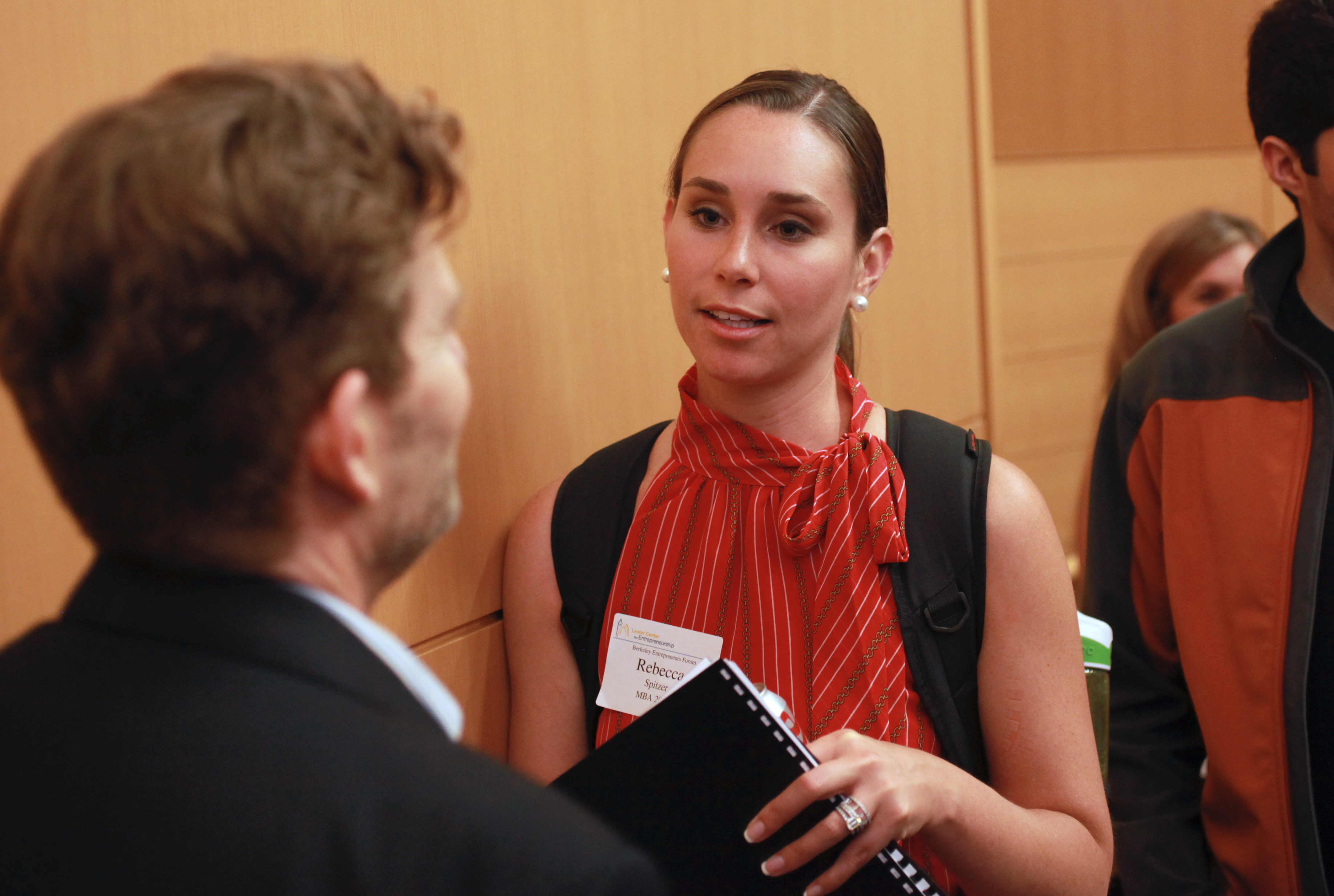
Moderator Sam Angus listens to student Rebecca Spitzer pitch her startup at the Berkeley Entrepreneurs Forum, August 30, 2012
Steve Bengston
PricewaterhouseCoopers
Steve Bengston heads the Emerging Company Services (ECS) group at PricewaterhouseCoopers. ECS acts as “mentor capitalists” for young, high potential companies.
Before joining PwC, Steve had 20 years of experience in a variety of marketing, business development and general management roles at several high tech companies in the Bay Area. Most recently, he was Pres/CEO of ynot.com [Note: not the website now online at that URL], a leading international emarketing and greeting card company. Previously, he was VP Marketing & Business Development at Worldview Systems, an Internet travel pioneer. At Worldview, Steve helped launch and market Travelocity with Sabre Interactive.
Steve has a BA in Economics and MBA from Stanford University. He works closely or sits on the Advisory Board at Churchill Club, SVASE, Life Science Angels, Bay Bio, and the Stanford/MIT Venture Lab, has taught classes on startups at UC Berkeley, San Jose State, Santa Clara Law School, Hastings Law School, and Stanford, and is active in a variety of other organizations in the Bay Area targeting entrepreneurs and investors. He is a frequent moderator/panelist at both university and industry sponsored events.
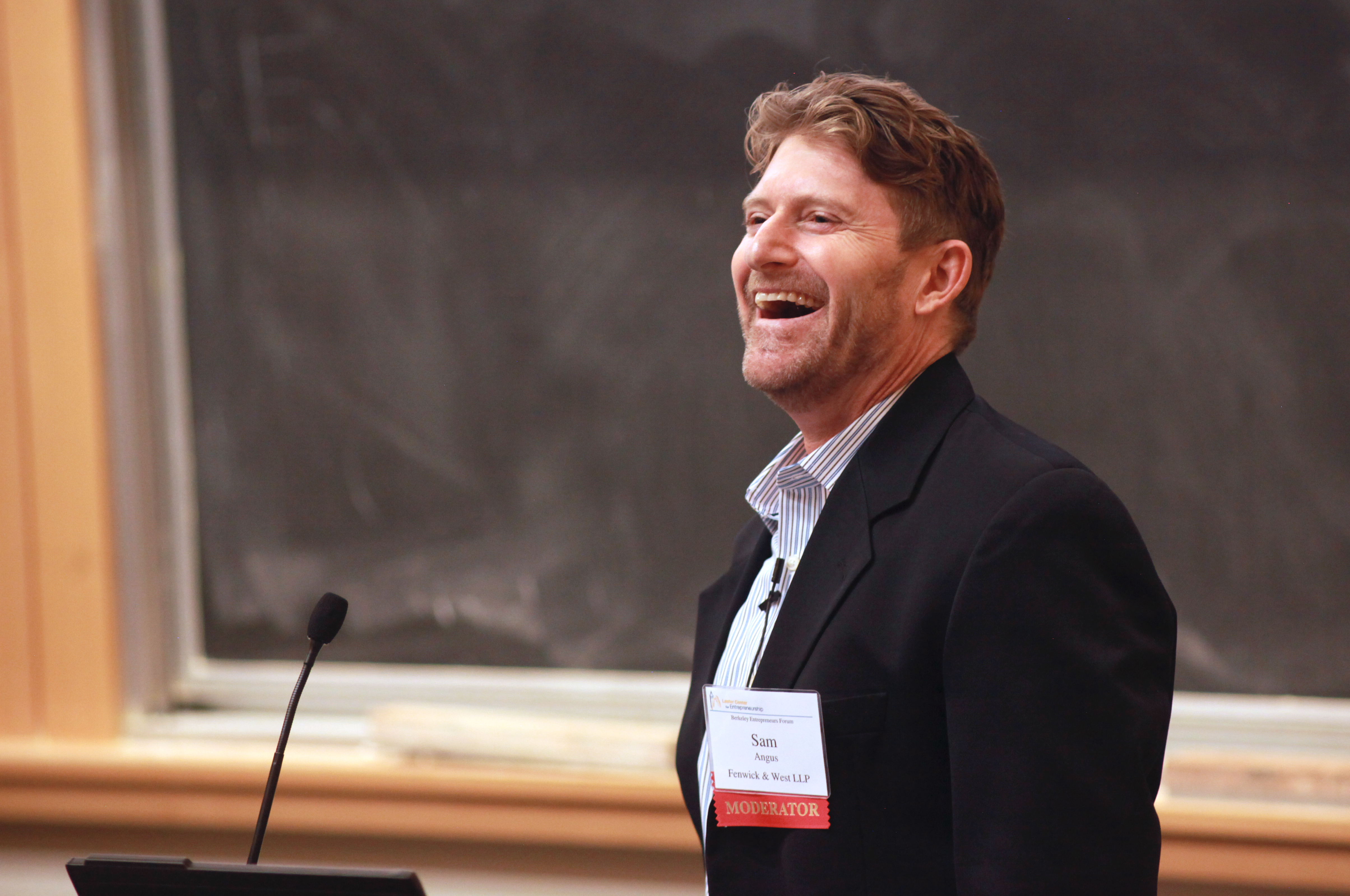
Sam Angus, a partner at law firm Fenwick & West LLP, moderates a panel at the Berkeley Entrepreneurs Forum, August 30, 2012
Jeff Clavier
Founder and Managing Partner
SoftTech VC
Based in Palo Alto, California, Jean-Francois “Jeff” Clavier is the Founder and Managing Partner of SoftTech VC, one of the most active seed stage investors in Web 2.0 startups. Since 2004, Jeff has invested 125 consumer internet startups (Fund I, Fund II, Fund III) in areas like social media, monetization, search, gaming or B2B/B2C web services. These investments are typically located in Silicon Valley, New-York and Boulder. With over 20 years of operational, entrepreneurial and venture capital experience, Jeff is able to add relevant perspective and value to his companies as they grow from inception to maturity, and hopefully, success.
Jeff was recognized as one of the 13 “Web 2.0 King Makers” by (late) Business 2.0. BusinessWeek named him one of “The 25 Most Influential People on the Web” in 2008, and one of the “Top 25 Angels in Tech” in 2010. He was also nominated in the “Best Angel” category at the Crunchies in 2009 and 2010. He is often noted for his investments in categories such as “passion-centric communities” or online gaming, or for having sold a number of his Web 2.0 startups to the likes of Yahoo, AOL, Intuit or more recently PayPal, Twitter and Groupon.
Some of Jeff’s representative investments include Mint (Intuit), Brightroll, Truveo (AOL), Userplane (AOL), Rapleaf, Ustream, Milo (eBay), Blekko, Eventbrite, Tapulous (Disney), DNANexus, FanBridge, BillFloat, Fab, Gigwalk, Byliner and Wildfire.
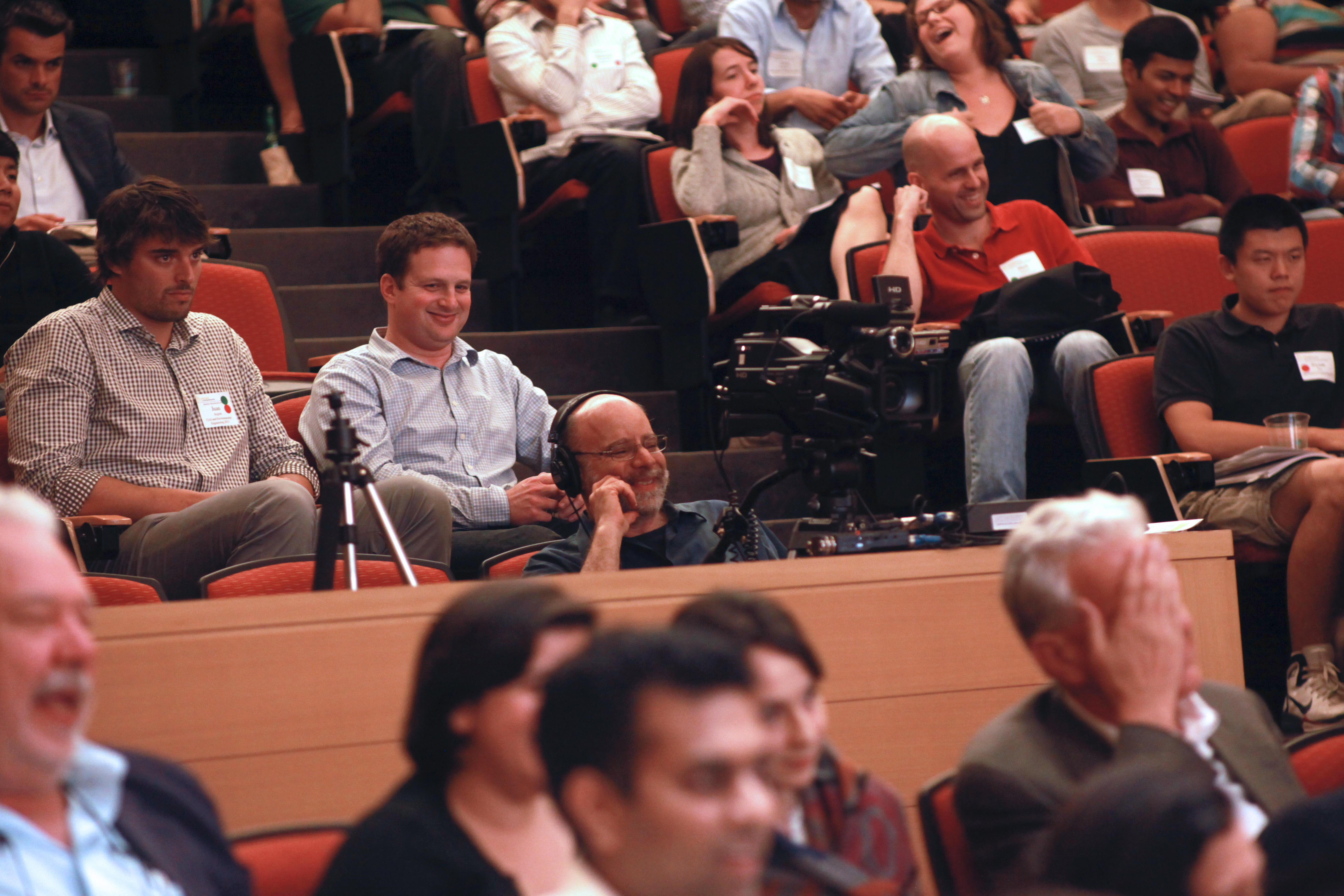
Stuart Sweetow, owner of Audio Video Consultants, capturing video at the Berkeley Entrepreneurs Forum, August 30, 2012
Vivek Mehra
August Capital
Vivek joined August Capital in 2003. He invests broadly in IT infrastructure and areas of interest include data center technologies, systems management, security, storage, and cloud computing systems and software. Prior to joining August Capital, Vivek co-founded Cobalt Networks in 1996. As CTO & VP of Product Development, Vivek built the first successful server appliance and grew Cobalt into a worldwide leader in the category, culminating in a successful IPO and acquisition by Sun Microsystems for $2B. At Sun, Vivek served as the Vice President and General Manager of the Cobalt Business Unit and a member of Sun’s Technical Architecture Council. Prior to founding Cobalt, Vivek held a number of technical and management positions at Apple, SGI, and Digital Equipment Corporation and successfully developed numerous products including Internet enabled set-top boxes, PDAs, RISC workstations, and high performance graphics subsystems.
Vivek received a BS in Electronics from Punjab University, India, and an MS in Computer Engineering from Iowa State University.
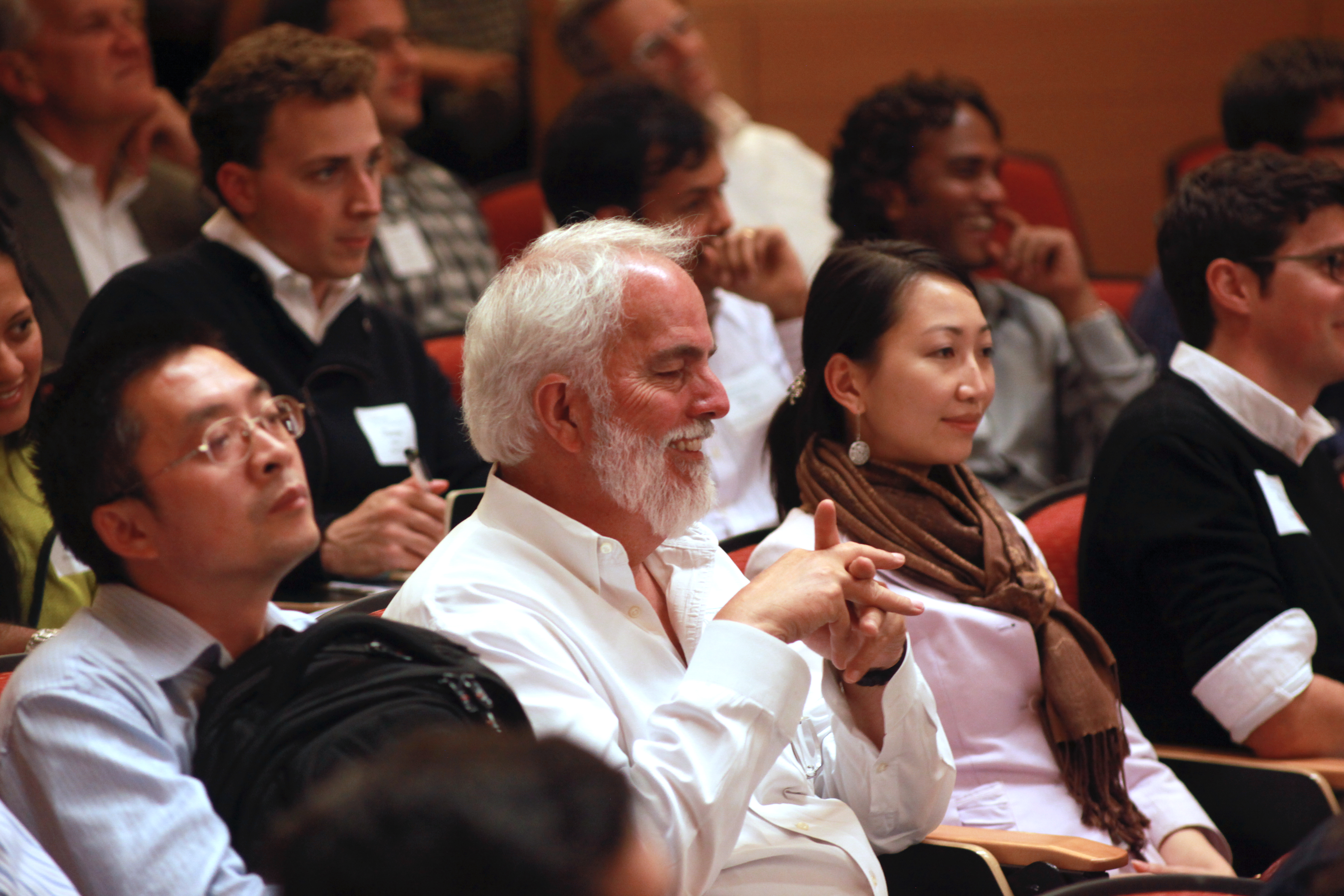
Audience members enjoying a funny moment at the Berkeley Entrepreneurs Forum, August 30, 2012
To my knowledge, I have been attending The Berkeley Entrepreneurs Forum for longer than anyone else besides Jerry Engel, who founded The Lester Center in 1991 and was its Executive Director for nearly two decades.
I have some suggestions to improve the The Entrepreneurs Forum, which I will describe here. I am posting these suggestions publicly because they are likely applicable to numerous programs across the globe, and I’d like to see these ideas adopted widely if people think they are worthwhile.
1. Dispense with the table panelists sit at. The table doesn’t look good on camera or video, and over time the majority audience for the Forum should be watching online, since the rooms frequently sell out already. Panelists should sit on arm chairs or couches, like they do at most tech conferences that I attend. The moderator should sit with the panelists and not be off to the side standing at a podium. All the people on stage should be outfitted with wireless lapel microphones. I would like the Forum to appear more conversational in style. The table separates the speakers from the audience, where arm chairs suggest a residence for a more intimate vibe.
Here’s an example of a more visually appealing way to run a panel. Steve Bengston is the moderator for this panel at The Churchill Club, where he is a member of its Board of Directors and its past Chair.

Jeff Burton, the brand new Executive Director of the UC Berkeley Skydeck, talks with Jim Barnett of Shasta Ventures, August 30, 2012
2. Commercial bottled water should be forbidden on stage, even if the speakers bring it with them. Nearly all the conferences I attend serve water from pitchers into real glasses. Bottled water is an evil product, and it looks bad in photographs and video to see those bottles. Image is important, and promoting bottled water by showing it on stage should stop.
3. Commercial bottled water should not be a beverage choice during the networking hour. Tap water should be offered, and it should not require a drink ticket.
4. When it comes time for audience questions, invite the questioner to sit on stage in an arm chair or on the couch while they ask the question and while they are receiving the answer. This will give the questioner time on video, and will permit them to look the speakers in the eye. This will be a treat for the audience members, because they’ll feel they get to ‘meet’ the panelists for 60 or 120 seconds. Questioners can line up to get their turn on stage. Questioners should be encouraged to state their first and last name, so they can be identified online.
5. Although I appreciate that it’s a lot of work, the Forums should be transcribed, and the transcribed text should be posted online. This is a certain way to get more traffic to The Lester Center website, and it’s likely to increase the interest in the Forum from attendees that can’t attend in person.
6. All Forums should be archived online, including Forums from ten and twenty years ago. Forums should never expire and be removed.
7. The ‘numbers’ should be videotaped and included in the online video. The numbers are often the most interesting part of the evening. The contact information for the number presenters should be posted online, with permission of course, and there should be a hyperlink to the project the person is working on.
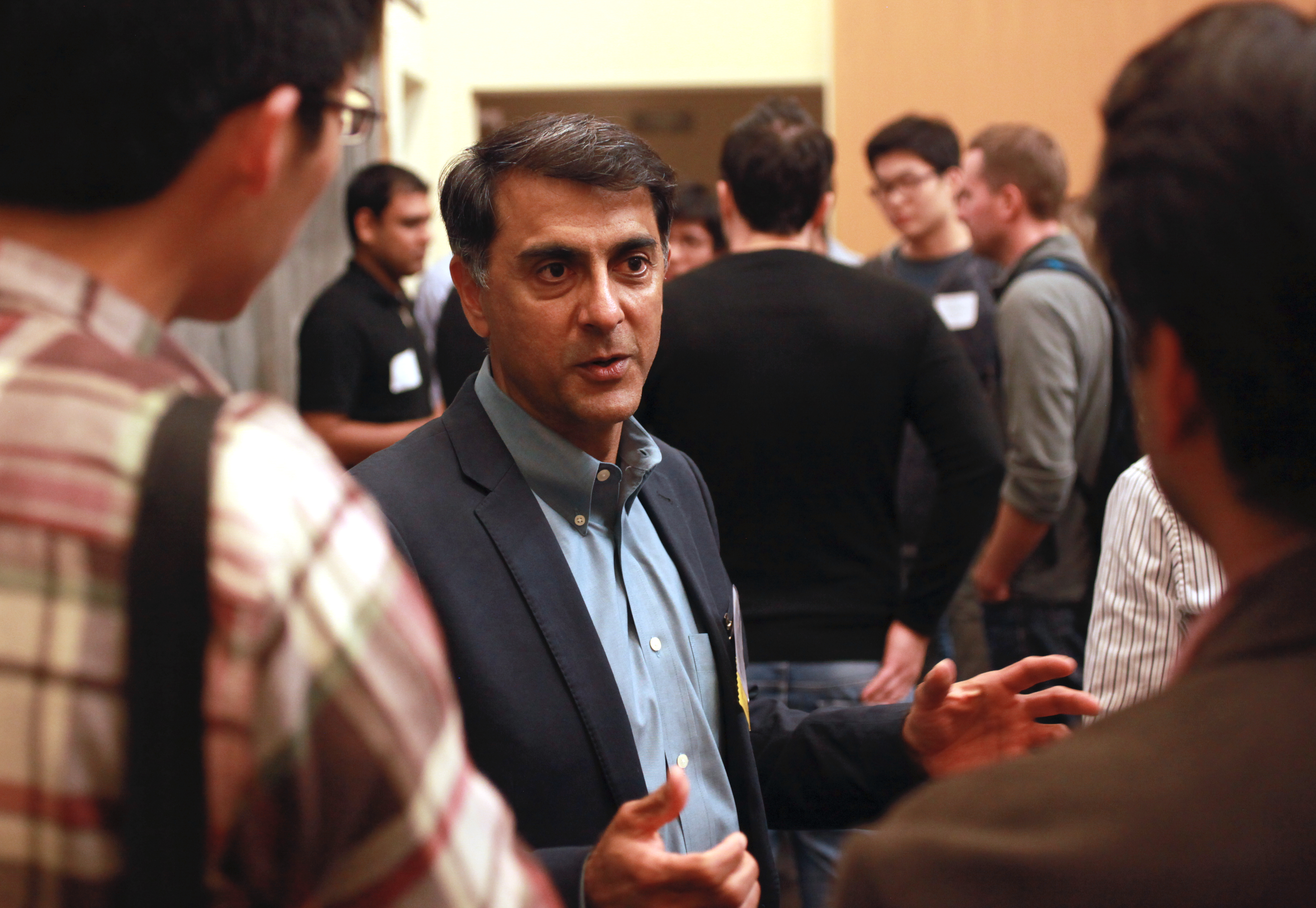
Vivek Mehra, a partner at August Capital, answers questions posed by attendees at the Berkeley Entrepreneurs Forum, August 30, 2012
8. The photographs taken by Bruce Cook, the official photographer, should be publicly posted to Facebook, and should be tagged. Once the identities of the people pictured are known via the tagging, the captions for the official Lester Center website should be updated to identify everyone whose name is known. If required, change the terms of the tickets purchased to give UC Berkeley the right to identify the people by name. Offer an ‘opt out’ list during checkin. Having the names with the pictures will increase traffic to The Lester Center website, since people will search for those names for decades to come. Invite people to tag the pictures in the emails The Lester Center sends out and via Facebook status updates.
9. A vast collection of at least 5,000 of Bruce Cook’s unpublished photographs of the Forum from the last twenty years should be published to Facebook and the Web, and they should be tagged and captioned. This was entirely my idea — Cook did not hint that I propose such an idea. The majority of the pictures published should be of the networking hour, to get as many people from the audiences over the years tagged as possible.
10. The Forum should be oversold, like airplane seats. This August 30th Forum was ‘sold out’ but there were unfilled seats in the auditorium, which takes away from the excitement of a sold out show. If too many people show up, they can watch on video monitors in the Bank of America Forum, and as compensation for not getting a seat, their entrance fee can be 100% refunded. I predict the revenue over time from overbooking will more than make up for the refunds that need to be given. Attendees should be told when they buy their tickets they risk being bumped, and encouraged to arrive early to be sure they get a seat.
11. The reminder to ‘Like’ The Lester Center on Facebook should be repeated on a poster displayed during the Forum. The Forum’s Twitter handle should also be on this poster.
12. Attendees should be given a perk if they follow the Forum on social networks, such as a second drink ticket on their next visit to the Forum, to encourage getting as many followers as possible. Currently attendees may eat unlimited quantities of food at the Forum, but are permitted only one drink, either with alcohol or without.
13. Attendees should be invited to blog and post about the Forums, and The Lester Center site should find and link to the best examples of such efforts, to encourage people to write about the Forum.
I am one of the only bloggers writing about the Forum, but there should be at least several.
14. I love the luxurious food served during the networking hour, but it sure seems like it must cost a fortune. I think it would be more than fine to switch to less fancy food. There is precedent for this. Last year at the Founder School Demo Day what appeared to be inexpensive sandwiches were served, but the event was superb and not diminished by the more everyday food. I suspect the food budget for the Forum could be cut by two thirds without getting more than a handful of complaints. The Forum is still too expensive at USD $25 a ticket, and I bet it loses money even at that price. When I started attending in my mid twenties, the cost was prohibitive. It was only due to my getting free tickets from my employer at the time, Cooley, that I attended regularly. The goal should be to get lots of currently poor entrepreneurs in the making to attend, including but not limited to Berkeley students.
I suggest the price should be no more than $10. To get the price that low, I suggest alcohol should cost extra.
That is all my suggestions for now. The Forum is already a success, or I would not have attended for twenty years. I am trying to make the Forum better.
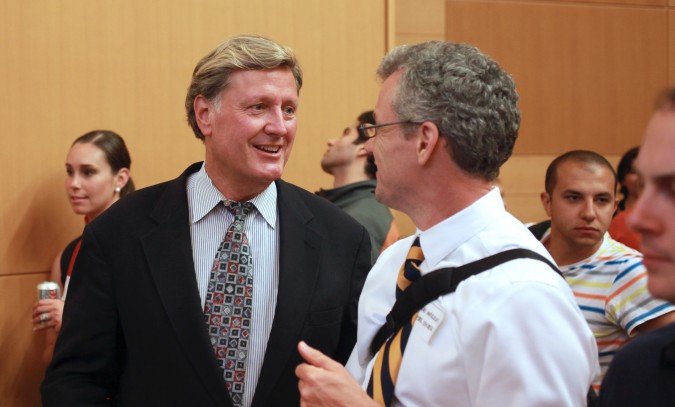
Jeff-Burton, left, the brand new Executive Director of the UC Berkeley Skydeck talks with Andre Marquis, Executive Director of The Lester Center for Entrepreneurship & Innovation, August 30, 2012. Photo by Kevin Warnock.
I upload pictures to this blog at the maximum resolution my camera produces — 21 megapixels. Click on them twice in delayed succession to see them at full size. I shot these pictures at ISO 4,000 due to the low lighting levels.
Click here to see all the posts I have written about the Berkeley Entrepreneurs Forum.
The law firm Fenwick & West LLP where Sam Angus is a partner produced and gave away a great 80 page booklet at the Forum. Retired Fenwick attorney Jacqueline Daunt wrote a fantastic introduction to startups that includes a capitalization table for a hypothetical company from pre-funding stage through a public stock offering. Thank you Fenwick! If I can post this booklet, please let me know and I’ll update this post with a link to a PDF scan of the booklet.
Finally, as an end note, I met Steve Bengston in 1999 during the first dot com boom, when he agreed to help me with Hotpaper, my startup at the time. It turned out I didn’t call on him much, since I lined up financing almost too easily, but I will never forget pitching him at his PriceWaterhouseCoopers office in San Jose, California USA, and him telling me at that meeting that he would help me. Bengston is well known, and I was thrilled to have his support, especially back then when I didn’t know many people or know much of anything.
Why in 1978 I moved to San Francisco from Chicago
The Memorial Church at Harvard University photographed by Flickr.com user Siim Teller, April 22, 2011
Tonight, September 2, 2012, I learned why in 1978 I moved to San Francisco, California USA. I never knew why until today, because I never thought to ask the right questions.
I was born in Chicago, Illinois, USA, at the University of Chicago, where my mother worked as a Pathologist.
My parents had married soon after she graduated from Harvard Medical School, where she was one of five women in a class with 145 men.
My mother met my father Robert Warnock at Harvard, where he earned his PhD in Physics.
My father and my mother got married in The Memorial Church on the Harvard University campus, a church I visited in 2000 when I was in Boston, Massachusetts, USA meeting with storage vendor EMC to discuss an investment by their venture capital division in my startup Hotpaper.
When I visited The Memorial Church, it was just another church. When I told my father about my tour of the Harvard campus, courtesy of my EMC provided limousine with two eager salesman trying to sell me an unnecessary USD $1,000,000 dollar storage array for my startup, my father said ‘your mother and I got married in that church!’
After they wed, my father decided to move with my mother to Chicago so that he could work at the Illinois Institute of Technology (IIT).
My mother was doing research at the University of Chicago, discovering that asbestos is even deadlier than was known at the time. Amazingly, the University of Chicago did not have a spectroscopy attachment for its electron microscope, and my mother needed this device for her research. IIT did have the needed equipment, but they charged money to use it, and IIT was a lengthy drive from our house at 5138 South Dorchester in Hyde Park, on the South side of Chicago. My mother rode her bicycle to University of Chicago, and it would have not have appealed to her to have had to drive to IIT on a frequent and regular basis.
My mother’s research was funded by the National Institutes of Health. I would think that a grant could have been won to order a spectroscopy attachment, but for whatever reason, that was not the path my mother took. Instead, she wrote to a friend she had worked with for a year some twenty years earlier in Seattle, Washington, USA. During that two decade span, that friend had become Chair of the Pathology Department at the University of California at San Francisco.
My mother explained her research and that she had heard that UCSF had a spectroscopy attachment for its electron microscope. My mother asked her friend if she could move to San Francisco and work at UCSF so she could use the required hardware. Her friend said ‘yes,’ and my mother started at UCSF as a full professor.
I learned tonight that my mother was promoted to full professor at University of Chicago just one month before she left for San Francisco. She had been an Associate Professor before that, and I remember as a kid the day my mother was granted tenure. Since I was young, I hadn’t heard that word before, so I thought she said ‘ten year.’ I assumed it was her tenth anniversary of employment. I told my mother that story tonight — perhaps for the first time.
I have a suspicion that University of Chicago panicked when they found out she was leaving for UCSF and rushed through the promotion to full professor, because the timing is so unlikely to have happened naturally. Even if that’s the case, I am sure my mother was pleased that she got to be a full professor at University of Chicago and University of California at San Francisco. My mother retired from UCSF years ago, so is now Professor Emeritus. She still has a website on the UCSF web server.
My mother decided to move our family to San Francisco, since my father had made the decision to move to Chicago. I did not know this until today.
I had always thought we moved to San Francisco because of its reputation as a great cosmopolitan city with superb weather. I had sometimes considered that perhaps UCSF had recruited my mother, but she dispelled that notion today. She did not have to interview for the job at UCSF. She did not have to compete with dozens of candidates. She asked her friend if she could work at UCSF and he said ‘yes.’
I am so thankful my mother needed a piece of equipment that University of Chicago didn’t have. She moved us to the center of the Internet world, and had we stayed in Chicago, I probably would not have become an Internet entrepreneur, which has allowed me to build a richly rewarding life that I cherish.
Thanks Mom! I love you.
Modify Watches trunk sale and party at D-Structure at 520 Haight Street, San Francisco

Modify Watches trunk show sign at D-Structure, 520 Haight Street, San Francisco, California, August 25, 2012
On Saturday, August 25, 2012, I attended a trunk sale at D-Structure, a clothing boutique and art gallery at 520 Haight Street in San Francisco, California USA.
Modify Industries, Inc. was the guest of honor at this trunk sale, showing their fashionable colorful Modify Watches brand wrist watches. The vibe at this trunk show was outstanding, due in part to the trendy location of D-Structure, between Mad Dog in the Fog at 530 Haight Street and Cafe International at 508 Haight Street, in the Lower Haight neighborhood.
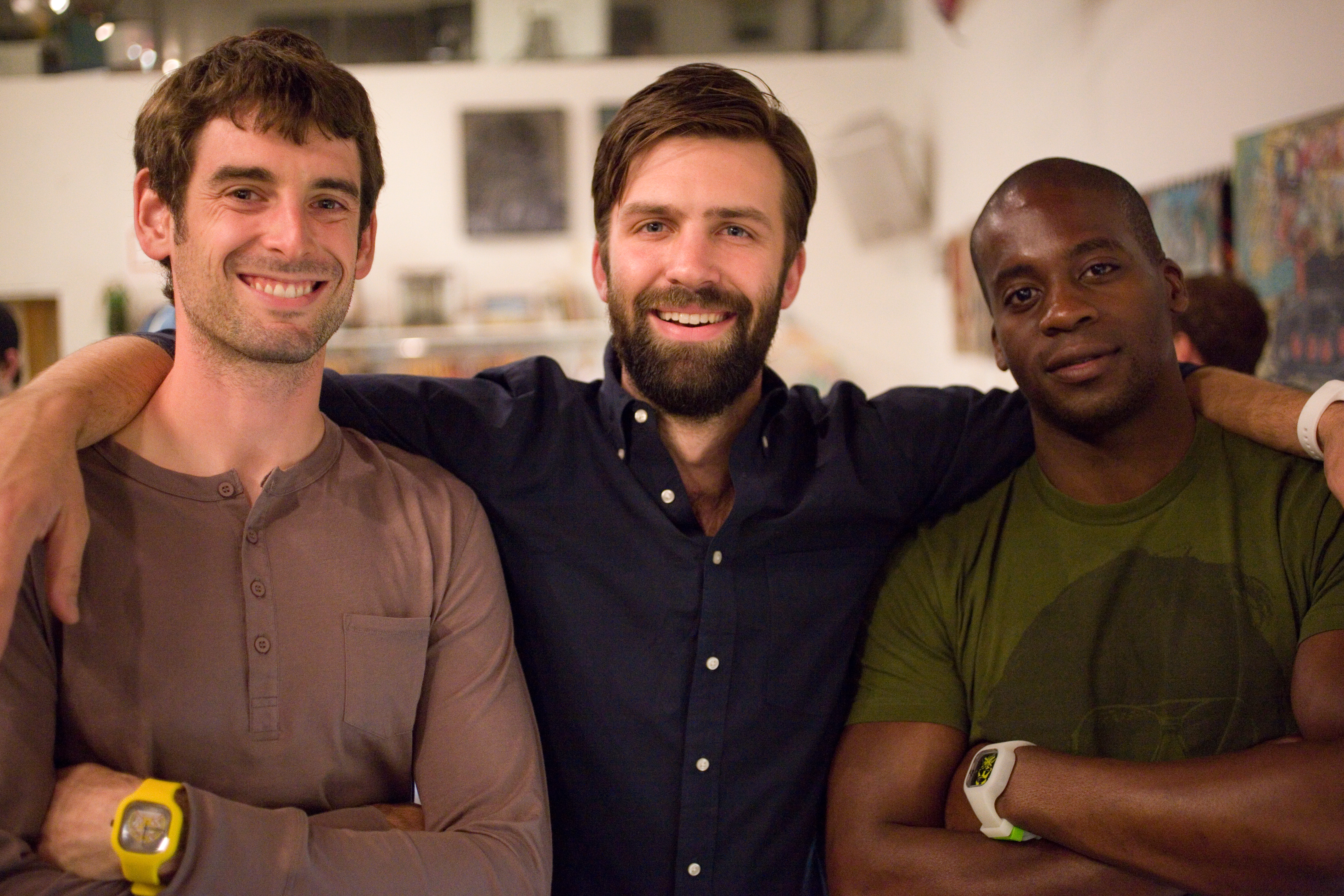
Aaron Schwartz, Devon Chulick and Ayo Oluwole at D-Structure, 520 Haight Street, San Francisco, California USA, August 25, 2012. Photo by Kevin Warnock.
I got to meet Devon Chulick, one of the co-owners of D-Structure.
Chulick told me that Aaron Schwartz came into his store to propose that D-Structure carry the Modify line.
Schwartz is the CEO of Modify Industries, and I didn’t know he made sales calls like this. Chulick told me he is totally bombarded with pitches from companies asking his store to carry their products, so Schwartz had to clear a high bar to get his product into D-Structure, which, from what I can tell, is well curated for its location and apparent target customers.
Schwartz, Chulick and Ayo Oluwole are pictured together above. Each is wearing a Modify Watches watch.
Oluwole is the VP of Marketing for Modify Watches. He used to live in New York where he did marketing for true luxury brands like Salvator Ferragamo. At Modify, I see evidence of Oluwole’s past experience with luxury goods — even his business car looks luxurious, with one rounded corner and muted pastel colors.
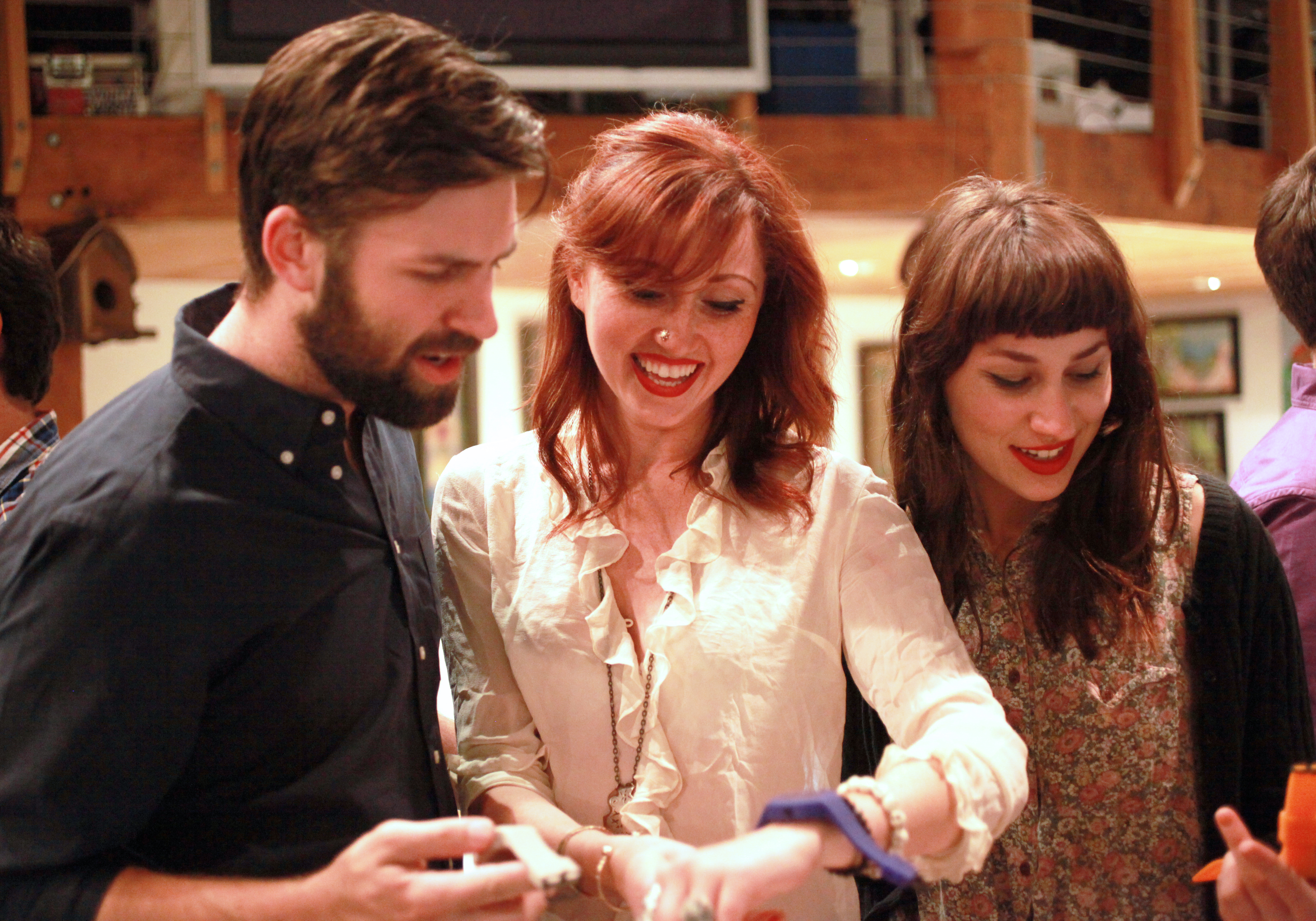
Devon Chulick, Hana Alyssa Sidia and Mary Frances Knapp at D-Structure, a clothing boutique at 520 Haight Street, San Francisco, California, August 25, 2012. Photo by Kevin Warnock.
Schwartz is a great salesman, once selling thousands of watches to a Silicon Valley company that’s known world wide after he was randomly seated on an airplane flight next to a buyer from that company.
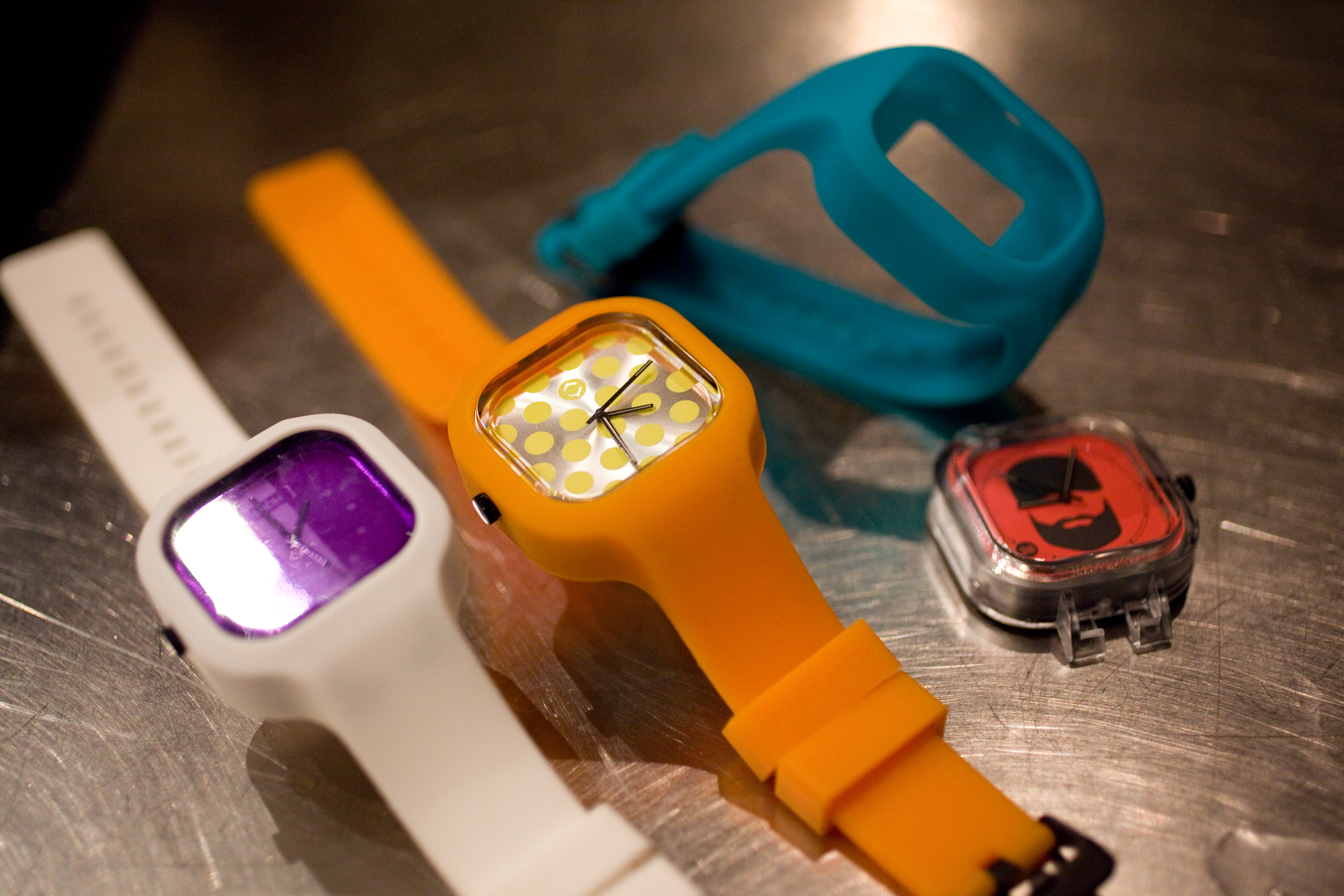
Modify Watches brand wrist watches by Modify Industries, Inc., August 25, 2012, D-Structure, 520 Haight Street, San Francisco, California USA. Photo by Kevin Warnock.
The watches are named Modify Watches because they are so easy to modify, without tools. The strap is made of soft and pliable silicone rubber, so one may take out the hard plastic time piece just by pushing it out of the strap. In the photograph above, you can see two complete watches on the left, and an empty watch band on the right, with the time piece sitting next to it. The time pieces and straps come in small and large — for women and men. The straps come in dozens of colors and the time piece inserts come in dozens of designs. Companies can order custom faces for the time pieces, in quantities as small as 200, the last time I heard. The swap-ability of the straps and time pieces gives buyers more fashion looks for less money. Modify Watches are simply fun, so I can see people buying them even if they carry a mobile phone, which, after all, is close to carrying an atomic clock in your pocket, because cell phones would not function if not for the extreme precision of the clocks the carriers use to make cell phone networks operate.
I’ve written about Modify Watches brand watches before, so I’ll tell you a bit about D-Structure. The store is beautiful — hip, quirky, warm and energetic. There was a quality DJ on hand for the event, and the sound system had quite good fidelity, and was loud enough to make you feel like music is a key element of the marketing strategy for the venue. It wasn’t loud like a nightclub, but it wasn’t soft either. It made the event feel like a real event, not a sales pitch.
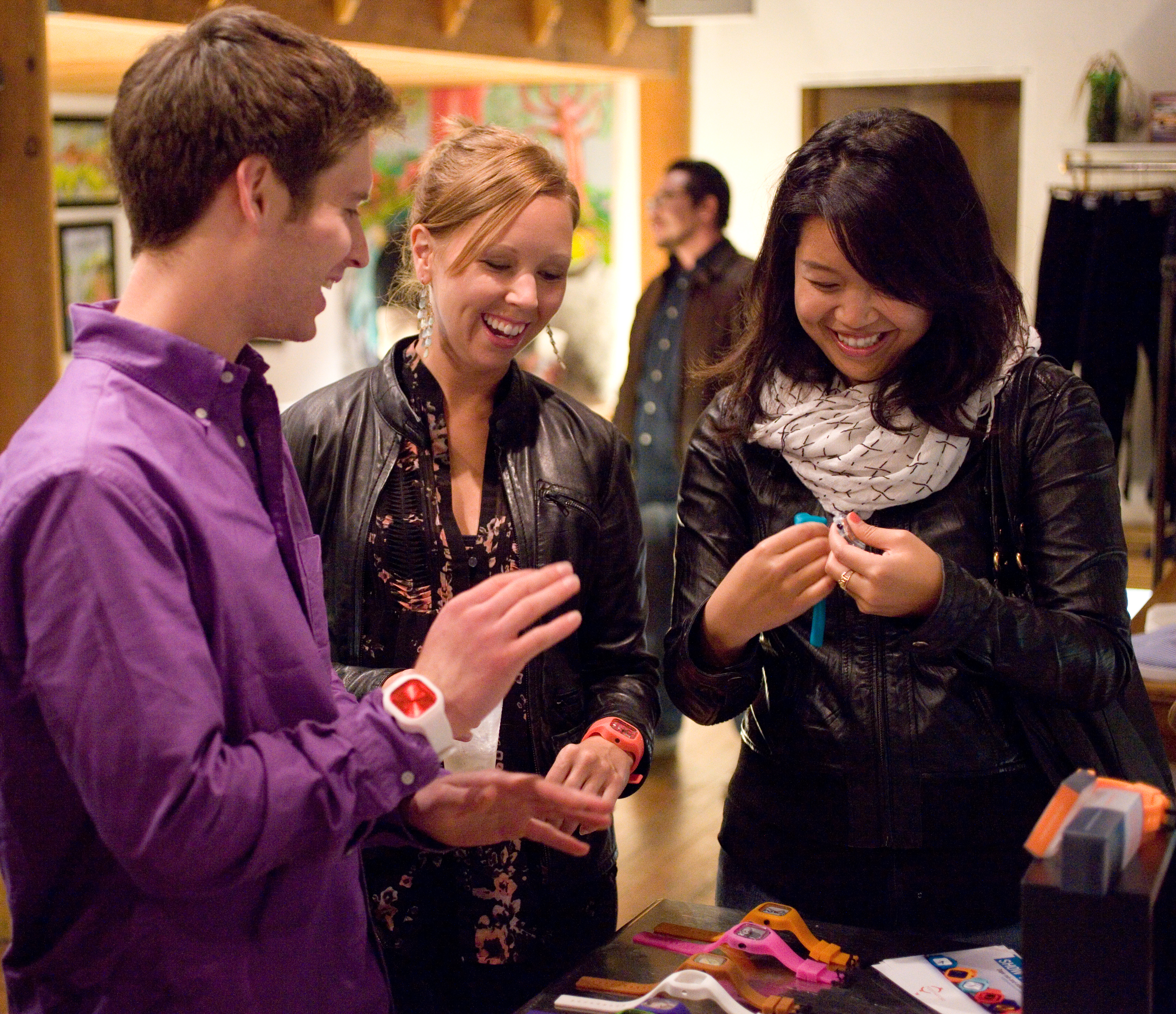
Devin Hexner and three fans of Modify Watches at D-Structure clothing boutique, 520 Haight Street, San Francisco, California USA, August, 25, 2012
Devin Hexner, an intern at Modify Watches, kept busy, and seemed to be doing a good job. I overheard him talking to some fans who work at a big national retailer, and Hexner sure looked like he was making a good impression, from all the smiles and laughter I saw.

Julia Garcia, left, and Shane Rand, right, at Modify Watches trunk sale at D-Structure at 520 Haight Street, San Francisco, California USA, August 25, 2012. Photo by Kevin Warnock.
I met a lot of people at the event. I spoke for a bit with Julia Garcia and her friend Shane Rand, pictured above. Garcia introduced herself to me because I had on my crushed red velvet sports jacket I got at a pop up sale for 90% off its original eye popping four figure price. I almost didn’t buy that jacket because I worried it would make me look like a young Hugh Hefner. I am thankful I bought it, since I have never owned an article of clothing that has garnered more compliments.
I would love to conduct one of my photoshoots of models in this store, with the model or models wearing some of the outfits the store has for sale. The location is very photogenic, as you can see in the photographs that I took that illustrate this post. Garcia and Rand are photogenic, so perhaps I can photograph them in the store, if they find this post and are interested.

Hana Alyssa Sidia and Mary Frances Knapp at D-Structure August 25, 2012, 520 Haight Street, San Francisco, California USA. Sidia and Knapp are trying on time pieces by Modify Watches.
Hana Alyssa Sidia and Mary Frances Knapp, the only two models I introduced myself to at the event, are photogenic, and I would enjoy having a chance to photograph them properly, with my lights and reflectors.

WkShp brand clothing for sale at D-Structure boutique, August 25, 2012
This trunk show was at night and I used only the ambient light available. This means I had to choose an ISO setting of 4,000, so these pictures are more grainy than usual. I upload my photographs at full camera resolution of 21 megapixels. To see the full size versions, click on the pictures twice in delayed succession.

Art for sale at D-Structure clothing boutique, August 25, 2012
The artwork is interesting — not something I would buy for my home, but it was engaging and fun. Totally appropriate and it improved the aesthetic of the shop. I especially liked the ‘antiques’ on display as decoration, including several manual typewriters from 50 or 75 years ago, and several cameras from the same time period.
Yellow 108 brand hats at D-Structure boutique, San Francisco, August 25, 2012
Yellow 108 brand hats looked great. I need to get into wearing hats.
Old camera for decoration at D-Structure, 520 Haight Street, San Francisco, California, USA, August 25, 2012
Look, a Schneider-Kreuznach lens on a camera that didn’t display its own brand where I could see it. I love old cameras.

Clothes on rack at D-Structure clothing boutique, 520 Haight Street, San Francisco, California, August 25, 2012
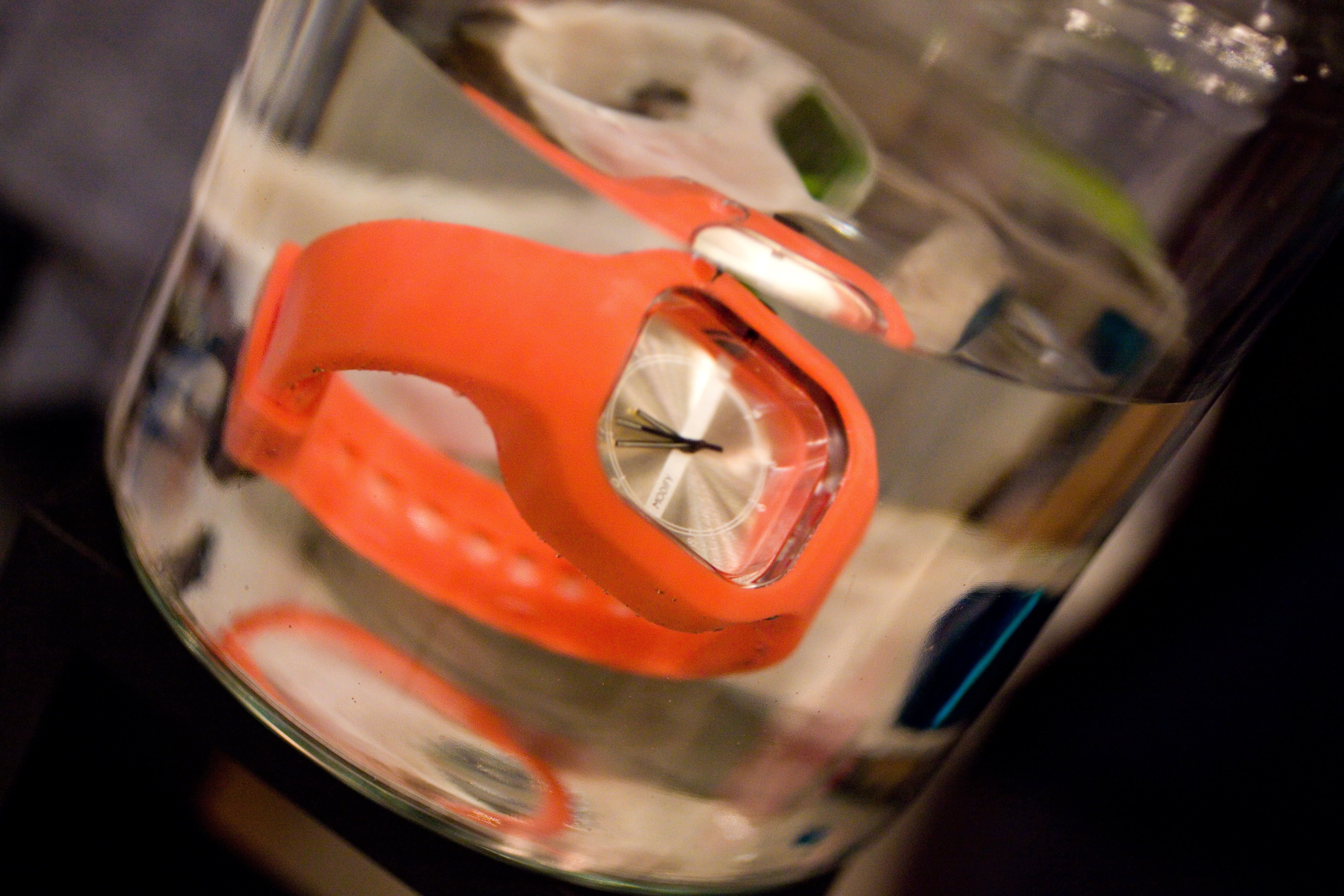
Modify Watches brand wrist watch underwater, August 25, 2012
Modify Watches are water resistant, a point hammered home by the three watches on display in a bowl of water, above.
Modify Industries is on a roll. I enjoy attending their events. Schwartz has allowed me to borrow some of his company’s products, which I have some of the models I work with wear on camera. I will return all these watches, and I did not write this or any post about Modify in exchange for this loan. Schwartz is my friend, and I like writing about companies where I know the founder or founders. I make this disclosure because it may be legally required.
