I sold my MCI 5a Challenger bus conversion
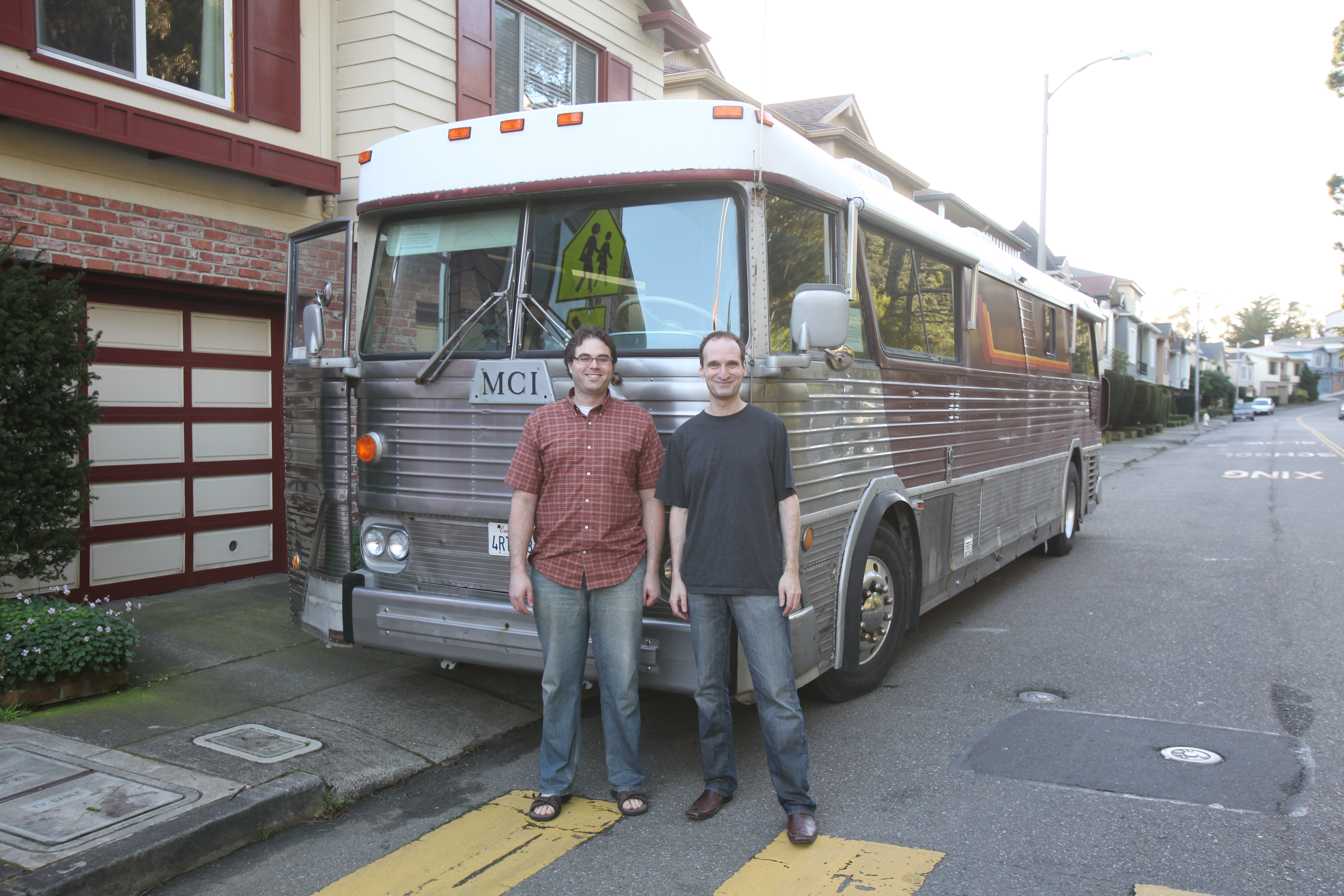
New owner Michael shows off his MCI 5a he just bought from Kevin Warnock January 2011
I sold my MCI 5a Challenger bus conversion last week! The buyer was a computer programmer like me, and I would guess he’s about the same age I was when I bought the vehicle in 2001. He wants to travel and be able to program on the road, just like I imagined when I bought the MCI.
I received a LOT of interest in my ad, which I posted on Craigslist.org. I got about 45 replies, and I showed the conversion to half a dozen potential buyers. What an interesting array of people came to see it.
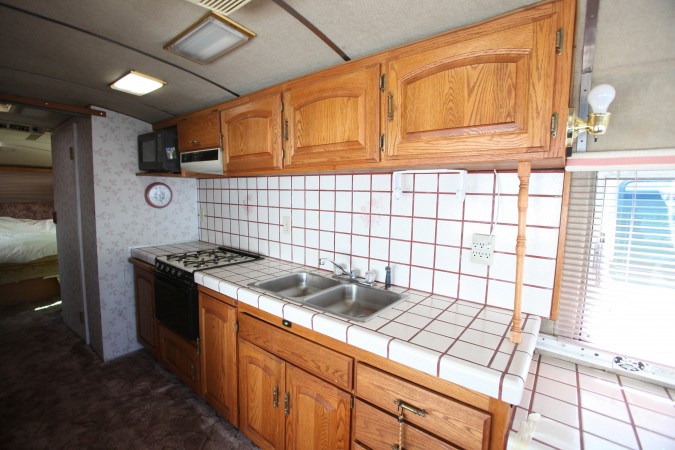
Kitchen area of 1967 MCI 5a Challenger bus conversion
The most surprising visit was from a married couple from Woodside, California. Woodside is one of the most exclusive towns in California. The homes run into the millions of dollars each, and the lots run into the acres each. This particular couple live on a 3 acre parcel. They are the last people I would think would be interested in a 45 year old $5,000 bus conversion.
I learned it wasn’t for them, but for their daughter who’s in her 20s. Their daughter wanted my conversion because four of her friends live in buses, and she wants to live in a bus too, but safely nestled on her parent’s property in Woodside. Apparently the property is so large the neighbors wouldn’t be able to see the home on wheels, which is probably a good thing, as I don’t know too many wealthy people who are fond of ancient, unrestored bus conversions.
The couple was plainly appalled that their daughter wanted my bus conversion. But they still spent a good hour in the rain with me looking over every aspect of their daughter’s proposed dream home. The wife told me I was an excellent salesman, and she seemed more charmed with the vehicle than I would have ever expected.
The reason they were there instead of the daughter is the daughter was away in India for a long trip, and wouldn’t return for a month. Her parents were seriously considering buying the beast and having me deliver it and park it on their estate, awaiting the return of their daughter.
I never heard from this couple after the very pleasant hour I spent with them, and I think it was wise for her daughter to not own my bus conversion, as it really is not set up for full time living, since the insulation is not sufficient for that use, in my estimation. I would much prefer that they hire me to build their daughter one of my ‘green homes’ I’ve been talking about here. That would probably give her outstanding bragging rights among her peers, and would be much more suited for full time living.
I got my full asking price of $5,000. I probably could have gotten more, as I had people begging me to accept a deposit to hold it until the bank opened the next business day. I didn’t think that would be fair to the other buyers I had scheduled for visits, so I declined. I do think I set the price fairly, and not too low, since the conversion wasn’t perfect. I do miss my beloved conversion, as I had a lot of good times on board. It’s the only vehicle I’ve driven across the United States, and the only vehicle I’ve called a home. When I was courting my last girlfriend, we took trips to Monterey and Yosemite, and those were some of the happiest days of my life. I hope the new owner builds a similar set of happy memories, and I wish him all the best.
Michael Milken speaks at The Commonwealth Club of California
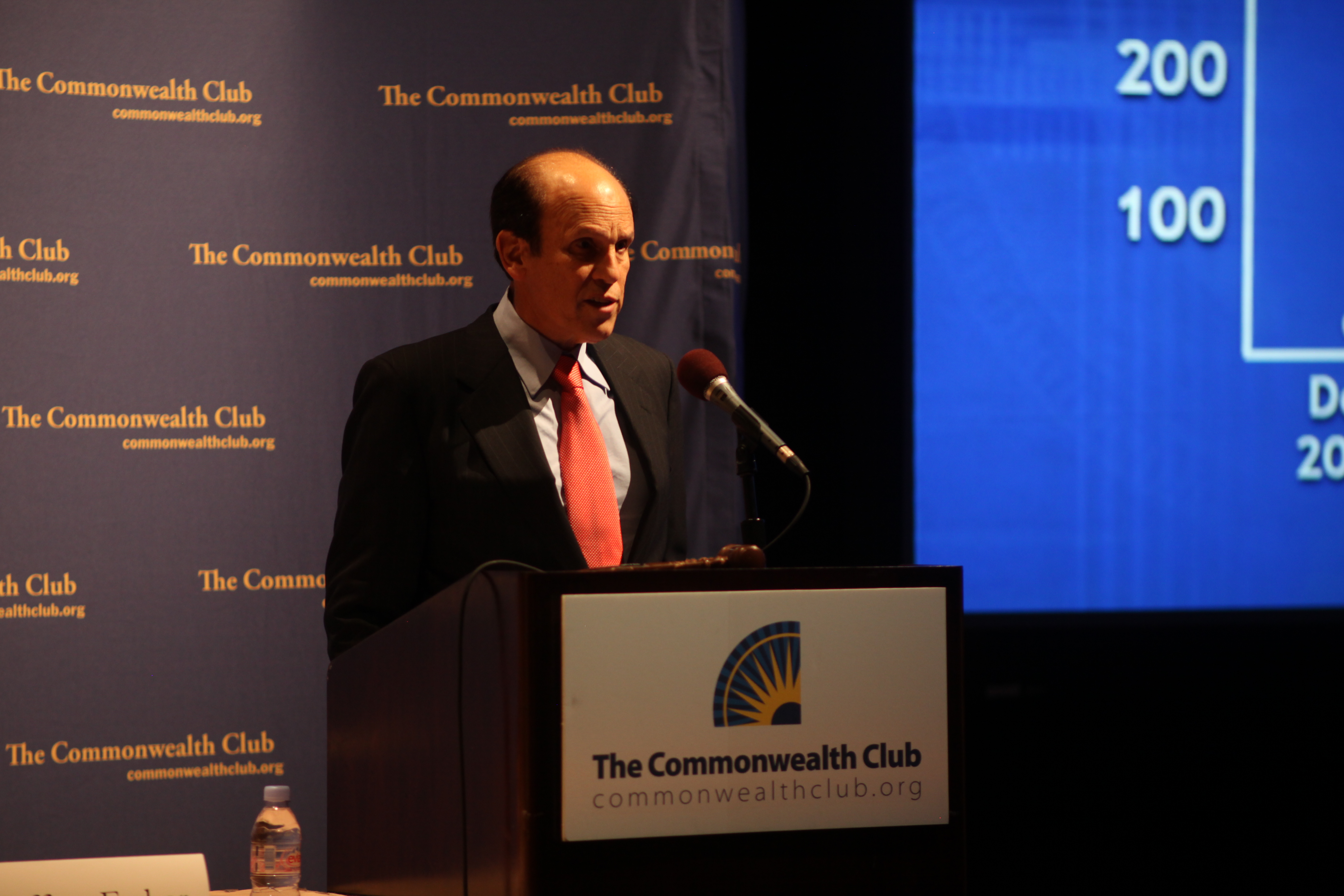
Michael Milken at The Commonwealth Club January 13 2011
I saw Michael Milken speak yesterday evening at The Commonwealth Club of California. Milken invested in my first Internet company Hotpaper.com, Inc., by his participation as a limited partner in the Angel Investors I fund, the notorious and newsworthy Ron Conway fund from the late 1990s first dot com boom. I disclose this since it seems the right thing to do, since I’m starting to consider myself a journalist by these blog posts. In fact, a staff member from the Club asked me if I was with the press at this event, probably because he saw me taking pictures from the side isle with my professional looking camera and telephoto lens. I told him I wasn’t from the press and he said I couldn’t stand in the isle, which was fine since I already had some good shots. This was at the Mark Hopkins hotel on Nob Hill in San Francisco, California, so it was a lot more formal than events I’ve attended at the Club’s office on Market Street.
I wonder what kind of press credential bloggers can get, and I wonder how serious I would need to become to be able to get such a credential. I recognize these posts are pretty insubstantial, but I do try and I hope to improve my writing and analysis over time.
Milken is a convicted felon who served time in prison for securities fraud, for those of you who don’t know who he is. I vividly remember his rise to fame and his fall from grace in the 1980s. I bought and read the chronicle of his life, Den of Thieves by James Stewart, when it was published, which is noteworthy because back then I read few books, and it took a lot to get me to read a long book. I couldn’t put this book down, and I can still remember stories from it, such as when Ivan Boesky couldn’t decide what to order at a fancy restaurant, so he ordered one of each entrée, and walked around the table and took one bite from each. So when I had a chance to see Milken in person, I just had to go. I’m glad I did, for Milken is a smart guy that had interesting things to say. In fact, I think Milken would love my Green Homes housing idea, and I plan to talk with him about it when the project is further refined.
I believe the Club will post the full video of Milken’s speech, so I won’t try to recount all he said. What I will do is focus on the key part I found most moving… that Americans spend far too much on housing relative to their incomes. This is a point that is near and dear to me, and is part of what motivates me to think about advancing my green home plan I’ve written about on this blog.
Milken said residents in South Korea spend 22% of their income on education and just 13% of their income on housing.
Milken also said residents in China spend an average of 15% of their income on their children’s education but only 10% of their income on housing.
More generally, he said the first four highest consumer spending expenses of residents in the United States are:
- Housing – 32.7%
- Transportation – 18%
- Food – 12.8
- Insurance and pensions – 11.2%
In contrast, he said the first four highest consumer spending expenses of residents in Asia are:
- Food – 23%
- Education – 15%
- Housing – 10%
- Clothing – 8%
In Asia, transportation and housing account for just 16% of household income, while in the United States, these two items account for 50.7% of household income. In Asia, transportation ranks 6th on the list for consumer spending, while in the United States, transportation ranks 2nd.
Stated another way, in the United States people pay 317% more for housing and transportation than do people in Asia. This is an astonishing disparity, and I suspect it’s a disparity that’s ruining the United States and dramatically benefitting Asia. We just must ditch our jumbo sized residences and move into smaller homes. The country’s future may depend on it.
Milken really emphasized his point about how ridiculous it is to spend over half ones income on just housing and transportation. The average home size in the United States has doubled in not many years. My parents raised me in a house much smaller than the average new home size today in the the US. I turned out fine, and our parents turned out fine, even though their houses were half the size or less of today’s average US home.
Milken had other shocking facts to deliver, such as the US spends more each year to buy potato chips than it spends each year to research heart disease. I can’t recall the exact numbers, but $3.5B for heart disease and $5B for potato chips is probably about right.
Milken also pointed out Americans have gained a lot of weight since 1991, and that the US could save something approaching a trillion dollars if its inhabitants did nothing more than return to the average weight in 1991. I wish I could remember the period of time over which that trillion dollars could be saved, but I can’t, I’m sorry. If someone has access to the Milken slide deck, please send it to me, as I could write another dozen blog posts if I could review those slides again.
I’m not vouching for Michael Milken by this post. I don’t know much about him, and a lot of what I know is from years ago. But I do know he speaks well and delivers an engaging message that big changes need to happen in the United States. His heart seems to be in the right place, and if what he says he’s done is true, it seems he’s more than made up for the 6 crimes he was convicted of and spent time in prison for. However, if you disagree, I welcome your comments. I got a long and detailed comment on my post about Tim Ferriss, and while the comment was highly critical of my review of Ferriss’ interview, I was still happy to have the comment. I hope that I can spark vigorous dialog in the comment sections of this blog.
My Healthy Check health checkup screening results
I just got back from my Healthy Check annual checkup through Anthem Blue Cross, and the results were pretty good I think. I’m posting them here to demonstrate how healthy eating and exercise can influence health. I ride my bicycle about 6 days a week and eat three balanced organic, mostly home cooked meals a day. I don’t drink or smoke or take drugs. I take no medications on a regular basis. When I have a cold, I take plain generic aspirin and perhaps a cold capsule and some cough syrup. I consider my health to be excellent. I am truly grateful for my health. I wear 110 SPF sunscreen on my face, neck, ears and hands nearly every time I leave the house, even if it’s overcast out. I’m also posting this information here for my own benefit, so I don’t lose the results in my file cabinet. If I post the results here each year, I’ll always be able to find them from anywhere. I also got a flu shot today, included at no extra charge in my checkup.
- Blood pressure: left arm 107/70; right arm 105/65
- Total cholesterol: 148
- Triglycerides: 95
- HDL: 58
- LDL: 70
- TC/HDL ratio: 2.5
- Glucose (fasting): 90
- Weight: 163lbs
- Height: 6’2″
- Waist: 31″
- Hip: 37″
- Ratio waist/hip: .84
- BMI: 20.9
- Body fat analysis: 18.4%
Cooking lessons with Kevin Warnock – episode #1
I promised my readers on January 2, 2011 that I would start an educational online cooking show by February 2011. I am happy to report that I created the first episode two days ago and I edited the video and uploaded the result today, 1/11/11.
As a side note, I started my company Silveroffice, Inc. 3/3/03, and on 6/6/06 I offered to give my domain gOffice.com to Google, Inc. for their use in branding what is known now as Google Apps. Google didn’t take me up on my offer, thank goodness, as I continue to use the domain for Silveroffice.
I plan to regularly release episodes of my cooking show, which I’m titling for now ‘Cooking Lessons With Kevin Warnock’.
I have a brand new and very photogenic temporary video production set I built in my garage. It’s sparkling new, and has never before been used for anything. I am proud of building this studio, as I had to learn new skills. For example, I personally cut the hole for the sink in the granite counter top. I also installed the granite counter tops and the cabinets and all the other appliances. This space looks like a real kitchen, but it’s not because there is no stove or oven yet. Originally the plan was to install one before I learned San Francisco doesn’t permit two stoves in a single family house. However, there is an exception for moving image production facilities, and I am using that exemption to bring you this cooking class series. Because of the exemption, I could install a permanent stove, but for now I will not, because a portable catering butane burner will work better from an aesthetics perspective, because I can place it right in front of the video camera and I can thus face the camera directly. If I had a normal range, the camera would need to be to my side, which would make it difficult to see what I’m doing.
I don’t store food on set, and I never use the set for personal cooking. I do all my cooking for sustenance in my real kitchen upstairs in the living area of my house. I welcome a visit at any time by San Francisco building inspectors to verify this claim, as I don’t want any trouble from the City. I don’t even have the refrigerator running except when I’m actively producing a video, to save electricity. An inspection will turn up a legitimate video set, not an illegal second kitchen. You can see in today’s video when I tried to use the microwave that I had to remove the instruction book from the oven, as I had never used it to heat food until this video.
I prepared this first episode using my camping propane burner. I didn’t know there are butane indoor safe burners that have enough heat output to cook Chinese food when I shot this video. Now that I know, I will be ordering the proper butane burner for future episodes. Please don’t use a propane camp stove indoors as they’re typically not supposed to be used indoors. I had a huge fire extinguisher a few feet away when I recorded this video, so I was taking precautions. Also, I only brought the burner inside right before shooting, and you can see me take it outside as soon as I complete the cooking in this episode. The proper indoor ready butane burner only costs USD $59.95, so if you have an electric stove but want to try gas, the entry price is quite reasonable.
When you watch this video, keep in mind this is my first run through ever. I did not practice even once beforehand. So there are some (charming?) errors in this video. For example, I forgot the cooking oil and a plate to serve the results on, so I had to run upstairs to my real kitchen during the shooting. I could have edited those moments out, but I figured I should just post this as is to show my very first attempt.
I used no recipe, and I have never made this dish before. I selected the ingredients moments before I shot this video. This is the way I usually cook Chinese food… I see what I have in the refrigerator and go from there. This works fine, and I’ve created some dishes that are delicious just by experimenting like this. Some of the most unusual dishes result when I run out of a key ingredient and have to leave it out.
The reason I’m doing this show is that I believe people eat out way too much. This contributes to obesity, poor health, financial difficulties and retirement marked by reduced standards of living. These are perhaps radical claims, but if one were to take a few hundred dollars spent eating out each month and invest that in a Standard and Poors 500 exchange traded fund (ETF), one would have a mini fortune saved at retirement. One would also probably be much slimmer and healthier and happier as well.
Home cooked food is often thought of as the ‘gold standard’ of eating. So why do so few people practice it much? I would suggest that people haven’t been taught how to cook and thus they’re intimidated. Until about five years ago, I didn’t know how to cook more than about two dozen dishes from memory. I rarely opened a cookbook, even though I owned perhaps 10 of them. I ate out a fair amount, and I’m embarrassed to admit that I ate a lot of canned prepared foods like Progresso soup, Dennison’s chili and Chef Boyardee Ravioli. I can hardly bring myself to eat these products now, even though I was conditioned for years by advertising to love them.
Another reason to cook at home is that you can use better ingredients than found at most of the world’s restaurants, and still save money over eating out. For example, I shop at Rainbow Grocery, a coop that sells mostly organic non meat products. Food here costs about double what it costs at a typical grocery store that sells mostly what Michael Pollan calls ‘industrial food.’ But food from Rainbow in my estimation is twice as intensely flavored as industrial food. I was a huge skeptic such could be the case, so I encourage you to try to find some organic vegetables and prepare the same dish twice at the same time, in two different pans on different burners. Then sit down and sample the results from each dish. I predict you will be able to tell the difference blindfolded. Michael Pollan writes about a reason that could explain the superior taste of organically raised vegetables. He writes, and I’m doing this from memory, that vegetables that don’t have the protection of commercial chemical pesticides to keep them free of harm from insects will make their own defenses, and that these defenses enhance the flavor. In effect, commercial pesticides make vegetables lazy, so they don’t taste as good as organic vegetables. Perhaps I’m oversimplifying, and if so, please correct me.
Few restaurants use organic produce and meat because it costs more. So if you eat out, you’re generally consuming more pesticides and other industrial inputs that you probably would be better off to avoid.
I’ve watched very few cooking shows on television, perhaps fewer than 30 hours my whole life. So what you see here probably will look childish in comparison. I read in a major publication recently that it takes years of grooming for a new television chef to be minted. I am starting out with zero minutes and zero years of grooming, so please be kind.
I am doing this show by myself for now, so there is no cameraperson. The camera is fixed for the duration of the show. I am using a good camera and the show is being presented in high definition at a resolution of 1280 x 768 at 25 frames per second. I am shooting in full HD, and once Vimeo.com (which hosts the video for this blog) allows long full HD clips, I’ll upgrade to that format. The camera I am using is a Canon 5D Mark II. This camera can shoot for only about 15 minutes at a time before I have to hit the record button again. So you’ll see a couple of stops and starts. There’s nothing I can do about this for the time being. I hope that Canon updates its firmware so that when one clip ends a new one is instantly started so the two clips can be stitched together in editing software so no break is detectable.
Eventually I hope to get a second 5D Mark II that I can mount on the ceiling over the burner so I can shoot looking down into the pan as I cook. Then I can edit in closeups of the cooking action to show you exactly the progress I’m making. For the time being, I will occasionally tilt the pan toward the camera so you can see what’s happening.
I am encouraged by my first attempt. I think the video studio looks nice. I used four auxiliary 4′ long fluorescent bulbs slightly off axis from the camera to brighten up my face, and I plan to add another four on the other side of the camera. These are mounted perpendicular to the floor and parallel to my body.
When I get into other projects like baking bread and making pizza, I’ll get a countertop convection oven, which I’ll be able to position precisely to give you a clear view of what’s going on.
I hope to educate my viewers as I educate myself. While I am reasonably good at preparing Chinese and Indian cuisine, I plan to learn and then show you how to prepare many other cuisines.
I probably will not ever be truly expert in anything I show you, as I am not a chef, and I am not pretending to be. I have never taken a cooking class, and I don’t really know if anything I am showing you is technically correct. But I hope and expect that if I make a glaring error that my readers will write to me to tell me, so I can improve.
I plan to talk about food quality, industrial food, how to shop and many other topics while I am also teaching you to cook. Since I have no plans to edit down video into a short segment, I will need to fill up time when the food is just cooking. I plan to fill this time be talking about subjects that I think you should know about. I have no idea if this will be welcome or annoying, but I’m going to give it a try. Please let me know what you think.
This first episode will show you you to make a Chinese dish I call Chicken with green beans, zuchinni and peppers. Here’s the ingredient list. Watch the video to learn what to do next.
1/4 pound boneless chicken breast
1 medium onion
1 cup Jasmine rice
1 1/2 cups water
15 green beans
15 small brown mushrooms
1 medium zucchini
1 tablespoon chili bean sauce
1 tablespoon garlic chili hot sauce
1 tablespoon guilin sauce
1/2 small green pepper
New Avenue, Inc. featured in today’s San Francisco Chronicle newspaper
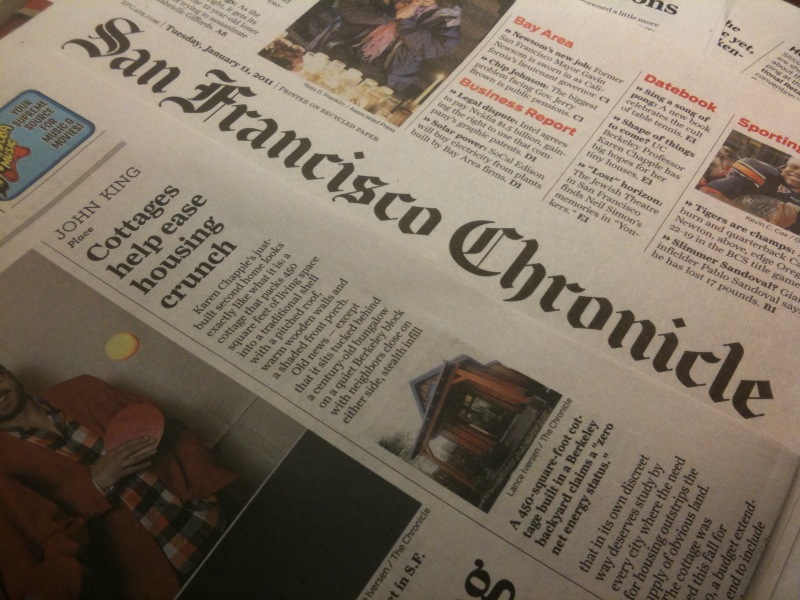
San Francisco Chronicle New Avenue Article Jan 11 2011
My friend Kevin Casey’s New Avenue, Inc. house that I’ve been writing about here was written about in today’s San Francisco Chronicle newspaper. This is the primary newspaper for San Francisco.
The story appears in the print edition and on the front page of the online edition in a story entitled Berkeley zero net energy cottage deserves study. Since the front page changes all the time, I made a screen capture SFGate_front_page_january_11_2011 so you may see the prominent coverage New Avenue received. I also made a screen capture of the article itself since the Chronicle may take down the article after some time, but I expect this blog will remain accessible indefinitely. Here’s the link to a PDF copy of the full article: SFGate Jan 11 2011 New Avenue article. Note that these PDFs have clickable links, so if you see something you like, you can click it and the link will take you to the same place the SFGate.com version will take you to.
Congratulations to Kevin and New Avenue!
Well done graphic describing dangers of drugs and alcohol

As you may have figured out by now, I live a healthy life and don’t take drugs or drink alcohol. I have seen too many people ruin their lives with drugs and alcohol, and it’s so sad to see people who were once full of promise do poorly because they were escaping reality through substance abuse.
An aquaintance of mine from my youth went on such an extreme bender about five years back that I heard he lost his wife and kids and now lives in San Francisco’s public Laguna Honda hospital and rehabilitation center, and will be there or somewhere similar for the rest of his life. He can’t remember his wife or kids or any of his friends, I’m told. I didn’t know him that well, but I’ve known him for 20 years or so. He was a charismatic artist and performer in his youth, with real magnetism. Now he apparently flirts with the nurses, but can’t recognize his own children. How sad. His name is Tony Chatham, and he was the lead singer for a band my friend was in. I photographed Tony’s band, and years later he told me a framed photograph from that shoot hung in his and his wife’s bedroom. He loved that band and that picture, and he always reminded me of that whenever he saw me. This, of course, was before his tragic overdose.
Here’s an attractively produced graphic that lists some of the horrors that can result from substance abuse. I found this today while looking at the website Digg where popular web pages are voted up by readers. If you’re in a position to influence people, you might want to display this poster sized graphic… it may help save someone the agony of what I’m sure Tony and his family went through and continue to go through.
New Avenue, Inc. Ribbon Cutting Ceremony For First Completed Project in Berkeley, California USA
Yesterday I attended the ribbon cutting ceremony for the first completed home built by New Avenue, Inc., which was founded by my friend Kevin Casey.
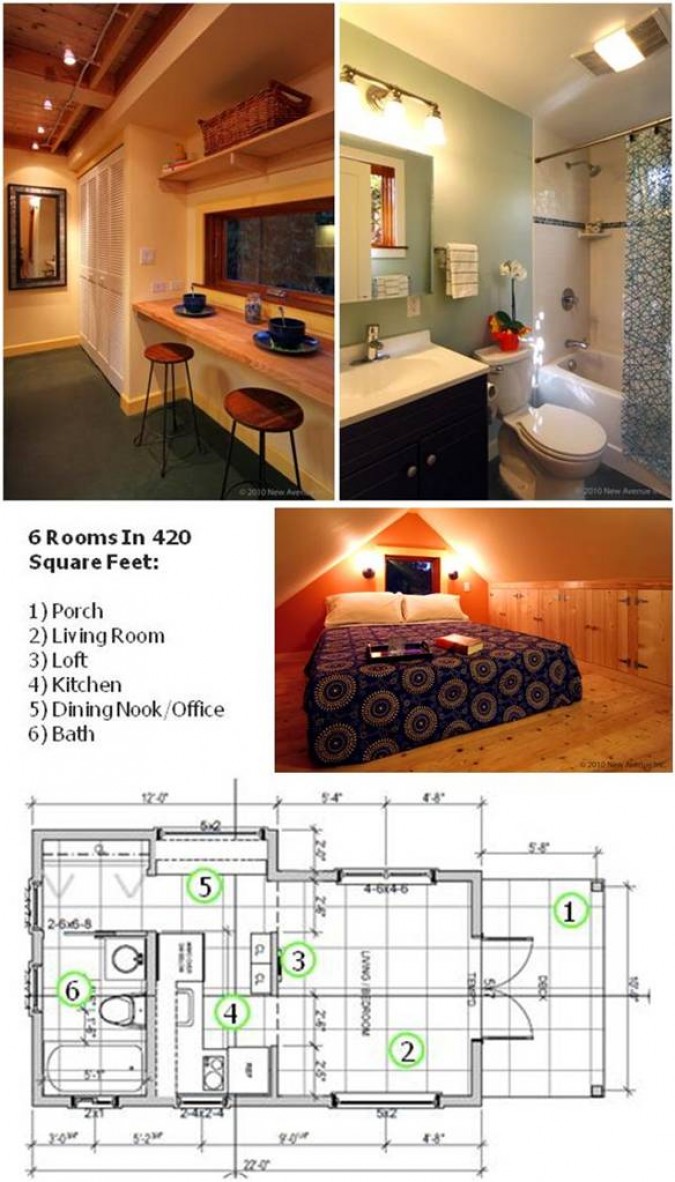
I estimate 200 people came by to see the 420 square foot backyard detached house. Kevin persuaded the mayors of Berkeley and El Cerrito to speak at the ribbon cutting. I introduced myself to both mayors after the conclusion of the formal event, and they were both very personable and warm.
I shot a lot of pictures and video, but I’ve not had time to edit it. So today I will just post the video of the formal spoken remarks. Later this week I will post the walkthrough video I shot, which is fascinating because you see all the attendees clamoring to examine every corner of this really charming house.
I spoke with many of the people in attendance, including a woman who lived recently in Hawaii in a house this size. She’s a graduate student at UC Berkeley now, and her enthusiasm for what New Avenue is trying to do was contagious.
Tim Ferriss interview at Commonwealth Club of California January 6, 2011
I joined the Commonwealth Club of California on January 6, 2011. Hours after I joined, I was at their Market Street, San Francisco headquarters watching Tim Ferriss be interviewed by a reporter for Bloomberg BusinessWeek magazine. Ferriss is the author of the best selling book The 4-Hour Workweek, which I read last year on the advice of my friend Gleb Budman. I have dismissed books of this genre in the past, but I don’t dismiss this book. There is a lot of wisdom in this book, and I came away from watching the interview thinking even more favorably of Ferriss. Yes, he is an outstanding self-promoter who’s even been voted the most effective self-promoter in the world. Yes, he has done some questionable things I don’t approve of. But he makes a strong case that there is a valid path to success that does not require working round the clock. As far as I can tell, Ferriss works far more than 4 hours per week, and I take the title of his book as being more provocative than literal.
The Commonwealth Club is a public affairs forum, and all speakers volunteer their time to talk at the forum. Thus Ferriss was not paid, although he probably commands a hefty speaking fee in other contexts. Perhaps as a result of the Commonwealth Club’s public mission, there were no requests to shut off cameras or recording devices. In fact, the moderator gave explicit instructions on how to Tweet most effectively about the event so the messages would be discoverable by the Club. As a result of the above, I shot video of the interview with my handheld camera, and part 1 of 3 appears above in this post. The quality is marginal because I can’t hold a camera steady, but the audio is good, and you can still see the action up close despite my less than good camera work. I am not intending to take away from income due Ferriss by posting this here, and if asked by the Club or Ferris or his representatives, I will remove this video immediately. I think that on balance, I help Ferriss by spreading the word to my readership about his work, and it’s in the spirit of helping Ferriss that I post this video here today. I will post parts 2 and 3 over the next week.
Tim Ferriss talks about his latest book, The 4-Hour Body, in this interview. I have not read that book, but I plan to. I flipped through it in the lobby, and it looks worth reading. It’s a large book, probably twice the size of The 4-Hour Workweek. Ferriss is both an entrepreneur and a health advocate, and his passion for both rings true. I got to meet Ferriss at the reception that followed the interview, and he sure makes a great effort to be personable and helpful. He had a swarm of people around him for well over an hour, and I got to meet him toward the end of that time. He was still cheerful and helpful even after what must have been an exhausting several hours for him.
My impression of the Commonwealth Club is great so far, and I look forward to seeing Michael Milken speak later this month.
Kevin Casey’s New Avenue Homes Ribbon Cutting Ceremony January 8, 2011
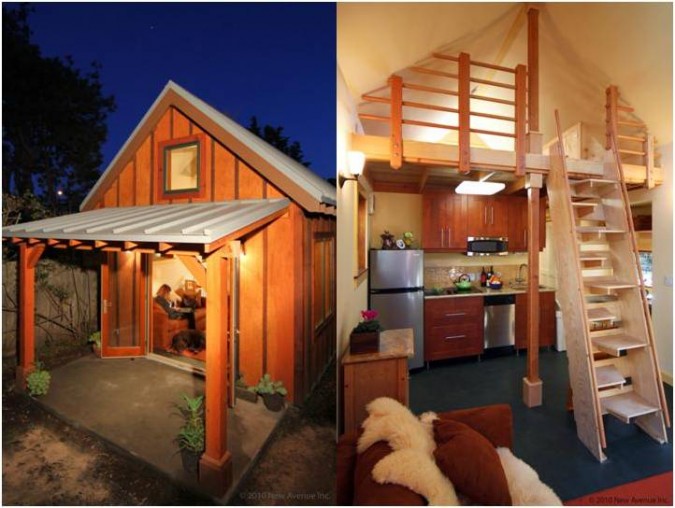
Kevin Casey's first New Avenue home. Outside view. Berkeley, California USA
One of the advantages to my sponsoring the Business Plan Competition at University of California at Berkeley is that I get to meet interesting, bright, motivated students. How does this work exactly? I’m a judge for the competition, and that puts me into regular contact with the student organizers. In about 2007, Kevin Casey was one of the organizers, and we got to know each other just a little bit. But I remembered him, and when he got into the tiny house movement, I took notice and contacted him.
He’s taking a different approach than I plan with my Green Homes venture I haven’t started but probably will at some point. But his approach is valid and he’s making solid progress.
Kevin Casey’s company is New Avenue, Inc. Here’s their mission statement, which I copied directly from their website for precision:
“In the United States 40 million of the 70 million single family homes have just one or two people living in them. These under-used homes were designed for easy building, not quality living, and they drive a seemingly endless list of negative effects such as sprawl, traffic congestion, lifelong “homeowner” debt, and costly energy use. This incredible waste of space is the result of the traditional model of accommodating growth through suburban tract home development. The US Census projects a need for 12.5 million additional homes by 2020 and we need a new way of creating these homes.
New Avenue is an alternative development model that enables communities to grow internally as opposed to externally. We do this by building homes on underutilized properties within existing neighborhoods. Our homes are designed to accommodate the true diversity of our family types, namely those of us that live in one or two person households. We call this the small plot development model and it can end suburban sprawl as we know it, accommodate the demand for 12.5 million new homes we need and bring financial and environmental sustainability to families.
Kevin Casey's first New Avenue home, inside view. Berkeley, California USA
New Avenue delivers a turnkey solution for building these one and two person homes. We have unique expertise in design, land use rights, financing, permitting and pre-fab manufacturing that allows us to create building opportunities where it is either illegal or unprofitable for the old fashioned banks, builders and developers to operate.
By creating new legal and financial products we eliminate the barriers that foil the old way of building and enable the creation of tens of thousands of right-sized homes that are energy efficient, attractive and healthy to live in. The homes we build provide financial security to landowners and strengthen our communities without consuming any additional green space.
The installation of small second homes can create community, enhance health, produce renewable energy, and provide a financially sustainable alternative for property owners and investors to shape the future of our communities.”
Kevin’s New Avenue has built its first home, close by in Berkeley, California. It’s in the back yard of a detached house that belongs to a UC Berkeley professor. I’ve toured Kevin’s tiny house twice, once while about half done and once after it was completed. It’s a charming, warm and livable home. It’s a mere 420 square feet, but I think a single person could comfortably live in it for years. The only thing it really needs that it doesn’t have is a washer and dryer.
Kevin arranged for no less than the mayor of Berkeley to be on hand for the ribbon cutting ceremony, which is scheduled for tomorrow, Saturday, January 8, 2011 at 2:30pm. The preliminary festivities start earlier at 1pm. I plan to attend, and if you’re in the area, I encourage you to attend as well. Kevin has BIG plans for New Avenue, and I wish him the best of success in his ambitious entrepreneurial adventure.
My friend Sara Olsen likes what Kevin’s doing as well. Here’s an article she wrote for GreenBiz.com entitled The Social ROI Green, Affordable Housing. She writes that Kevin plans to build a stunning 10,000 tiny houses in the next few years. Kevin shared that detail with me as well, but I didn’t know if it was a number intended to be publicized. Since Sara published it, I’ll emphasize her point here. Kevin certainly thinks big. Maybe I’ll one day be talking about shipping 10,000 shipping container Green Homes… I hope so.
Please fill in your email address in the upper right corner of this page if you’d like to subscribe to this blog. I’m trying to build my subscriber base, which is why I’m cluttering up some of these posts with this request. If you like my writing, please also leave me a comment and tell your friends about this blog. Thank you!
1967 MCI 5A Challenger Bus Conversion For Sale
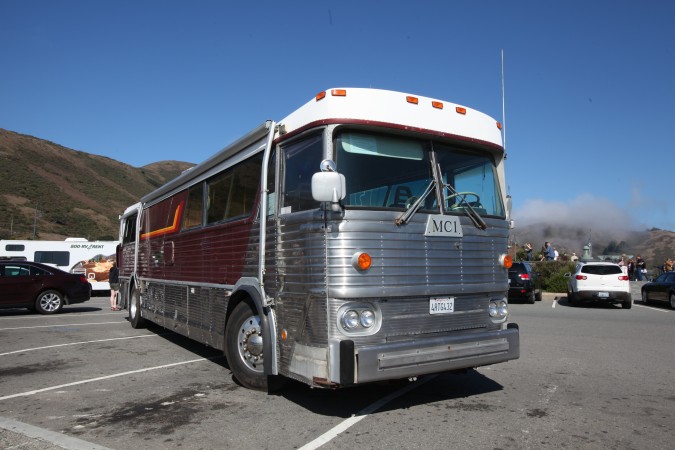
1967 MCI 5A Challenger Bus Conversion, front 3/4 view
The time has finally come for me to find a new home for my beloved first bus conversion, a proud Motor Coach Industries model 5A Challenger from 1967, The Summer of Love.
I love this bus, and I’ll no doubt shed some tears when the happy new owner drives off into the sunset to start building their golden dreams on the open road.
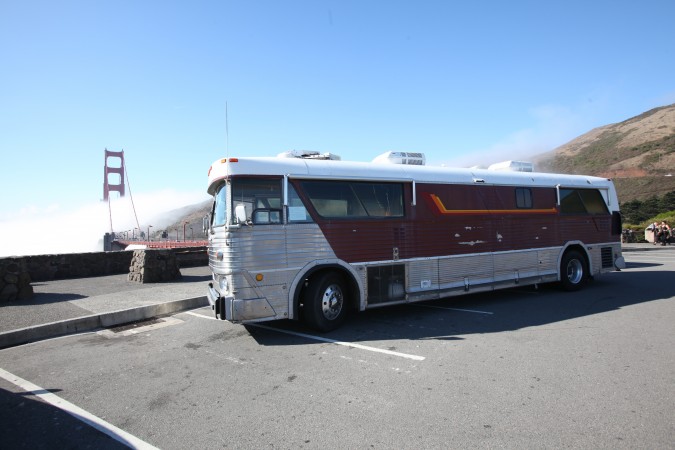
1967 MCI 5A Challenger Bus Conversion By Golden Gate Bridge, Marin, California
The story behind this bus is worth sharing. This story was related to me by John Ridley, the former owner. He said in about 1992 six Arizona fireman retired at the same time and all bought passenger buses for themselves. Together, they all converted these six buses to motorhomes, or ‘bus conversions’. Then, after a period of time, the fireman all sold the buses at the same time and all bought boats. The story ended there, but something tells me they later sold the boats and all bought some new toy at once.
John Ridley bought one of these fireman converted buses. John served for the US in the Vietnam War, where he was injured. He could walk for many years after the war, despite his injuries. Later in life, after a career as a truck driver, he was confined to a wheelchair. This didn’t stop him from maintaining and driving his bus conversion. He had hand controls installed for the accelerator and brakes, and a cruise control so he could relax on the highway and not have to apply constant pressure with his hands on the hand controls.
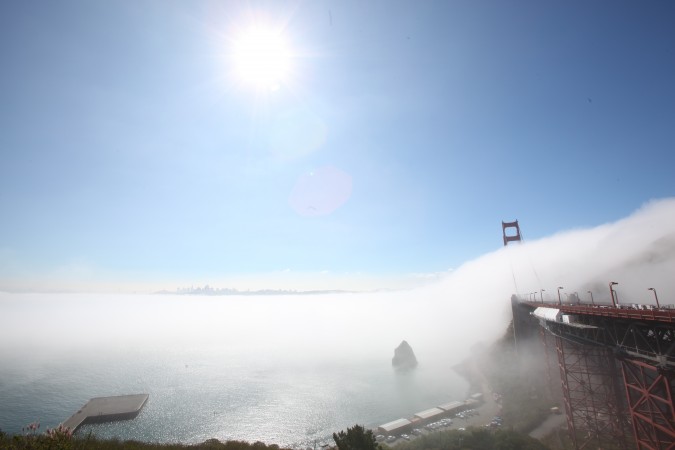
San Francisco skyline with Golden Gate Bridge and the sun, September 20, 2010
His wheelchair was manual and snapped apart into four pieces easily. He could back the chair up to the passenger door, use his arms to shift his position from the chair to the bottom step, where he could sit while he snapped apart his chair and hoisted its component pieces over his head to place them inside the conversion. Then he would use his arms to ‘climb’ the stairs, back first. He could then scoot across the floor to the driver’s seat and pull himself into position by grabbing the steering wheel. He wasn’t going to let his disability interfere with his love of buses.
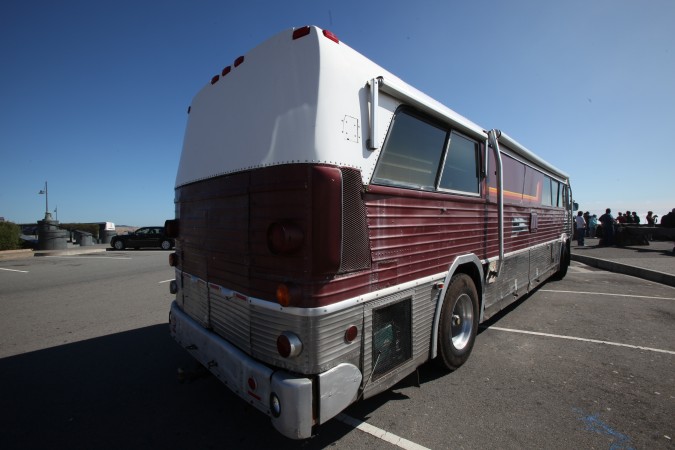
1967 MCI 5A Challenger Bus Conversion, rear 3/4 view
Once he got to his destination, his wife, a school bus driver by profession, would unload their Harley Davidson motorcylcle with sidecar from the trailer they towed behind the MCI. Then they would go motorcycling together with his wife driving the Harley and John riding in the sidecar. This all worked out for years. Sadly, John’s disability progressed to the point he couldn’t do routine maintenance on the conversion any more so he felt he needed to find a new owner for it. I was thrilled to buy this vehicle from John, and he spent two days showing me how to drive it well. He also hand printed an instruction book telling me how to operate the systems. He also had the original MCI owner’s manuals, and I will include all of this material with the bus when I sell it.
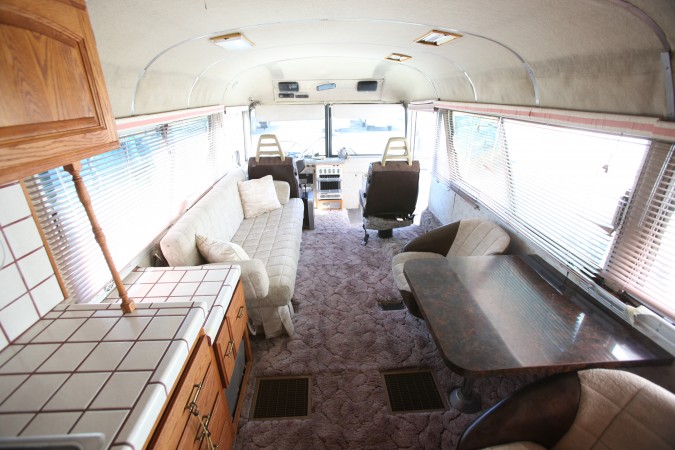
1967 MCI 5A Challenger Bus Conversion, interior looking forward
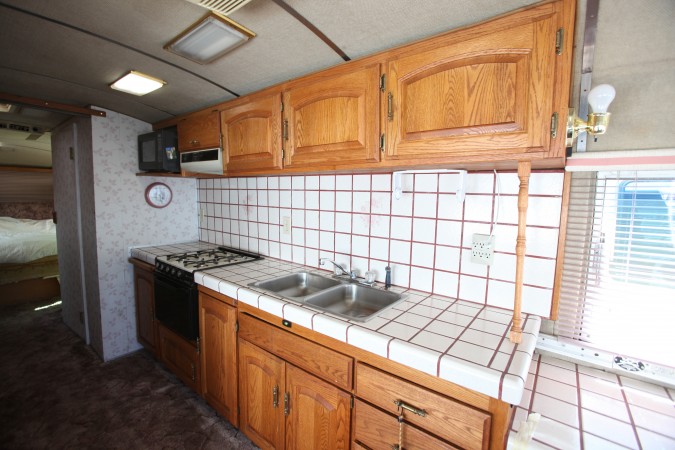
1967 MCI 5A Challenger, Kitchen
The above picture shows the kitchen area. The range is fueled by propane, and it features four burners plus an oven. There are pull out cutting boards to the left and right of the range. The sink has two bowls, and there is a sprayer for cleaning up with. There is an exhaust hood over the stove which vents to the outside, and the hood has a light in it. There is a microwave oven to the left of the range hood. The cabinets doors are solid oak and were custom made for this conversion.
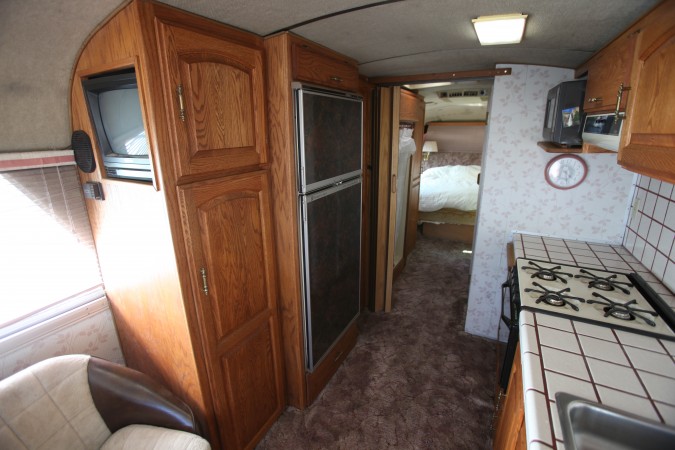
1967 MCI 5A Challenger, TV, refrigerator, closets and shower stall
The photo immediately above shows the television set for the living room, inside the cabinet. The cabinet wall also has the room thermostat for the forced air furnace. There is also one of four stereo speakers, visible just above the thermostat. The refrigerator runs on 110 volts AC or propane. It has a separate freezer section, like a home refrigerator.
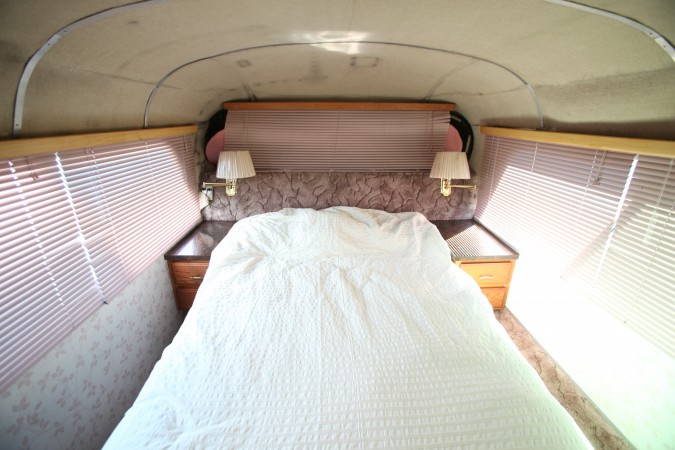
1967 MCI 5A Challenger Bus Conversion, bedroom
This is a full size mattress in the bedroom. The reading lights have three way bulbs in them, for reading or mood lighting. The nightstand cabinets are custom made and the door fronts are made from solid oak and match the rest of the cabinets throughout the rolling home.
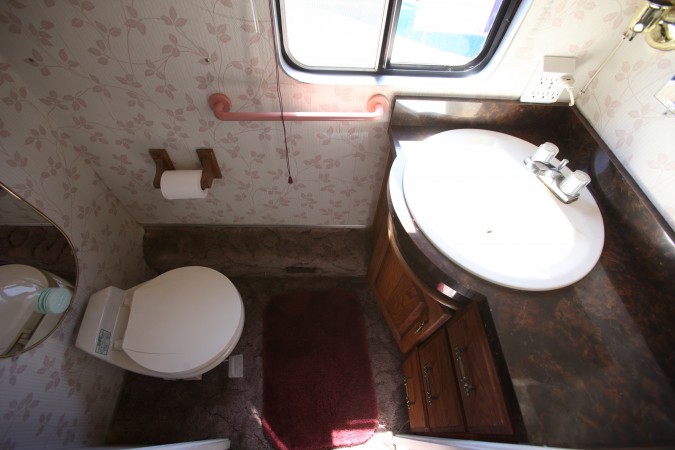
1967 MCI 5A Challenger Bus Conversion, bathroom
The photo above shows the toilet and vanity. The vanity is custom made and matches the rest of the cabinets. The Formica matches the front of the refrigerator. The sink is real ceramic, not plastic like you would find in some RVs.
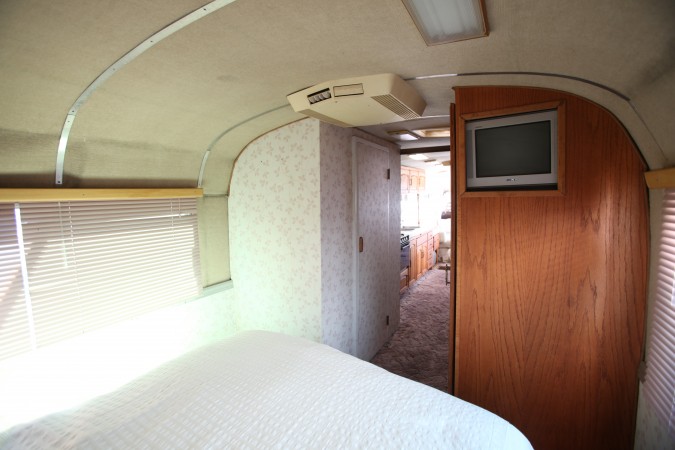
1967 MCI 5A Challenger Bus Conversion, bedroom looking toward bathroom and TV
The photograph above shows the bathroom in the center. The shower stall is across the hall from the bathroom, behind the TV, which is in the closet. Again, this cabinetry is all hand made. One of the two air conditioners can be seen on the ceiling over the hallway. The kitchen can be seen in the distance.
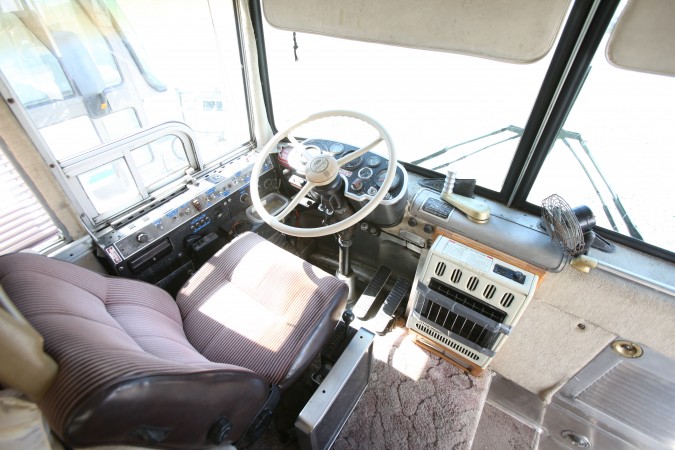
1967 MCI 5A Challenger, driver's seat
The photo above shows the driver’s seat. There is a propane heater to the right of the seat, which can be used alone or with the forced air furnace. The handle to open the passenger door can be seen to the right of the steering wheel. This handle still works. There is a fan for the driver to the right of the door handle. The conversion has an automatic transmission, and the shift knob is to the driver’s right, next to the seat cushion.
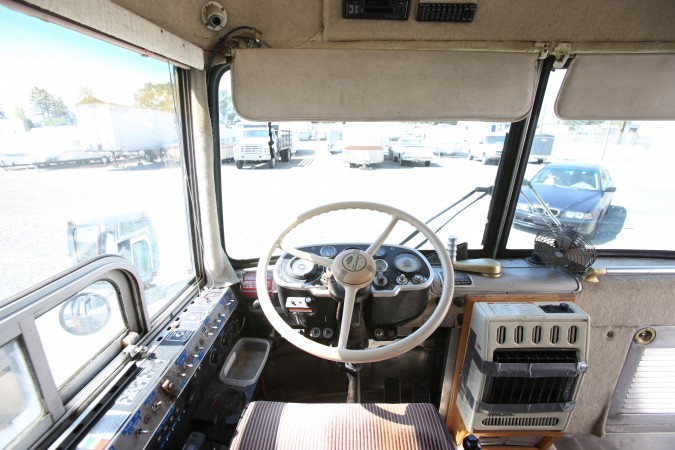
1967 MCI 5A Challenger, view from driver's seat looking forward
This is the view from the driver’s seat. You can see my blue BMW 525i right above the driver’s fan. The view above the traffic from this seat is outstanding, and one feels very secure driving this vehicle, as it’s rock solid and dependable.
The engine is a Detroit Diesel 8V-71. It’s in good shape, and I welcome potential buyers to take the bus conversion to their own mechanic for inspection prior to purchase. I’ll even let your mechanic keep the vehicle overnight so he can attest to how easily it starts when cold.
In 2002 I drove this conversion from San Francisco, California to New York City, New York, over a 2 1/2 month period. The only trouble I had was two flat tires, but that was to be expected since the tires that blew were old. I had no mechanical trouble with the rest of the vehicle, which was comforting.
There is a gas Onan 6,500 watt generator with about 600 hours on it. That means it has a lot of life left in it. It starts right up even if it’s not used for over a year. This is a non-electronic model, so it’s much more reliable over the long term than a modern electronically controlled model. The bus engine is also mechanical, so it’s likely to run forever, if maintained. There is nearly a full tank of diesel in the 100+ gallon tank, and I always stored it with a full tank, which is recommended for long term storage of any diesel vehicle.
There is no inverter, but it’s wired for a large inverter, and there is a 500 pound capacity battery slide installed as well. I moved the inverter to my RTS conversion, so that’s why there isn’t one included with this vehicle. However, the previous owner used the conversion the entire time he owned it without an inverter, so one is not needed since there is a very capable generator on board, with inside the vehicle remote start.
This vehicle is a pleasure to drive. There is very little play in the steering, since it has ‘new’ steering. You won’t grow tired correcting the steering like many other old buses. The air conditioning is powerful, and will keep the inside cool even in Las Vegas when it’s 107F out. I know because I stayed there a few days under such conditions.
Please contact me if you’d like to schedule a test drive. You don’t need a special license or training to drive this, believe it or not. If you don’t know how to drive a bus conversion, I’ll show you. That’s how I learned, while in the buying process, so it can be done.
If you want to learn more about bus conversions, visit the two primary bus conversion websites in the United States, BusNut.com and BusConversions.com. I am asking $5,000 for this bus conversion, which is a steal, as I paid $33,000 for it in 2002. The market for bus conversions was much stronger then, and the prices were much higher. Today they are really depressed, thus my low price. You’ll have a great time with this bus conversion.
